Wikimedia Commons · Public domain · Hover to magnify, click for fullscreen
Original fileThe Ploughman (from Les Simulachres & Historiees Faces de la Mort)
1. Holbein death plowman.300dpi

About This Work
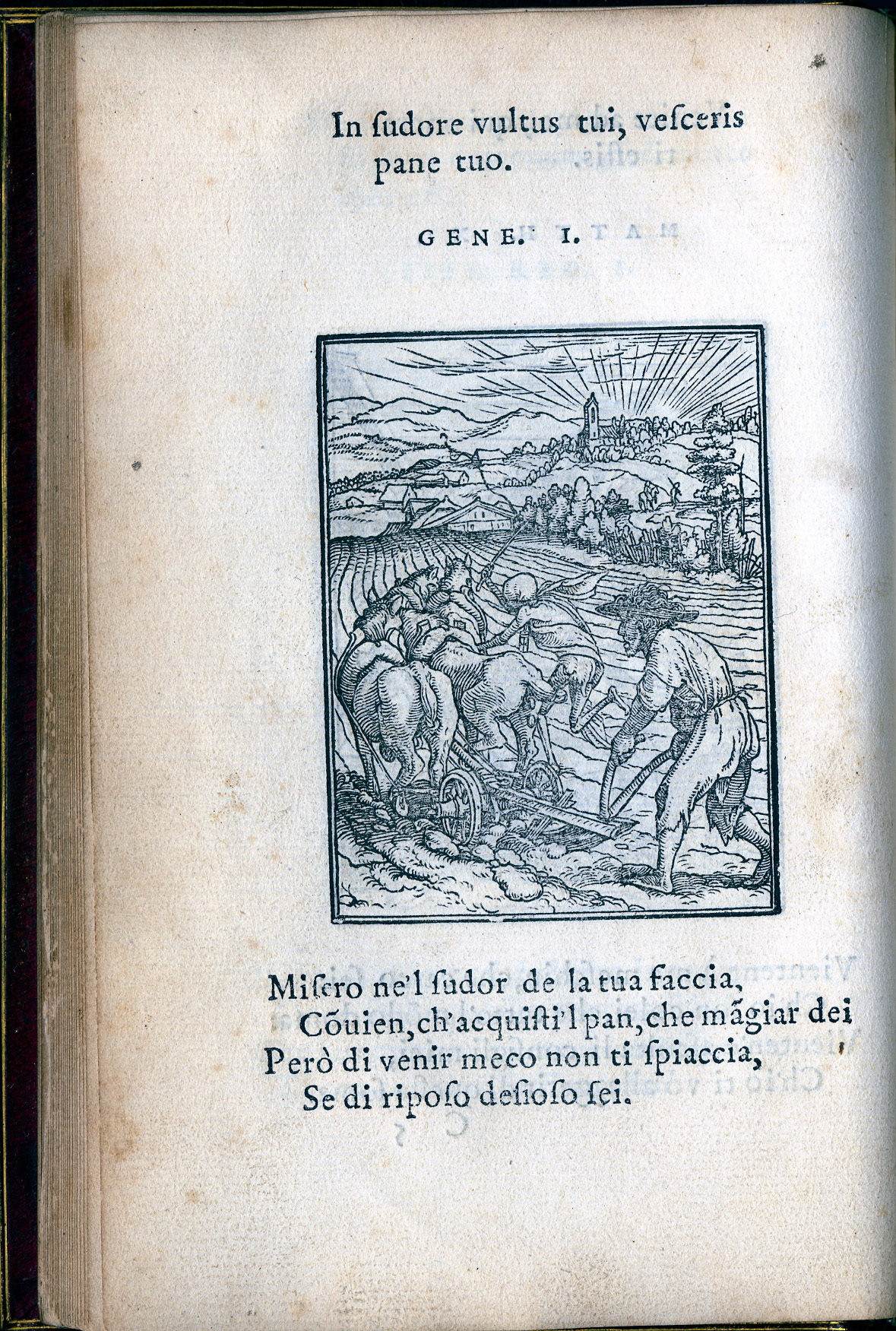
A woodcut illustration shows a skeletal figure, Death, standing behind a team of horses and guiding the plow. A male peasant, dressed in simple farm clothes and a broad-brimmed hat, walks alongside the plow, holding the handles. The scene is set in an agricultural landscape with a distant village and a sun rising or setting over hills. The image is rendered in stark black lines on a white background, characteristic of the 16th-century woodcut style.
This print is part of Hans Holbein’s 'Danse Macabre' series, which serves as a memento mori, reminding the viewer of the universality of death regardless of social station. It draws directly from the biblical curse found in Genesis 3:19, emphasizing labor and mortality.
Inscriptions(Latin, Italian)
In sudore vultus tui, vesceris
pane tuo.

G E N E.  I.

Misero ne'l sudor de la tua faccia,
Cõuien, ch'acquist'l pan, che mãgiar dei
Però di venir meco non ti spiaccia,
Se di riposo desioso sei.
Translation
In the sweat of thy face shalt thou eat bread. (Gen 3)

Wretch, by the sweat of your face,
You must earn the bread that you must eat,
Therefore do not be displeased to come with me,
If you are desirous of rest.
Connected Texts
Genesis 3:19
The Latin inscription is a direct quotation of the Vulgate text describing the curse of labor.