Wikimedia Commons · Public domain · Hover to magnify, click for fullscreen
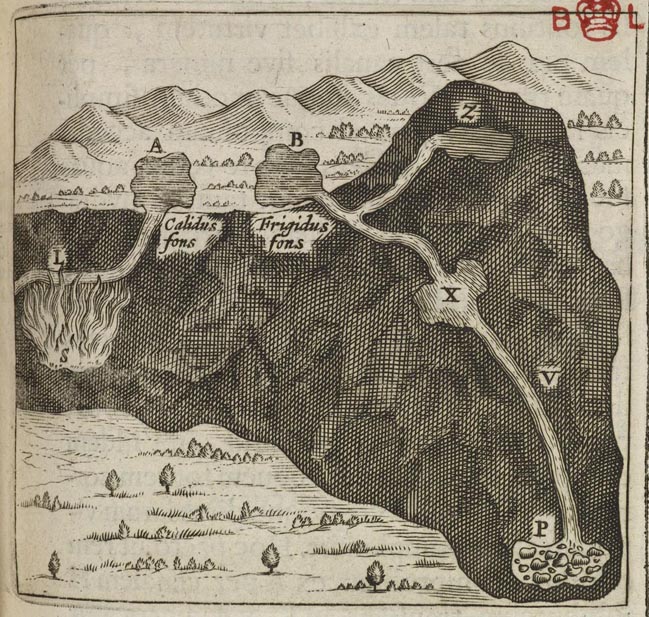
Original fileDiagram of Subterranean Hydrography from Mundus Subterraneus
Athanasius Kircher - Mundus subterraneus (1665) - BL 505.ee.4 - 4

About This Work
The woodcut presents a cross-section of a mountain range revealing a complex network of underground tunnels and chambers labeled with letters. On the left, a cavern containing stylized flames represents a subterranean fire heating a water source labeled 'Calidus fons'. To the right, a series of connected channels leads from a cold spring ('Frigidus fons') through various rock layers marked Z, X, and V, ultimately draining into a pool of stones at the base labeled P. The engraving uses dense cross-hatching to define the density of the earth, contrasting with the light, open lines of the surface landscape and the fluid channels.
This image is a quintessential example of Kircher's early modern attempt to systematize geological and hydrological knowledge, reflecting a worldview that perceived the Earth as a living, heat-regulated organism rather than a static mass. It is a central visual component of his encyclopedic work 'Mundus subterraneus', which sought to bridge the gap between ancient Hermetic philosophy and modern empirical natural science.
Inscriptions(Latin)
A
B
Z
L
S
Calidus fons
Frigidus fons
X
V
P