Wikimedia Commons · Public domain · Hover to magnify, click for fullscreen
Original fileDance of Death (Les Simulachres & Historiees Faces de la Mort)
Brockhaus and Efron Encyclopedic Dictionary b46 942-0

About This Work
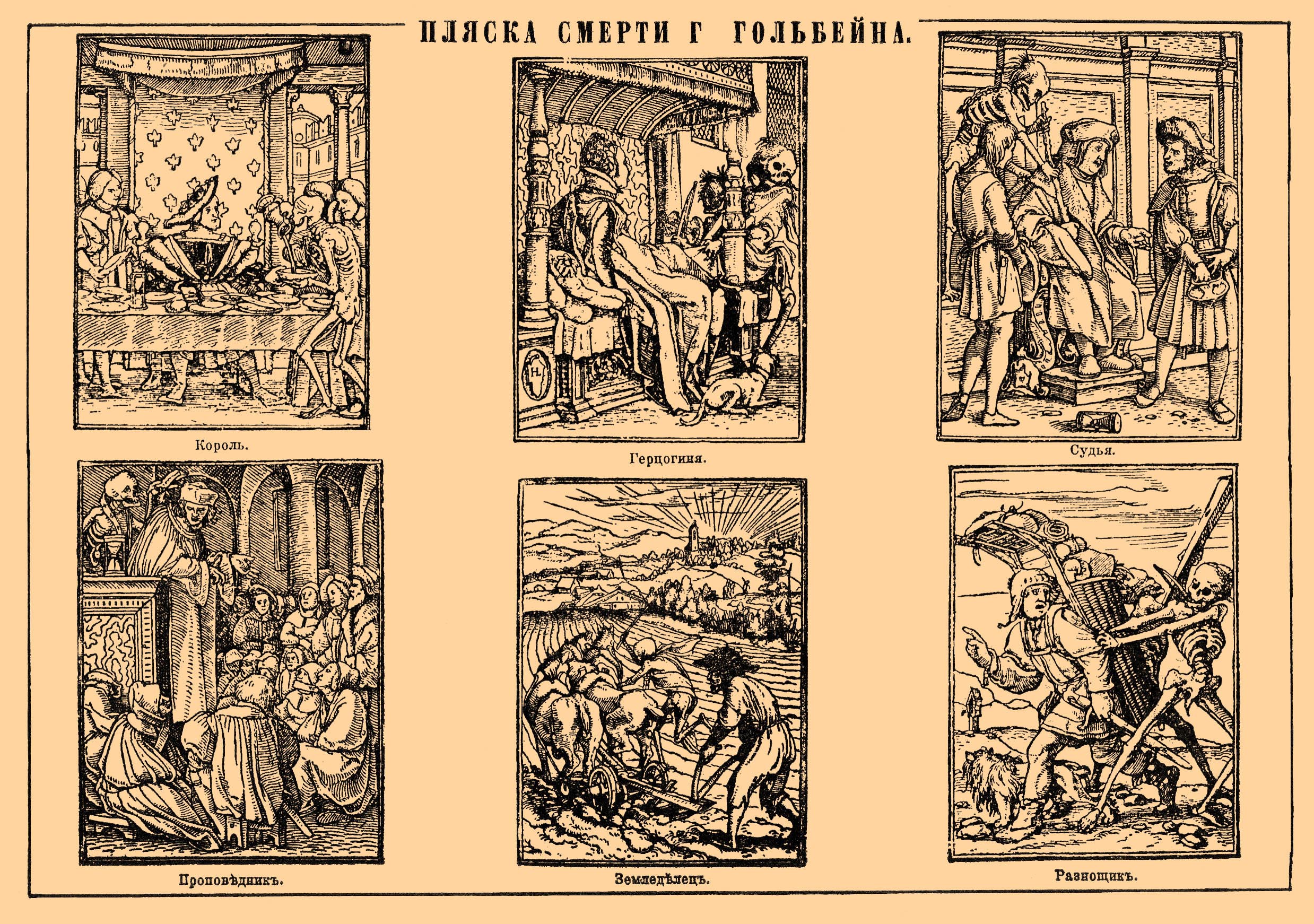
This composite print features six individual woodcut-style scenes arranged in a grid, each showing a personified skeleton interacting with a human subject. In the top row, a skeleton serves a King at a banquet, pulls the robes of a seated Duchess in her bedchamber, and grabs a Judge in his court. The bottom row displays a skeleton standing in a pulpit behind a Preacher, guiding a Farmer’s team of horses through a field, and adding weight to the heavy basket carried by a traveling Peddler. The figures are rendered with thick black outlines characteristic of 16th-century woodcuts, set against a plain background.
These images are derived from Hans Holbein the Younger’s iconic 'Danse Macabre' series, which serves as a quintessential memento mori, reminding viewers of the universality of death across all social strata. The series reflects the medieval and early modern preoccupation with the inevitability of mortality, a theme popularized through texts and visual arts following the Black Death.