Wikimedia Commons · Public domain · Hover to magnify, click for fullscreen
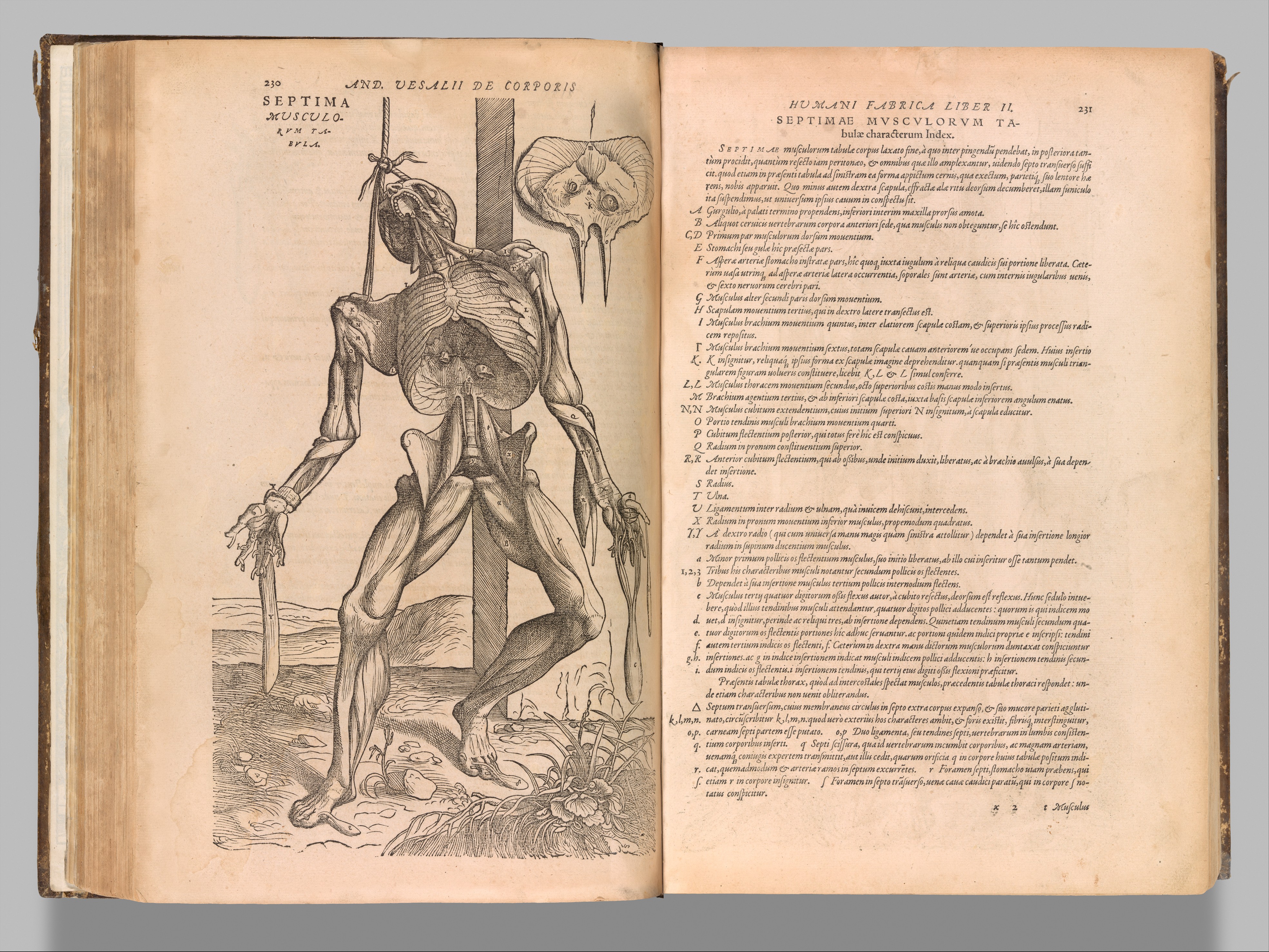
Original fileAnatomical Study of the Muscular System (Seventh Plate)
De humani corporis fabrica (Of the Structure of the Human Body)
About This Work
The image shows a flayed human figure standing in a landscape, hanging from a wooden post by a rope tied around its neck. The skin has been removed to reveal the underlying muscular structure, with various muscles labeled with letters for scientific identification. The figure’s arms hang limply, and it is positioned against a minimalist background featuring a few tufts of grass and rocks. A separate, floating diagram of muscle tissue is visible in the upper right corner, and the entire page is heavily annotated with Latin text describing the anatomical features.
This print is from the 'De humani corporis fabrica', a landmark work in anatomy that moved medicine away from Galenic tradition toward empirical, observation-based science. It fundamentally altered the study of human anatomy by prioritizing direct dissection over ancient text.
Inscriptions(Latin)
230
SEPTIMA
MVCVLO-
RVM TA-
BVL A.

AND. VESALII DE CORPORIS

HUMANI FABRICA LIBER II,
SEPTIMAE MVSCLORVM TA-
bulæ characterum Index.

[Followed by extensive Latin index of anatomical labels A-Z, a-f]
Translation