Wikimedia Commons · Public domain · Hover to magnify, click for fullscreen
Original fileEl jardín de las Delicias

About This Work
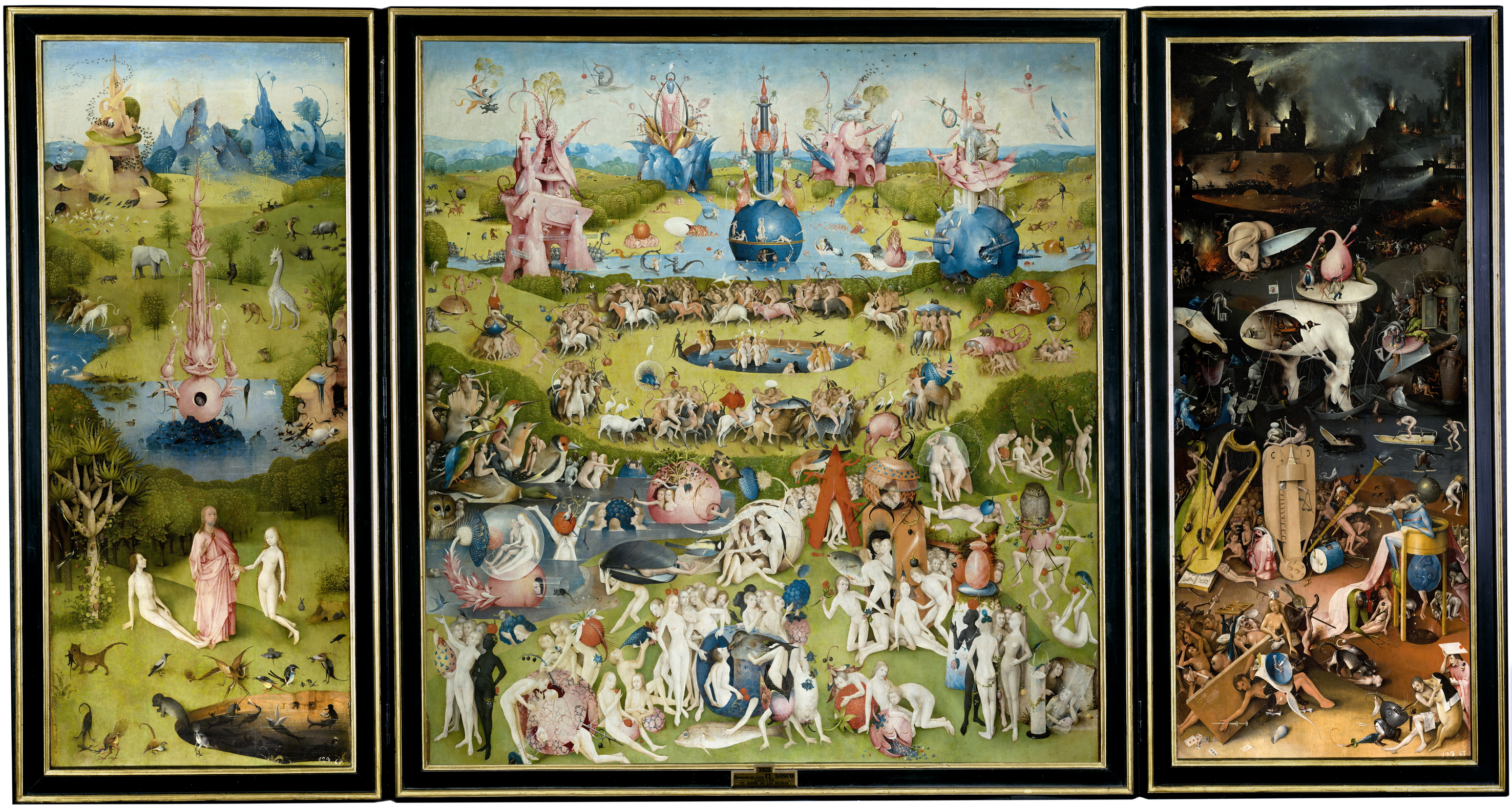
In the open triptych three scenes are included. The left panel is dedicated to Paradise, with the creation of Eve and the Fountain of Life, while the right one shows Hell. The central panel gives its name to the ensemble, since in a garden are represented the delights or pleasures of life. Between Paradise and Hell, these delights are nothing but allusions to Sin, showing humanity given over to various worldly pleasures. The representations of Lust, with a strong erotic charge, are evident, together with others of a more enigmatic meaning. Through the fleeting beauty of flowers or the sweetness of fruits, a message of fragility is conveyed, of the ephemeral character of happiness and the enjoyment of pleasure. Certain groups seem to confirm this, such as the couple enclosed in a glass bubble on the left side, probably alluding to the Flemish saying: “Happiness is like glass, it breaks quickly.” The closed triptych represents in grisaille the third day of the creation of the World, with God the Father as Creator, according to the inscriptions on each panel: “He himself said it and everything was made” and “He himself commanded it and everything was created” Genesis (1:9–13). A work of moralizing character, it is one of Bosch’s most enigmatic, complex and beautiful creations, made in the last stage of his life. Acquired in the auction of the prior don Fernando, natural son of the great Duke of Alba, Philip II took it to El Escorial in 1593.
Collections
Provenance & Source
Object
Digital Source