Wikimedia Commons · Public domain · Hover to magnify, click for fullscreen
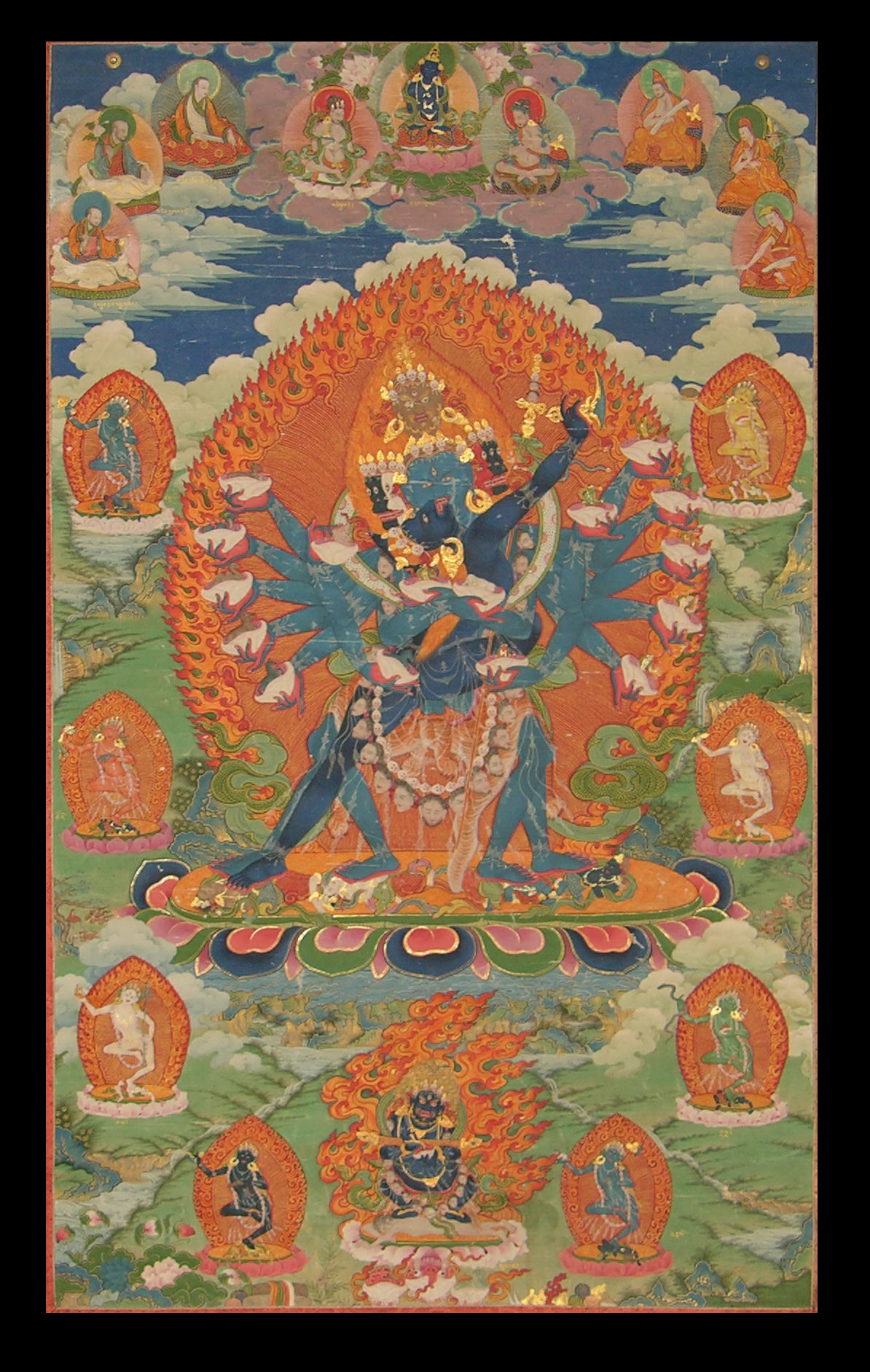
Original fileHevajra in Yab-Yum with Consort Nairatmya
Hevajra-Tibetan

About This Work
Hevajra is depicted as a multi-armed blue deity, standing in a wide-legged, aggressive posture, holding skull-cups in his hands and wearing a garland of severed human heads. He is in sexual union with his consort, Nairatmya, who is also blue and wraps her legs around his waist. They are encompassed by a large, circular orange-red halo of wisdom fire. Surrounding the central couple, eight smaller dancing dakinis in various colors (white, red, green, yellow, blue) occupy lotus pedestals within ovoid flames. At the bottom center, a wrathful, dark blue, multi-armed deity stands atop a supine figure. The background features stylized green hills and wispy clouds, while the top register contains a lineage of Buddhist masters seated on clouds.
This thangka represents the Hevajra Tantra, a key text of the Anuttarayoga class in Tibetan Buddhism. The iconography of the yab-yum (sexual union) symbolizes the union of wisdom (prajna, represented by the female) and method/compassion (upaya, represented by the male), essential for achieving enlightenment within the Vajrayana tradition.
Connected Texts
Hevajra Tantra
This work depicts the primary deity and cosmological framework described in the Hevajra Tantra.
Collections
Provenance & Source
Object
thangka
silk
18th century
Tibetan
religious
Digital Source
Wikimedia Commons · Public domain
1194 × 1884 px
Linked Data