Wikimedia Commons · Public domain · Hover to magnify, click for fullscreen
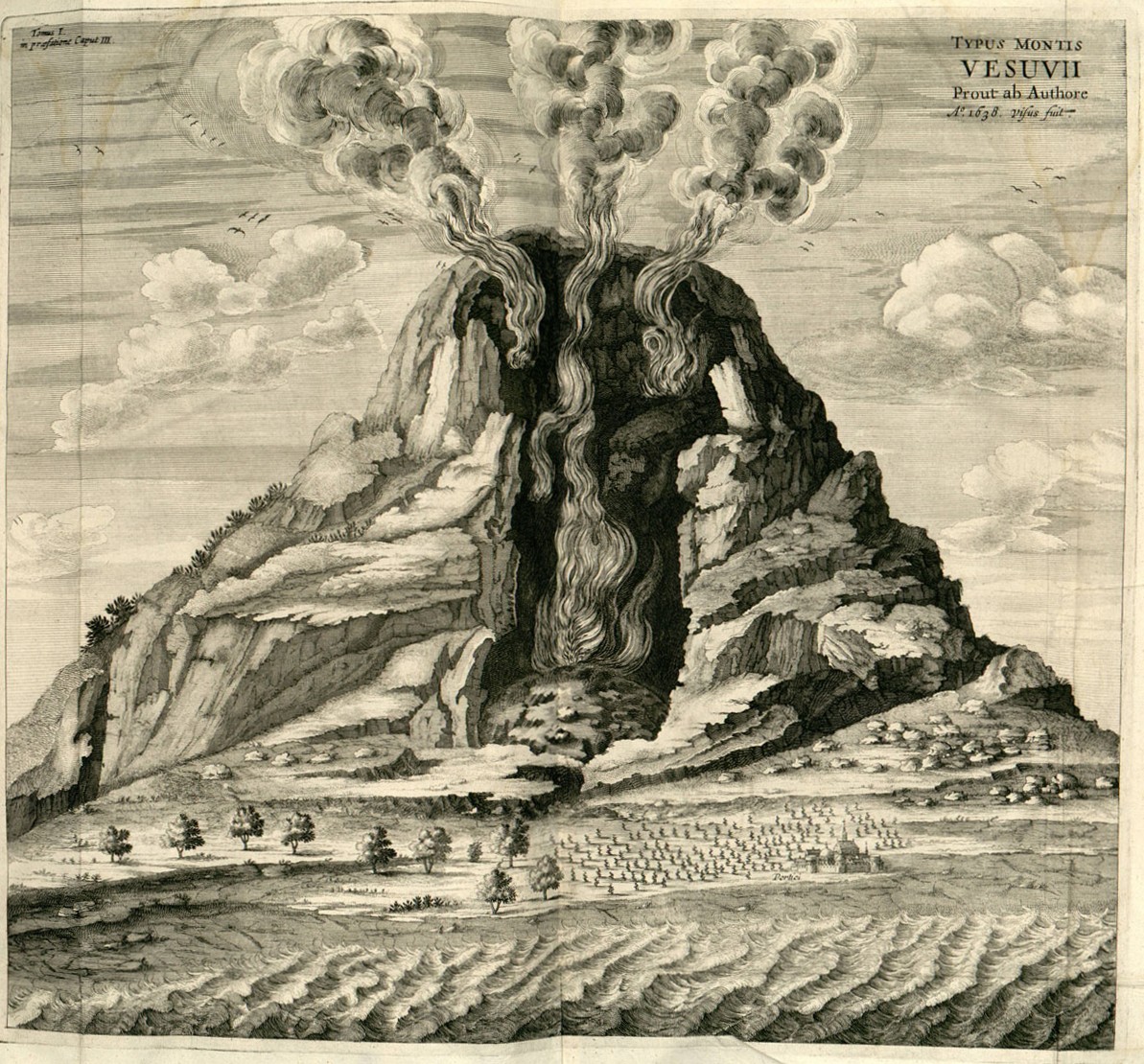
Original fileThe Eruption of Mount Vesuvius in 1638
Kircher Mundus Subterraneus Vesuvius 1638

About This Work
This engraving depicts Mount Vesuvius with a jagged, split summit billowing thick clouds of smoke and flames into the sky. At the base of the mountain, a rocky, rugged landscape transitions into a flatter plain where a small town labeled 'Portici' sits near a coastline with stylized, rolling waves. The composition is monochromatic with fine hatching lines used to convey the texture of the rock, the density of the smoke, and the movement of the sea.
This image is a key illustration from Kircher's 'Mundus Subterraneus', a seminal work in early modern volcanology and geology that conceptualized the Earth as having a central fire and interconnected subterranean conduits.
Inscriptions(Latin)
Tomus I.
in praefatione Caput III.

TYPUS MONTIS
VESUVII
Prout ab Authore
Aº 1638. visus fuit

Portici
Translation
Volume I. / In the preface, Chapter III. / Representation of Mount Vesuvius as seen by the author in the year 1638. / Portici