Wikimedia Commons · Public domain · Hover to magnify, click for fullscreen
Original fileKing Chujiang of the Ten Kings of Hell
Ten Kings of Hell
About This Work
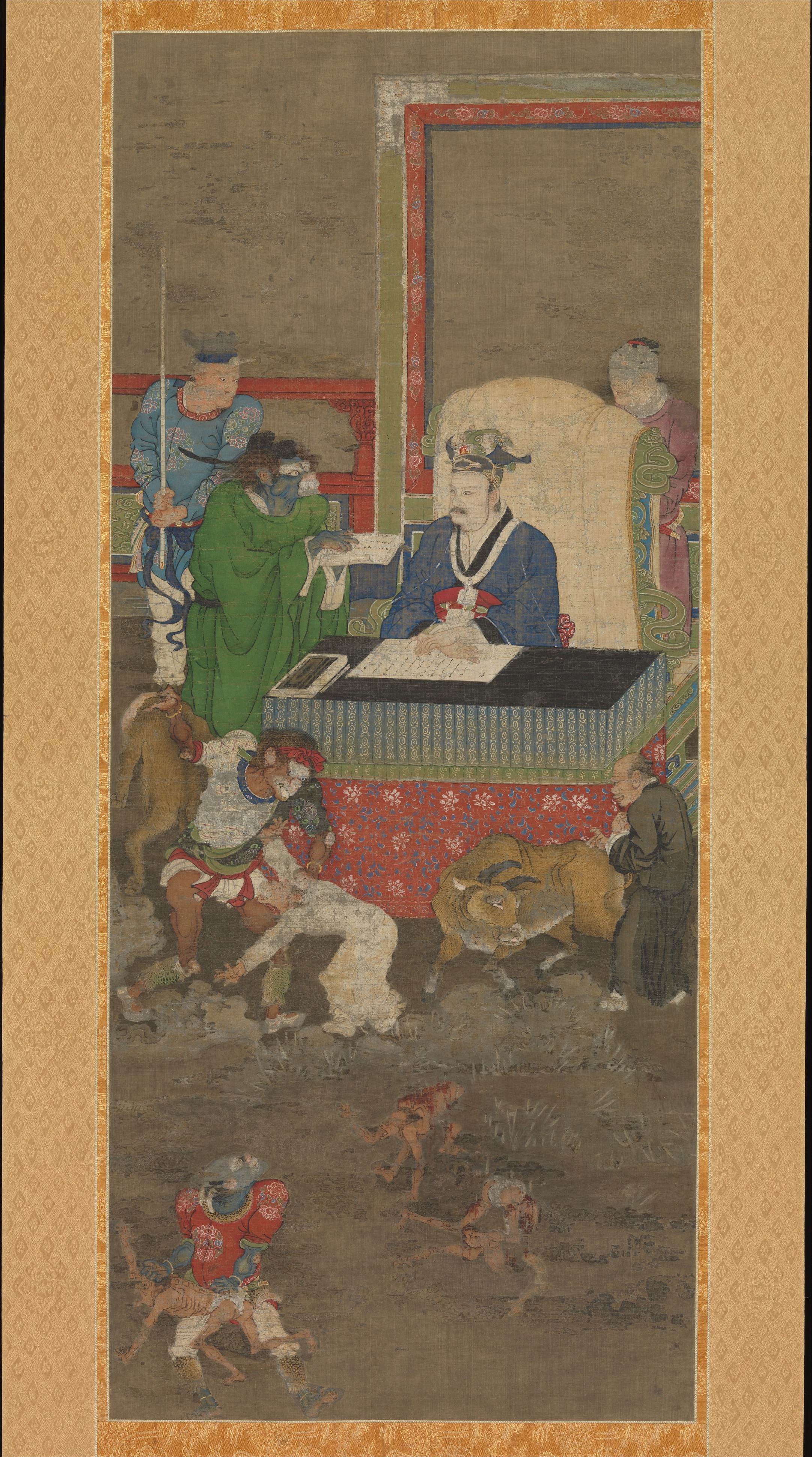
The composition is vertically oriented, featuring King Chujiang seated at a central desk draped in ornate, floral-patterned textiles, wearing a scholar's cap and a blue robe. To his left, a green-skinned, anthropomorphic demon with a simian face presents a record of the sinner's deeds; a human assistant in a blue robe stands behind holding a staff. In the foreground, a demon with reddish fur and armored chest piece manhandles a kneeling sinner, who is in the process of a karmic transformation into an ox, indicated by the animal's head emerging from their back. Beside them, an elderly man in plain robes appears to be observing or awaiting his turn, while in the lower section, smaller, grotesque demons attend to the gruesome tasks of the underworld.
This scroll belongs to a series representing the Ten Kings of Hell, a central concept in Buddhist eschatology in East Asia, illustrating the karmic judgment of the deceased based on the 'Sutra of the Ten Kings' (Shiwang jing). It reflects the synthesis of Buddhist concepts of reincarnation and Chinese bureaucratic structures of administration.