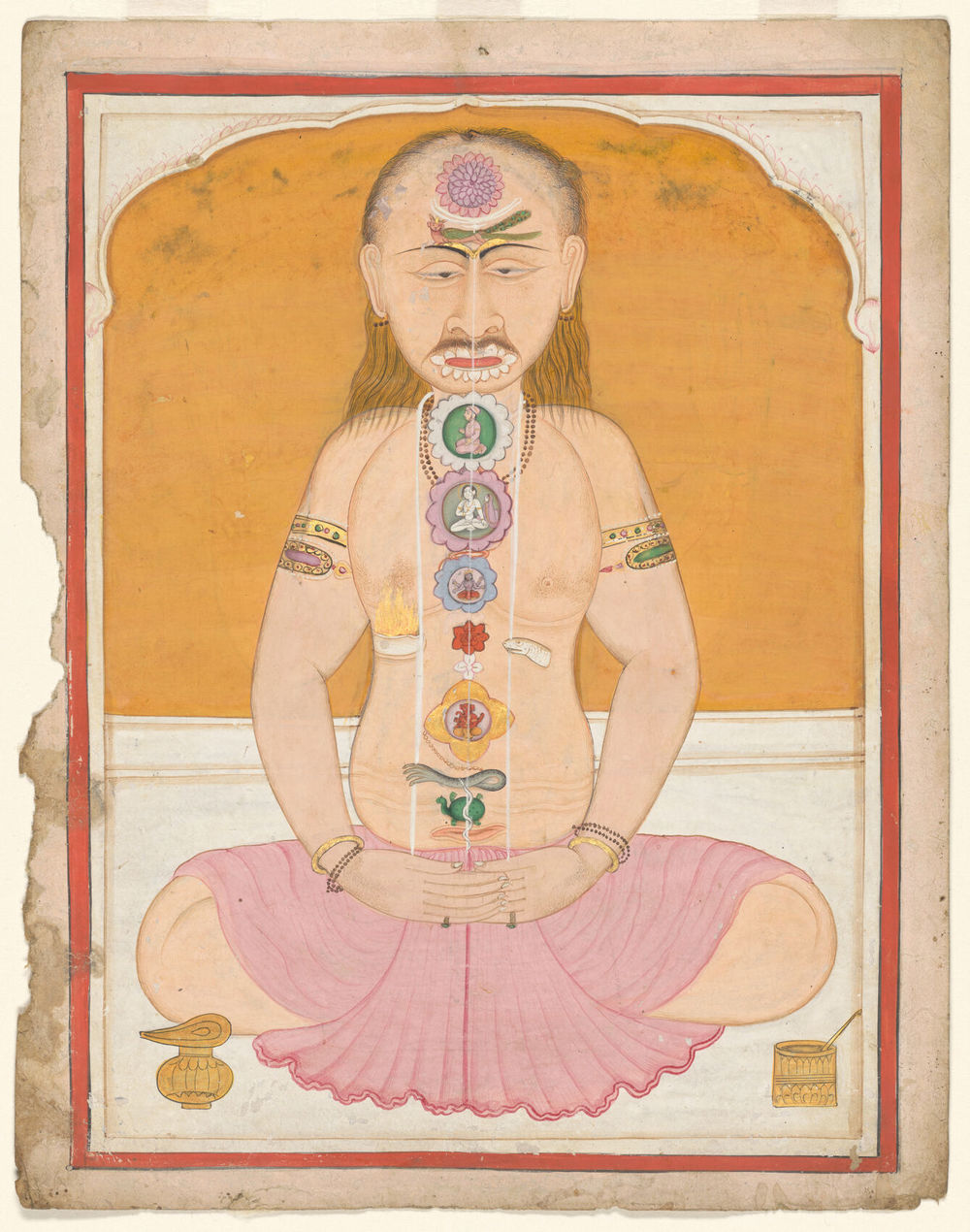
The word “chakra” has become so common in modern wellness culture that it is easy to forget it has a textual history stretching back over a thousand years. The system of subtle energy centres running along the spine — with its lotuses, seed syllables, presiding deities, and ascending kundalini — was never a single, fixed doctrine. It was a living tradition debated and refined across dozens of Sanskrit tantric texts, most of which have never been translated into English.
Source Library is now working to change that. Over the past weeks we have imported, digitized, and begun translating a substantial collection of the primary Sanskrit sources on the chakra system, drawn from the Internet Archive, the Wellcome Collection, and the Cambridge Digital Library. Several of these texts have never appeared in any Western language. What follows is an overview of the tradition these texts represent, and why making them accessible matters.
The Roots: Before There Were Seven
The earliest references to centres of power within the body appear in the Upanishads, but they look nothing like the familiar seven-chakra diagram hanging in yoga studios. The Yoga Kundalini Upanishad and the Yoga Chudamani Upanishad describe a channel (nadi) system and a coiled energy (kundalini) at the base of the spine, but the number and placement of the centres varies. Some texts describe four. Others describe five, or six, or nine.
The standardization into a six-chakra system (plus the transcendent sahasrara at the crown) came relatively late, crystallizing in the 16th century Sat-Cakra-Nirupana of Purnananda Yati. It was this text, translated by Arthur Avalon (Sir John Woodroffe) in 1919 as part of The Serpent Power, that became the basis for nearly everything the West knows about chakras. But Avalon's translation — brilliant and pioneering as it was — drew from a single lineage. The broader tradition is far richer, more varied, and in many cases more sophisticated than that one text can convey.
“The notion that there is one ‘correct’ chakra system is a modern invention. The original texts present a rich diversity of models, each embedded in its own ritual and philosophical context.”
— Christopher Wallis, Tantra Illuminated
The Core Texts
The tantric literature on the subtle body is vast. At its centre stand a handful of foundational works that shaped how later authors understood chakras, nadis, and kundalini. Source Library now holds digitized copies of many of these, and several are in active translation:
The Tantraloka of Abhinavagupta
The Tantraloka (“Light on Tantra”) is the masterwork of the Kashmiri Shaiva philosopher Abhinavagupta (c. 950–1016 CE). At nearly 4,000 pages in its Sanskrit editions, it is the most comprehensive synthesis of tantric philosophy and practice ever composed. No complete English translation exists. Source Library is currently translating the full text — 3,931 pages — which would represent the first time the complete Tantraloka has been available in English.
Abhinavagupta's treatment of the subtle body is philosophically dense. Unlike later popular accounts, he grounds the chakra system in a sophisticated metaphysics of consciousness (cit) and its power of self-expression (vimarsha). The chakras are not fixed anatomical points but manifestations of consciousness at different degrees of contraction and expansion. Understanding this philosophical framework transforms how one reads every subsequent text in the tradition.
The Svacchanda Tantra
One of the oldest surviving Bhairava Tantras (perhaps 7th–8th century), the Svacchanda Tantra presents an early and detailed map of the subtle body that differs in important ways from later standardizations. Source Library holds the first volume of the Sanskrit edition with commentary (440 pages), fully translated.
The Netra Tantra
A Shaiva text focused on the deity Amriteshvara, the Netra Tantra (“Tantra of the Eye”) contains important material on kundalini yoga and the relationship between breath, consciousness, and the energy channels. Our edition, with Kṣemarāja's commentary, runs to 318 pages. Like the Svacchanda Tantra, it has never had a complete published English translation.
The Goraksha Samhita
Attributed to Gorakhnath, the legendary founder of the Nath tradition, this text bridges the gap between the high philosophy of Kashmir Shaivism and the practical hatha yoga that would become popular across India. The Nath yogis were the primary carriers of chakra knowledge into mainstream Indian religious culture. The text preserves teachings on the six chakras, kundalini awakening, and the network of nadis that became standard in later yoga manuals.
The Sat-Cakra-Nirupana & Paduka-Pancaka
Purnananda Yati's 16th-century Sat-Cakra-Nirupana (“Description of the Six Centres”) is the most influential single text on the chakra system. It provides the detailed descriptions of each chakra — number of petals, colour, seed syllable, presiding deity, element — that are now widely reproduced. Source Library holds the Sanskrit original (107 pages), allowing readers to compare the source text against Avalon's influential translation. The Wellcome Collection also holds a separate manuscript edition and a remarkable illustrated version with hand-painted chakra diagrams.
The Hathayogapradipika
Svatmarama's 15th-century manual is the most widely known hatha yoga text, and its treatment of pranayama, bandhas, mudras, and kundalini awakening represents the practical application of the subtle body theory developed in the tantric texts. Source Library holds multiple editions, including a version from the Wellcome Collection with both the Jyotsna and Manobhilasini commentaries (200 pages) — offering layers of interpretation rarely available in translation.
Beyond the Familiar
Several texts in our collection go well beyond the standard chakra model, revealing the full richness of Indian subtle body theory:
- •Kaulajnana Nirnaya (attributed to Matsyendranath) — Perhaps the oldest surviving Kaula text, this work describes a chakra system embedded in transgressive ritual and goddess worship that predates the “cleaned up” versions found in later yoga manuals.
- •Siddha Siddhanta Paddhati (attributed to Gorakhnath) — This text maps nine chakras (not six or seven) and describes the body as a microcosm containing the entire universe — mountains, rivers, sacred sites, and celestial realms all located within the practitioner's own subtle anatomy.
- •Tantraraja Tantra — A major Shakta text focused on the goddess Tripurasundari, containing detailed practices involving chakra visualization and mantra that operate within a framework quite different from the Shaiva texts. 396 pages.
- •Paramesvaratantra (828 CE) — A unique early witness from the Cambridge Digital Library, this palm-leaf manuscript is one of the oldest dateable tantric texts in existence. 124 pages from the original manuscript.
- •Chakra and Nadi in the Shaiva Tradition — An illustrated manuscript from the Wellcome Collection showing the subtle body maps as living visual art, not just textual description.
- •Kularnava Tantra — One of the most important Kaula texts, containing teachings on guru-disciple initiation, the transformation of desire into spiritual practice, and the subtle body as a site of ritual action. Source Library also holds Arthur Avalon's English translation for comparison.
Why Translation Matters
The modern understanding of chakras in the West derives almost entirely from three sources: Arthur Avalon's 1919 The Serpent Power, C.W. Leadbeater's 1927 Theosophical reinterpretation, and their popularization through 20th-century yoga culture. Each layer added simplifications and distortions. Leadbeater introduced the rainbow colour scheme (red, orange, yellow, green, blue, indigo, violet) that appears nowhere in the Sanskrit sources. The original texts assign colours based on elemental and deity associations that vary from text to text.
Making the primary sources available in English — in their full complexity, with their internal disagreements intact — is not an academic exercise. It restores the tradition to its actual depth. Readers can discover that the chakra system was not a fixed anatomical model but a sophisticated technology of consciousness, intimately connected to specific deities, mantras, cosmological principles, and ritual practices.
These translations are produced using AI (Google's Gemini models), with the original Sanskrit always preserved alongside the English for verification. They are working translations — first drafts that make previously inaccessible texts readable for the first time. We hope they will serve as a foundation for future scholarly editions and deeper study.
What's Available Now
Source Library currently holds over 70 texts related to yoga, tantra, and the subtle body tradition. The core chakra collection includes:
| Text | Pages | Source | Status |
|---|---|---|---|
| Tantraloka, Vol. 1 (with Jayaratha's commentary) | 372 | Internet Archive | Translated |
| Svacchanda Tantra (Vol. I) | 440 | Internet Archive | Translated |
| Netra Tantra | 318 | Internet Archive | Translated |
| Tantraraja Tantra | 396 | Internet Archive | Digitized |
| Hathayogapradipika (with commentaries) | 200 | Wellcome Collection | Digitized |
| Kriyakandakramavali | 156 | Cambridge Digital Library | Digitized |
| Paramesvaratantra (828 CE) | 124 | Cambridge Digital Library | Digitized |
| Sat-Cakra-Nirupana | 107 | Internet Archive | Digitized |
| Satchakranirupanam | 88 | Wellcome Collection | Digitized |
| Satchakranirupanacitram (Illustrated) | 63 | Wellcome Collection | Digitized |
| Vajramratatantra | 12 | Cambridge Digital Library | Digitized |
| Chakra and Nadi in the Shaiva Tradition | 10 | Wellcome Collection | Digitized |
All texts are freely readable — the Sanskrit originals are public domain, and our translations are CC BY-SA 4.0. The originals are preserved alongside any translations, and every page links back to its source institution. This is a growing collection — as we process, translate, and verify these texts, their status will update on the site.