Ask what a demon is and you will get five very different answers depending on which century, which tradition, and which text you pick up. The Greek daimōn is a beneficent intermediary between gods and mortals — a cosmic middleman who keeps the universe talking to itself. The Hermetic daemon is your personal guardian, assigned at birth, present at death. The Islamic jinn are an entire parallel civilization, made from smokeless fire, with their own prophets and their own final judgment. The Christian daemon is a fallen angel, malevolent by nature, deployed by Satan to corrupt human souls. And in ceremonial magic — in the grimoires — demons are powerful intelligences that can be bound, commanded, and put to work.
These are not five versions of the same idea. They are five genuinely different ontologies. Source Library holds the primary texts behind each of them — not commentaries, not encyclopedias, but the actual manuscripts and printed books that shaped what educated people in each tradition believed about the invisible world.

I. The Greek Daimōn: Intermediary Between Worlds
The Greek word daimōn (δαίμων) originally carried no negative charge whatsoever. In Hesiod, the souls of the men of the Golden Age become daimones after death — benevolent guardians who wander the earth protecting mortals. In Plato’s Symposium, Diotima explains to Socrates that Eros himself is a great daimōn, and that “the whole of the daimonic is between god and mortal” — a mediating power that ferries prayers upward and divine gifts downward.
Socrates famously claimed to have a personal daimonion — a divine sign that spoke to him, never commanding but always warning. This is the voice that prevented him from pursuing certain courses of action, and which Plato treats with complete seriousness. When Socrates’ accusers charged him with introducing new divinities, the daimonion was part of what they had in mind.
The philosophical framework that would influence all subsequent Western demonology came from the Neoplatonists. Plotinus, Porphyry, and Iamblichus built elaborate cosmologies in which daimones filled the great chain of being between the gods and humanity — necessary intermediaries in a universe so hierarchically ordered that divine and mortal could not communicate directly.
“The daemoniacal race indeed is subservient to the Gods, but is cooperative with the human race, and watches over its welfare. However, it is not simply subservient to every God, but is distributed according to the orders of the Gods, some daemons being subservient to one God, and others to another.”
Iamblichus, De Mysteriis — on the function of daimones in the divine hierarchy
What matters here is the topology: daimones are not opposed to the divine but continuous with it. They are part of the same hierarchical system, differentiated by degree not kind. This is the cosmology that the Hermetica would inherit and transform.
II. The Hermetic Daemon: Your Personal Guardian
The Corpus Hermeticum — a collection of philosophical and religious texts written in Greek in Egypt during the 2nd–3rd centuries CE, attributed to the legendary sage Hermes Trismegistus — takes the Greek daimonic framework and makes it intensely personal.
In the Poimandres, the first and most cosmologically ambitious tractate, the Mind (Nous) descends through the planetary spheres and takes on qualities from each before incarnating in a human body. But the mind does not abandon the soul at incarnation: it remains present as a guardian, accessible to those who are pure.
“I, the Mind, am present to those who are holy, good, pure, religious, and clement, and my presence is a help to them, and straightway they know all things and lovingly propitiate the Father, giving Him thanks, praising Him, and singing hymns to Him with filial love and natural feeling.”
Pimander (Corpus Hermeticum), 1493 — the Mind as guardian presence
Later Hermetic texts develop a more structured account of the personal daemon. At birth, each soul is assigned a daemon who accompanies it through life and stands beside it at the moment of death. This is not a metaphor: the daemon is a real entity, functionally indistinguishable from what later traditions would call a guardian angel.
“Each body is possessed by a daemon, and the soul and body are led on by the daemon’s power… At the moment of birth, O Asclepius, the soul receives a daemon according to the degree of the hour; and that daemon guides the soul through life.”
Hermetica (Scott translation), Vol. I — from the Asclepius
This is the daemon at its most benign — your personal cosmic escort, present at birth and death, guiding your soul through the vicissitudes of incarnated existence. The daimon as spiritual advisor would survive the transition to Christianity in disguised form, but by the 15th century it had been largely demonized — assimilated into the Christian framework as a tempter rather than a guide.
The Hermetic texts themselves were largely unknown in the Latin West until 1462, when Cosimo de’ Medici commissioned Marsilio Ficino to translate the Corpus Hermeticum from a Greek manuscript just brought to Florence from Macedonia. Ficino interrupted his translation of Plato to work on the Hermetica first — on Cosimo’s orders, because Cosimo was dying and wanted to read the work before he died. Source Library holds both Ficino’s 1481 Venice edition and the 1493 printing — among the most influential books in Renaissance intellectual history.
III. The Islamic Jinn: A Parallel Civilization
The Islamic cosmology of spirits is more elaborate than any Western parallel and considerably more democratic. The jinn — created from smokeless fire, as humans were created from clay and angels from light — constitute an entire civilization parallel to the human one. They have their own prophets (the Quran was sent to both jinn and humans), their own communities of believers and unbelievers, and their own final judgment.
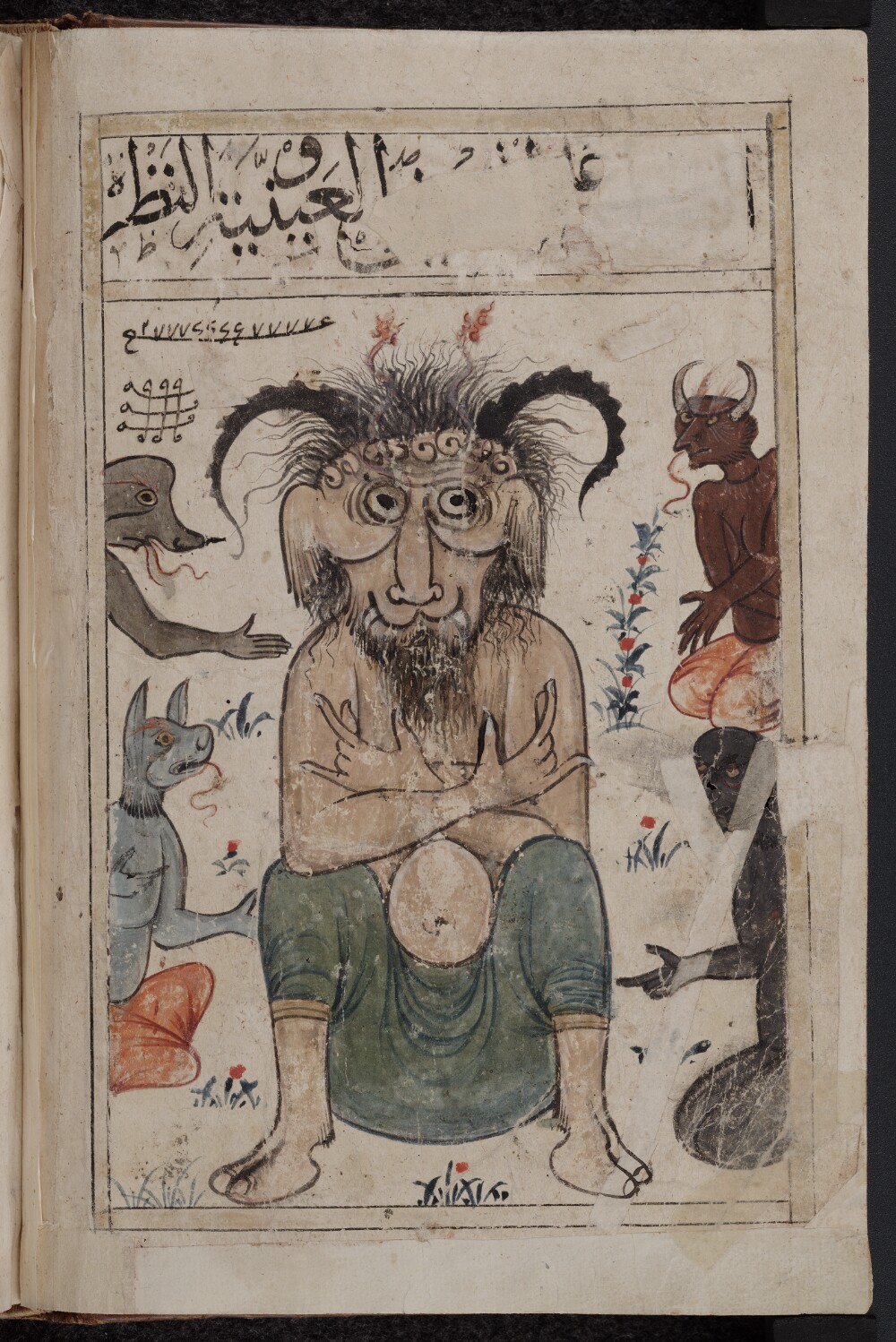
The most visually spectacular source in Source Library for Islamic spirit taxonomy is the Kitab al-Bulhan, an Arabic manuscript held at the Bodleian Library in Oxford, dated to the 14th century but drawing on much older sources. It is an encyclopedic work covering astrology, divination, and the nature of the supernatural — illustrated with remarkable paintings of planets, signs of the zodiac, and the spirits associated with them.
“Know that the jinn are of various kinds. Among them are Muslims and unbelievers. Among them are the obedient and the rebellious. Among them are those who fly through the air, and those who dwell in ruins, and those who inhabit the sea. And among them are those who take human form, and those who appear as animals.”
Kitab al-Bulhan — Arabic spirit taxonomy, Bodleian MS Arab d. 84

The distinction between jinn and shayatin (satans/demons) is important in Islamic thought. Shayatin are jinn who have chosen to rebel against God and follow Iblis (Satan). But ordinary jinn are morally neutral — capable of good or evil, belief or unbelief, just like humans. This is fundamentally different from the Christian model in which demons are irrevocably fallen, incapable of redemption or genuine virtue.
The Islamic magical tradition built extensively on this taxonomy. The great tradition of Arabic sihr (magic) and ilm al-hiyal (the science of devices) involved elaborate systems for communicating with and commanding jinn — a tradition that fed directly into the grimoire literature that would flourish in Latin Europe through the medieval and Renaissance periods.
IV. The Christian Demon: Fallen Angel, Cosmic Enemy
The transformation of the Greek daimōn into the Christian daemon is one of the major intellectual operations of late antiquity. The process was not sudden: it took centuries, and it was contested. But by the 5th century, when Augustine wrote The City of God, the theological position was largely fixed: what the pagans called daimones were in fact fallen angels, ontologically evil, incapable of good, deployed by Satan to deceive humanity and lure souls to damnation.
The medieval theological synthesis — Aquinas, Bonaventure, Albertus Magnus — developed an elaborate demonology from these foundations. Demons were spiritual beings with intellect and will; they had real powers over matter and could perform genuine marvels; but their will was permanently bent toward evil, and any apparent good they did was instrumental, designed to trap souls through greater evil later.
The most notorious text in this tradition is the Malleus Maleficarum(“The Hammer of Witches”), written by the Dominican inquisitors Heinrich Kramer and Jacob Sprenger in 1486, with a (probably forged) papal endorsement from Innocent VIII. It is not a work of theology but of prosecution — a manual for identifying, interrogating, and executing witches. But its demonology is consistent with the mainstream theological tradition: demons are real, powerful, and specifically interested in corrupting human sexuality.
“In them, according to Dionysius, there is an irrational fury, a mindless lust, and an unceasing appetite for injury. They are the enemies of all righteousness, whether divine or human.”
Malleus Maleficarum, Kramer & Sprenger, 1486
The Malleus went through at least 14 editions before 1520 and became the standard reference work for witch trials across Catholic and, later, Protestant Europe. The Source Library copy is the 1486 first edition — the year of initial publication, one of the rarest and most consequential books in the history of persecution.
A century later, the Protestant Reformation did not soften the demonology. If anything, it intensified it. King James VI of Scotland (later James I of England) wrote his Daemonologie in 1597, partly as a response to skeptical humanists like Reginald Scot who doubted that witches had any real power at all. James was a convinced believer — he personally supervised the torture of accused witches in the North Berwick trials, and he would later sponsor the translation of the Bible that bears his name.
“The fearefull aboundinge at this time in this countrie, of these detestable slaues of the Deuill, the Witches or enchaunters, hath moved me (beloued reader) to dispatch in post, this following treatise of mine, not in any wise (as I protest) to serue for a shew of my learning & ingine, but onely (mooued of conscience) to preasse thereby, so farre as I can, to resolue the doubting harts of many.”
Daemonologie, King James VI of Scotland, 1597 — Preface
James’s Daemonologie is organized as a Socratic dialogue in three books: the first on magic and necromancy, the second on witchcraft, the third on spectres and apparitions. His demon theory is orthodox Calvinist: Satan operates through human agents (witches) who have entered into a formal pact, and the reality of this operation is proven by Scripture, reason, and the testimony of those who have confessed under examination.
What makes these texts genuinely strange to read today is not their cruelty — we expect that — but their intellectual seriousness. Both Kramer and James are arguing from premises that their educated contemporaries shared. The question was not whether demons existed but what they could do and whether humans could make binding agreements with them. The demonological literature of the 15th–17th centuries is not superstition dressed up as theology. It is theology — systematic, argued, institutionally supported.
V. The Ceremonial Magician: Working With Demons
The grimoire tradition takes a view that is technically incompatible with Christian demonology but practically coexisted with it for centuries: demons are real, they are powerful, and if you know the right procedures you can command them.
The Lemegeton, or Lesser Key of Solomon, is the most famous of the Solomonic grimoires — collections of magical procedures attributed (falsely but conventionally) to the biblical king whose power over demons was legendary. The first book of the Lemegeton is the Goetia, which names and describes 72 demons with their ranks, powers, seals, and the methods for evoking and binding them.
The Goetia’s procedure begins with a ritual of self-purification and authorization. The magician enters a circle, invokes the authority of God and the angels, and then calls the demon into a triangle outside the circle. The crucial element is that the magician does not worship the demon — the magician commands it, in God’s name. This distinction allowed grimoire practitioners to argue (with varying plausibility) that their practice was consistent with Christian piety.
“I invoke thee, the one in the void spirit, terrible, invisible, Almighty God of Gods, who created the earth and the firmament, who created the night and the day, thou who didst create the light and the darkness. I call upon thee, the holy and great name… Come thou forth and follow, and make all spirits subject unto me, so that every spirit of the firmament and of the ether, upon the earth and under the earth, on dry land and in the water, of whirling air and of rushing fire, and every spell and scourge of God, may be obedient unto me.”
The Lesser Key of Solomon (Goetia) — the Bornless Ritual

The language here is liturgical, not adversarial. The magician is praying to God while commanding a demon — a theological contortion that church authorities found unpersuasive. Grimoire magic was consistently condemned by the Church. The Fourth Book of Occult Philosophy, attributed (probably falsely) to Heinrich Cornelius Agrippa, acknowledges this tension and attempts to resolve it by restricting spirit contact to angels and to the “good daemons” of the Neoplatonic tradition.
“Good Daemons do indeed perform their offices, not out of fear of punishment or for the sake of reward, but out of good will and divine love… The evil daemons do nothing else but hinder and obstruct the operations of good men, and make the wicked their instruments.”
Fourth Book of Occult Philosophy, attributed to Agrippa
The grimoire tradition was never unified. Different texts took different positions on whether the spirits named were fallen angels, planetary intelligences, jinn, Neoplatonic daimones, or something else entirely. What they shared was the operational assumption that these entities could be reached, and that the correct procedures would compel their cooperation.
The Reversal
The trajectory from Greek daimōn to Christian daemon is not a story of growing sophistication. It is a story of increasing hostility to the category itself. The Greek daimōn was ontologically neutral or positive — a go-between, a helper, sometimes a guide. The Hermetic daemon was your guardian. The Christian demon is your enemy.
What drove the transformation was not better evidence but institutional politics. Early Christian missionaries needed to discredit the religious practices of the cultures they were converting. The most efficient way to do this was to assimilate the indigenous spirits into a category of cosmic evil — not to deny their existence (which would have been harder to argue), but to assert that they were malevolent, that working with them was damnation, and that the Church had replaced them with a better offer.
The Islamic tradition avoided this demonization partly because it was not in the same business of wholesale displacement. The jinn were already part of Quranic cosmology, present from the beginning of the tradition rather than inherited from a culture being absorbed. They could be morally complex because they did not need to be systematically condemned.
What Source Library makes visible, if you read across these traditions, is the extraordinary diversity of answers that human cultures have given to the same question: are there invisible intelligences, and if so, what are they for? The Greek philosopher, the Hermetic initiate, the Islamic scholar, the Christian inquisitor, and the Renaissance magician all say yes — and then completely disagree about everything else.
Primary Sources in Source Library
Pimander (Corpus Hermeticum)
Marsilio Ficino translation, 1493 — editio princeps
Hermetica (Scott translation)
Walter Scott, Vol. I — includes Asclepius
Malleus Maleficarum
Kramer & Sprenger, 1486 first edition
Daemonologie
King James VI of Scotland, Edinburgh 1597
Lesser Key of Solomon (Goetia)
The 72 demons — seals, ranks, and procedures
Fourth Book of Occult Philosophy
Attributed to Agrippa — spirit contact theory
Kitab al-Bulhan
Bodleian MS Arab d. 84 — illustrated jinn taxonomy