Every psychology student learns the Weber-Fechner law: the relationship between a physical stimulus and its perceived intensity is logarithmic. It is the founding equation of experimental psychology, the moment the discipline became a quantitative science. What almost no one learns is why Gustav Theodor Fechner derived it. He was not trying to measure sensation. He was trying to prove that the entire universe is conscious — and he found his deepest inspiration in the writings of a 17th-century German mystic named Jakob Böhme.
Source Library has assembled what may be the most complete digital collection of Fechner's philosophical works available anywhere — 17 volumes spanning his entire career, almost all in the original German, almost all never translated into English. Read together, they reveal a thinker whose scientific contributions were not separate from his mystical vision but inseparable from it.
The Crisis
Fechner was born in 1801 in a village in Lower Lusatia, the son of a Lutheran pastor who scandalized his congregation by installing a lightning rod on the church tower — a small emblem of the tension between natural philosophy and faith that would define his son's life. By his thirties, Fechner was a professor of physics at Leipzig, translating French scientific textbooks, contributing to electrical theory, and editing an encyclopaedia of chemistry. He was, by all appearances, a conventional German natural scientist.
Then, in 1839, he went blind. Years of staring at the sun during experiments on afterimages and colour perception had damaged his retinas. He resigned his chair, withdrew into darkness, and spent three years unable to read, write, or endure light. He fell into a profound depression. He could barely eat. His colleagues assumed his career was over.
When his sight returned in 1842, Fechner emerged a changed man. Walking in his garden, seeing flowers and sunlight for the first time in years, he experienced what he described as a direct perception of the inner life of nature — the conviction that everything around him, plants, earth, stars, was not dead matter animated from outside but living being, conscious from within. He would spend the remaining four decades of his life trying to articulate and defend this vision.
The Daylight View
Fechner gave his philosophy a name: the Tagesansicht, the “daylight view,” as opposed to the Nachtansicht, the “night view” of materialism that sees the universe as fundamentally dead. The night view holds that consciousness is an accident, a late-emerging epiphenomenon of complex matter. The daylight view holds that consciousness is fundamental — that the physical and the psychical are two aspects of one reality, and that what we call “matter” is simply how mind looks from the outside.
This is not a metaphor. Fechner meant it literally. In Nanna, oder über das Seelenleben der Pflanzen (1848), he argued that plants have souls — not in a poetic sense, but as a philosophical claim that the responsiveness of plants to light, gravity, and season indicates genuine inner experience. In Zend-Avesta, oder über die Dinge des Himmels und des Jenseits (1851), he extended the argument to the earth itself, the planets, and the stars. The title is deliberately borrowed from Zoroastrian scripture — Fechner saw himself as recovering an ancient truth about the living cosmos that modern science had obscured.
In Über die Seelenfrage (1861) — “On the Soul Question: A Walk Through the Visible World to Find the Invisible” — he made the case most systematically. And in Ueber das höchste Gut (1846), he grounded his ethics in the same vision: the highest good is the maximisation of pleasure and minimisation of pain across all conscious beings — which, for Fechner, means across the entire universe.
“The earth is a living being, and we are parts of its body as cells are parts of ours. It has a consciousness that encompasses ours as ours encompasses the consciousness of our cells.”
— Gustav Fechner, Zend-Avesta (1851), paraphrased
The Böhme Connection
Where did this vision come from? Fechner scholars have pointed to Schelling's Naturphilosophie, to Spinoza's monism, to Leibniz's monadology — all legitimate influences. But Fechner himself pointed to a more surprising source. In 1857, he published Jakob Böhme: sein Leben und seine Schriften — a full-length biographical and philosophical study of the Silesian shoemaker-mystic who had died two centuries earlier.
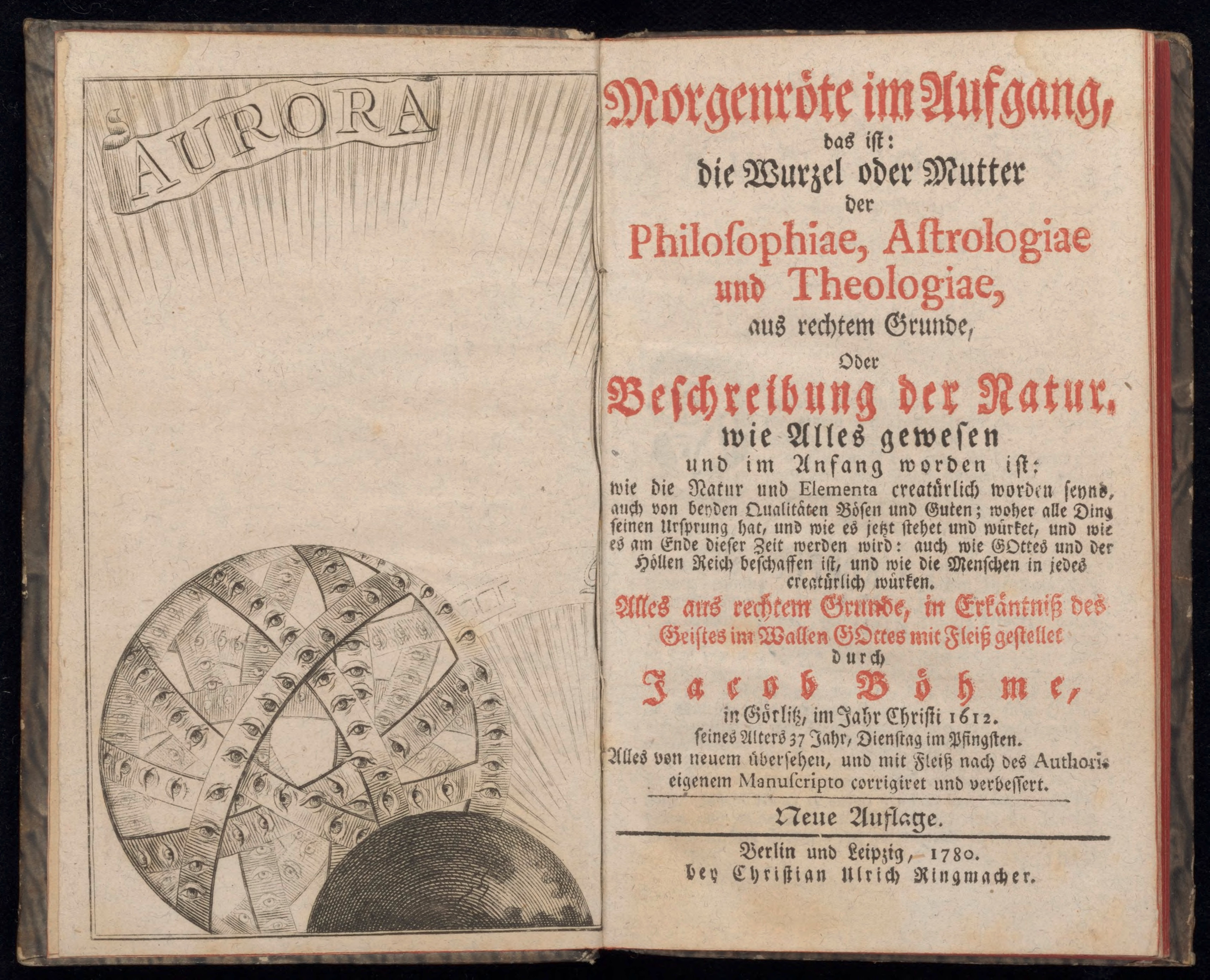
This was not a casual project. Böhme's Aurora (1612), his first and most famous work, describes a moment of illumination in which Böhme perceived the inner life of all things — the Signatura Rerum, the signature of spirit in every natural form. Everything in nature, Böhme argued, is an expression of a living divine process. Matter is not dead; it is the outermost manifestation of an inner spiritual reality. The cosmos is not a machine but a theophany — God making himself visible.
The parallels with Fechner are unmistakable. Böhme's Signatura Rerum — the idea that every natural thing bears the signature of its inner character — maps directly onto Fechner's psychophysical parallelism, in which every physical process has a corresponding inner, experiential aspect. Böhme's vision of nature as a living whole, conscious at every level, is precisely Fechner's Tagesansicht. Even Fechner's hierarchy of souls — the soul of a cell within the soul of an organism within the soul of the earth within the soul of the cosmos — echoes Böhme's nested theophanies in the Mysterium Magnum.
Fechner, of course, was not simply repeating Böhme. He was translating Böhme's visionary theology into the language of 19th-century science. Where Böhme spoke of the divine Ungrund (the groundless ground), Fechner spoke of psychophysical identity. Where Böhme saw signatures, Fechner measured thresholds. The content is remarkably similar; the method is utterly transformed.
The Equation
This brings us to the famous equation. On the morning of 22 October 1850, Fechner was lying in bed when the key insight struck him: the relationship between mind and body could be expressed mathematically. If the intensity of a sensation increases as the logarithm of the stimulus, then the inner world and the outer world are linked by a precise, lawful relationship — neither reducible to the other, but rigorously correlated.
He spent the next decade working out the implications. The Elemente der Psychophysik, Volume I and Volume II (1860) laid out the experimental evidence and mathematical framework. The work founded a new science. Wundt built his laboratory on it. Helmholtz, Weber, and the entire tradition of German experimental psychology descends from it. The English translation (1966) made Volume I accessible to Anglophone readers — but only the experimental content, stripped of its metaphysical context.
Because here is the point that the textbooks omit: Fechner did not derive the psychophysical law in order to found experimental psychology. He derived it in order to demonstrate the unity of mind and matter — to prove, with the rigour of physics, that the inner life and the outer world are two aspects of one reality. The Elemente was not a step away from Böhme; it was the mathematical proof of Böhme's vision. Sensation and stimulus, mind and matter, the invisible and the visible, are not separate substances but a single thing viewed from two sides.
Fechner defended and refined this position for another two decades. In In Sachen der Psychophysik (1877) and the Revision der Hauptpuncte der Psychophysik (1882), he responded to critics and extended the mathematical framework. These works exist in no English translation.
“The whole material world may be said to be alive. Consciousness is not a rare accident in the universe but a fundamental feature of it.”
— Gustav Fechner, Elemente der Psychophysik (1860), paraphrased
The Aesthetics of Consciousness
Late in life, Fechner turned to aesthetics. The Vorschule der Aesthetik, Band 1 and Band 2 (1876) pioneered what he called “aesthetics from below” — the empirical study of what people actually find beautiful, measured through controlled experiments rather than deduced from philosophical first principles. He invented preference testing. He ran some of the first controlled psychological experiments in history, including his famous study of the golden ratio using rectangles of different proportions.
But again, the method served the metaphysics. For Fechner, beauty is not arbitrary; it is the perception of harmony, and harmony is the signature of the underlying unity of things. Aesthetic experience is the moment when the inner life of the perceiver resonates with the inner life of the perceived. The golden ratio is not a mathematical curiosity; it is a window into the structure of consciousness itself. Aesthetics from below leads, if you follow Fechner far enough, back to Böhme's signatures.
The Afterlife of Fechner
Fechner died in 1887, the same year he published Das Büchlein vom Leben nach dem Tode — The Little Book of Life After Death, one of the few works translated into English. It argues that death is not annihilation but a transition: just as waking succeeds sleep, a higher consciousness succeeds bodily death. The individual soul is absorbed into the greater soul of the earth and cosmos — not destroyed but expanded.
William James read Fechner seriously and devoted an entire chapter to him in A Pluralistic Universe (1909), calling his vision “the most logically worked-out panpsychism in existence.” James found Fechner's earth-soul doctrine genuinely compelling and regretted that Anglophone philosophy had ignored it.
Then Fechner was split in two. The experimentalists kept the psychophysical methods and discarded the metaphysics. The philosophers of mind rediscovered panpsychism in the late 20th century but rarely traced it back to Fechner. The result is that the most important panpsychist philosopher since Leibniz — the one who actually built an empirical research programme on his metaphysics — has been largely forgotten as a philosopher, even as his methods remain foundational.
What's in the Collection
Source Library now holds 17 works by Fechner — likely the most complete digital collection of his philosophical writings available. Here is what it contains, and what each work contributes to the picture:
| Work | Year | Subject | English? |
|---|---|---|---|
| Ueber das höchste Gut | 1846 | Ethics: the highest good as universal pleasure | No |
| Nanna | 1848 | The soul-life of plants | No |
| Zend-Avesta | 1851 | Cosmic panpsychism: earth, planets, stars as ensouled beings | No |
| Über die physikalische und philosophische Atomenlehre | 1855 | Physical vs philosophical atomism | No |
| Jakob Böhme: sein Leben und seine Schriften | 1857 | Fechner's study of the mystic who inspired his vision | No |
| Elemente der Psychophysik I & II | 1860 | The founding text of experimental psychology | Vol. I only |
| Über die Seelenfrage | 1861 | Systematic case for universal consciousness | No |
| Die drei Motive und Gründe des Glaubens | 1863 | The three motives and grounds of belief | No |
| Vorschule der Aesthetik I & II | 1876 | Experimental aesthetics: beauty as signature of unity | No |
| In Sachen der Psychophysik | 1877 | Defence against critics | No |
| Revision der Hauptpuncte der Psychophysik | 1882 | Revised psychophysical theory | No |
| Das Büchlein vom Leben nach dem Tode | 1887 | Death as transition to cosmic consciousness | Yes |
| Kollektivmasslehre | 1897 | Collective measurement theory (posthumous) | No |
Of seventeen works, only two have ever been translated into English — and one of those only partially. The Elemente der Psychophysik was translated in 1966, but only Volume I; Volume II, which contains some of Fechner's most important philosophical arguments, remains German-only. The Little Book of Life After Death was translated in 1904, but it is a short, popular work — the least representative of Fechner's serious philosophical thinking.
The works that constitute Fechner's actual philosophical system — Nanna, Zend-Avesta, Über die Seelenfrage, the Vorschule der Aesthetik, the Böhme study — exist only in 19th-century German. This means that the Anglophone world has received Fechner's methods but not his reasons, his equations but not his metaphysics, his psychophysics but not his panpsychism. It is as if Newton were known for his optics experiments but not for his theory of gravitation.
Böhme in the Library
Source Library holds an extensive collection of Böhme's own writings, making it possible to read Fechner's study alongside the primary sources he was working from:
- Aurora — Böhme's first vision (1612)
- Morgenröte im Aufgang — the German original of the Aurora
- Mysterium Magnum — Böhme's commentary on Genesis, his fullest cosmological vision
- Alle Theosophische Wercken — the complete works in the original German
- Christosophia: Der Weg zu Christo — Böhme's spiritual practice
- Von der Genaden-Wahl — on the election of grace
- Het Mysterium Magnum — Dutch translation, evidence of Böhme's reach
Reading Fechner's Jakob Böhme alongside Böhme's own Aurora is to watch one of the strangest and most productive encounters in intellectual history: a laboratory physicist finding in a visionary shoemaker the metaphysical framework for a new science.
Why This Matters Now
Panpsychism is having a revival. Philosophers like David Chalmers, Galen Strawson, and Philip Goff have argued that consciousness may be a fundamental feature of matter rather than an emergent property of complex brains. The “hard problem of consciousness” — why there is subjective experience at all — has resisted every materialist explanation, and panpsychism offers an alternative: consciousness doesn't need to be explained as emerging from non-conscious matter because it was never absent.
This is exactly Fechner's position, worked out in detail 170 years ago, complete with an empirical research programme, a mathematical framework, an aesthetic theory, an ethics, and a cosmology. The contemporary panpsychists are largely reinventing Fechner without reading him — because they can't. His major works are in untranslated German.
Source Library's AI-powered translation pipeline can change this. The same system that has translated thousands of pages of Latin, German, and French philosophical texts can make Fechner's corpus accessible for the first time. Nanna, Zend-Avesta, Über die Seelenfrage, the Vorschule der Aesthetik, the Böhme study — all of these await their first English rendering.
The founder of experimental psychology was, in his own understanding, completing the work of a 17th-century mystic. The equation and the vision are not separate achievements; they are one project. To recover that project — to read Fechner whole — is to discover that the history of psychology, and the history of consciousness studies, is stranger and richer than the textbooks suggest.
Explore the Fechner Collection
Browse all 17 works by Gustav Fechner in Source Library, from the psychophysical foundations to the panpsychist philosophy — most available in digital form for the first time.