There is a manuscript in the Bibliothèque nationale de France, copied for King Francis I around 1545, in which the first 150 pages describe how to build steam engines, automatic temple doors, singing bird automata, and a water-powered pipe organ. Page 153 begins the Poimandres of Hermes Trismegistus — a mystical vision of divine light and the creation of the cosmos.
The same scribe, the same royal binding, the same book. Hero of Alexandria’s Pneumatica — the foundational text of ancient mechanical engineering — bound with the Corpus Hermeticum, the foundational text of Western mystical philosophy. Nobody in the sixteenth century saw a contradiction. The knowledge belonged together.
This post follows that thread: engineering knowledge hidden inside books of magic, alchemy, and esoteric philosophy. Not metaphorical engineering. Actual technical specifications for actual machines — found in the last places a modern reader would think to look. Source Library holds the primary texts, translated and annotated. Every quote below links to the original page.
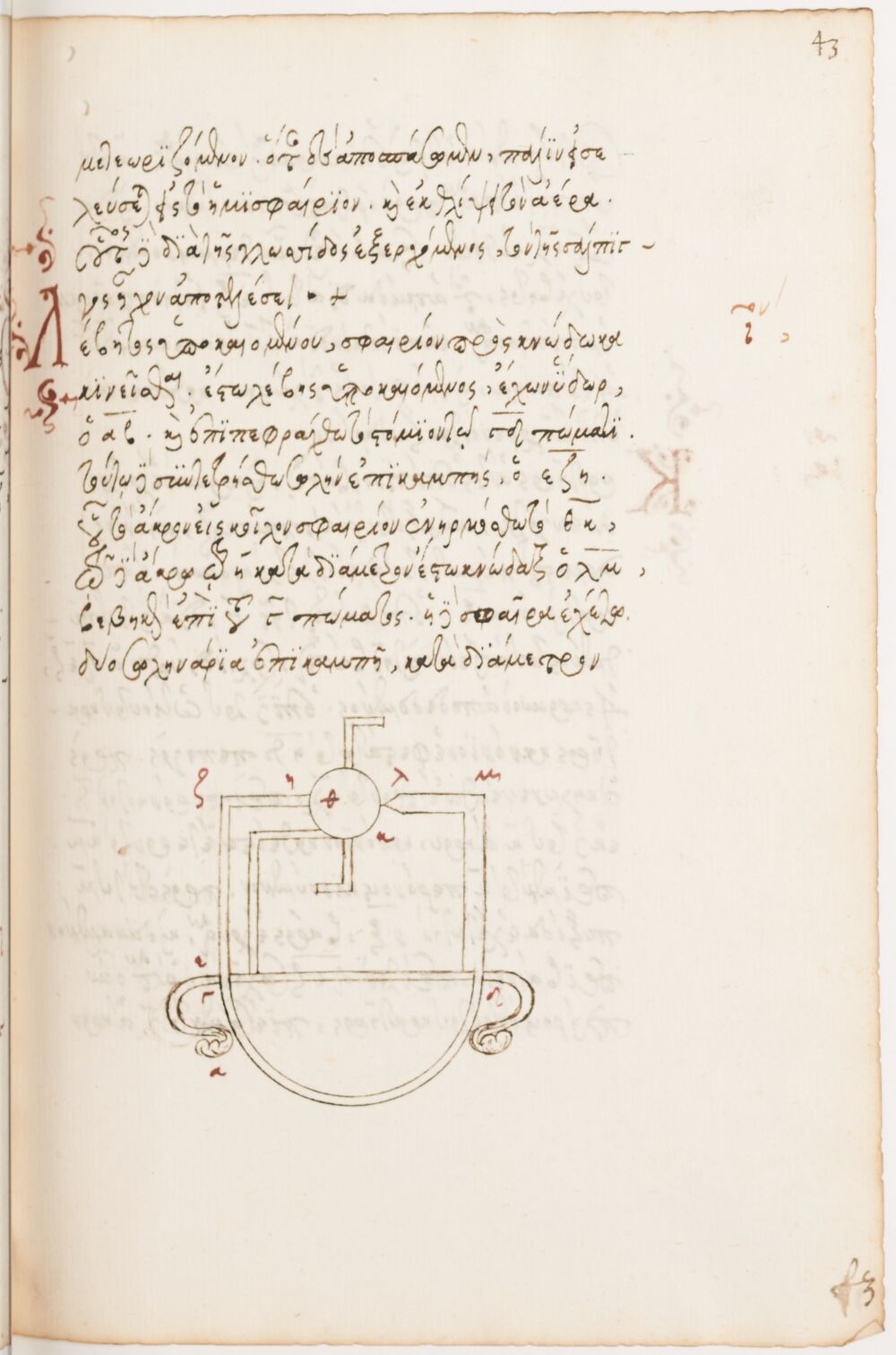
I. The Manuscript That Says It All
The manuscript is BnF Suppl. gr. 607 — a 284-page Greek codex copied by the royal scribe Ange Vergèce for King Francis I of France. It contains two works that modern categories would place in entirely different disciplines.
The first half is Hero of Alexandria’s Pneumatica, written in the first century CE. Hero was an engineer at the Mouseion of Alexandria, and the Pneumatica is a catalog of devices powered by air, water, steam, and vacuum — what we would now call fluid mechanics and thermodynamics. It opens with a theoretical treatment of the void, then proceeds through dozens of working machines.
Theorem 37 describes automatic temple doors. A fire is lit on an altar, heating air in a sealed chamber. The expanding air pushes water through a system of vessels and counterweights, which pulls open the temple doors. When the fire dies, the air contracts, the water flows back, and the doors close. The congregation sees the doors open “by themselves” as the sacrifice is offered. Hero gives the mechanism:
“Let there be a circular shrine upon a base, upon which a small altar is placed. Through this small altar, we shall pass a tube… the air inside the small altar, being heated, will expand into a larger space. Passing through the tube into the sphere, it will force out the liquid within it, through the siphon, into the hanging vessel. This vessel, becoming heavy as it fills, will pull the small chains and open the doors.”
The devices escalate. Theorem 45 describes a water organ — the hydraulis. Theorem 49 produces “singing birds” that fall silent when an owl rotates toward them, driven by the same siphon-and-counterweight principles.
Then comes Theorem 50: the aeolipile. A sealed cauldron of boiling water feeds steam through a tube into a hollow sphere mounted on a pivot. The sphere has two bent nozzles pointing in opposite directions. As the steam escapes through the nozzles, the sphere rotates — a jet engine in miniature, described in the first century.
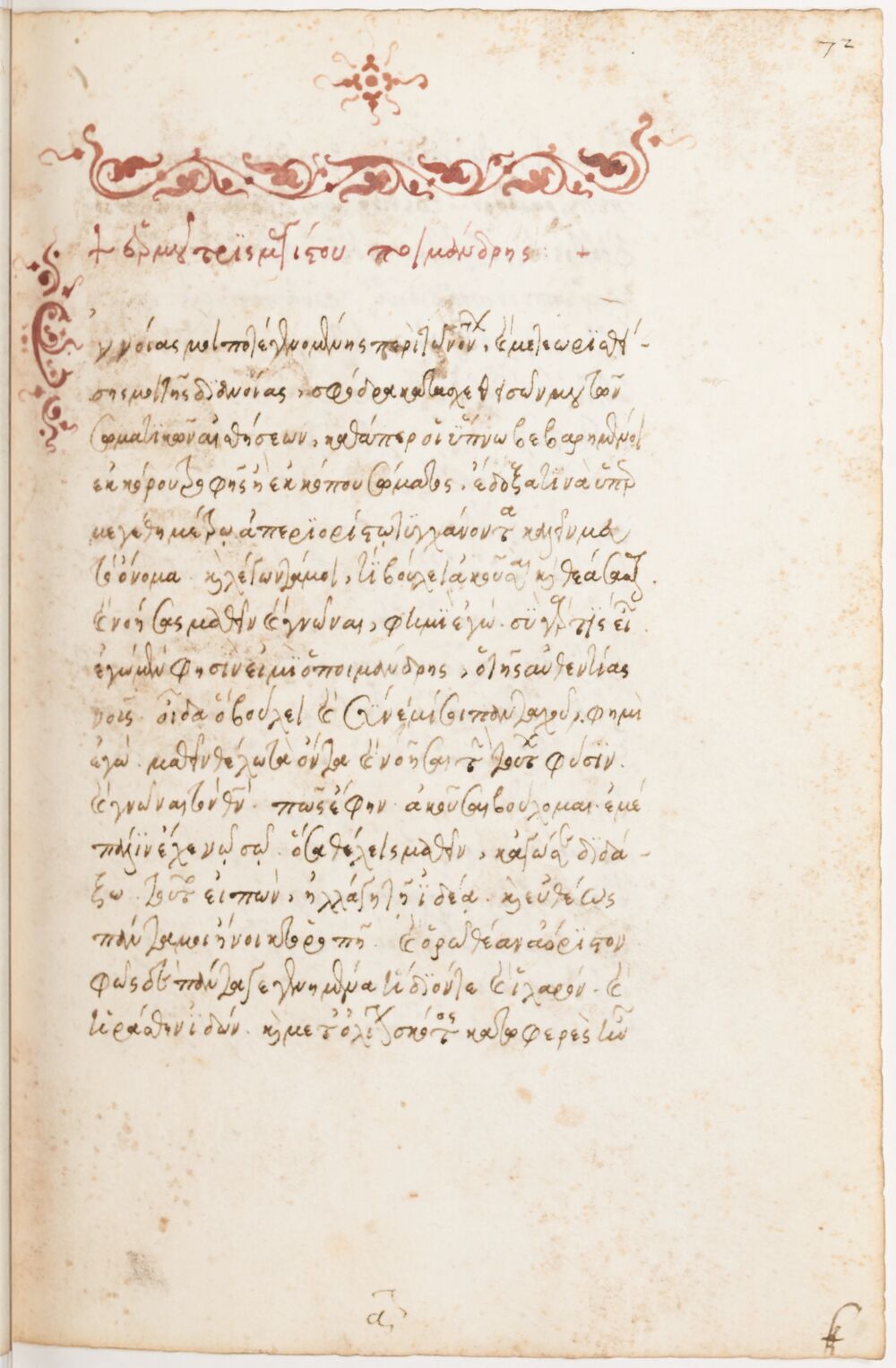
After the aeolipile, a few blank leaves, and then — in the same hand, with a decorative headpiece in red ink — the Poimandres begins:
“Once, when I began to meditate on the beings, and my thought was greatly uplifted, while my bodily senses were held in check — I thought I saw a being of immense size, beyond all limited measure, calling my name and saying to me: ‘What do you wish to hear and see, and having understood in your mind, to learn and know?’”
Steam engines and divine visions. The same scribe, the same patron, the same physical codex. For Francis I and his scholars, these texts belonged in the same volume because they came from the same intellectual world: the Greek-speaking civilization of Alexandria, where technology and theology were not separate departments.
II. Natural Magic as Applied Physics
Giambattista della Porta’s Magia Naturalis (Naples, 1558; expanded edition 1589) is one of the most widely read books of the sixteenth century. The title promises “natural magic” — and modern readers expect occultism. What they get, in the final books, is a pneumatics textbook.
Book XVII describes the camera obscura and explains the optics of lenses and mirrors. Book XIX, titled “On Pneumatics,” is a systematic treatment of hydraulics, siphons, and air-pressure devices that cites Hero of Alexandria by name. Della Porta introduces it as a branch of natural philosophy, not supernatural knowledge:
“How fire-throwing tubes are constructed… Hero advises soldiers about to scale city walls to use portable, hand-held engines that throw fire from a distance.”
Della Porta, Magia Naturalis, Book XII, Ch. 4 — citing Hero’s military applications of pneumatics
The final chapter of Book XX, titled “On certain mechanical experiments,” makes the scope explicit. This is not metaphor. Della Porta describes how to build a kite — calling it a Draco volans, a “Flying Dragon” — with exact specifications for the frame, the covering, the tail, and the wind conditions:
“Let a quadrangle be constructed from the thinner sticks of reeds, so that the length is in a sesquialter proportion to the width… Thus launched with a light pull, it is to be entrusted to the hands of the craftsman, who should push it neither sluggishly nor carelessly, but strongly; and thus the flying canvas seeks the air.”
He notes that people attach lanterns to make it look like a comet. Others tie firecrackers to it and send a lit fuse up the rope. “Some even tie a cat or a puppy to it and listen to their voices as they are sent through the air.” (The sixteenth century was not sentimental about animal welfare.) And then the punchline:
“From this, the ingenious man will be able to foresee the principles by which even a man might be able to fly.”
Della Porta, Magia Naturalis, Book XX, Ch. 10 — the kite as a prototype for human flight
The book ends with Archytas of Tarentum’s legendary wooden dove, said to have flown by means of “an enclosed and hidden breath of air” — compressed air or steam. Della Porta frames this as evidence that human flight is achievable. The last word of the last page of Magia Naturalis is “THE END” — but the word just before it is mechanics.
This is what “natural magic” actually meant: the systematic investigation of nature’s hidden properties. Magnetism was natural magic. Optics was natural magic. Pneumatics was natural magic. The category that modern readers dismiss as superstition was, in the sixteenth century, the institutional home of experimental physics.
III. The Aeolipile Experiment
Vitruvius — writing around 30 BCE — placed his description of the aeolipile not in a treatise on engineering but in a chapter about wind and urban planning. The aeolipile is offered as a demonstration experiment: if you want to understand where wind comes from, build one and watch.

The 1521 edition held in Source Library includes an elaborate woodcut: the aeolipile rendered as a decorated sphere with acanthus leaves, as if it were a work of art rather than a scientific instrument. This is characteristic of how engineering knowledge traveled in the Renaissance — embedded in luxurious editions of classical texts, where the boundary between natural philosophy, architecture, and applied physics did not exist.
Vitruvius himself would not have understood the modern separation. His De architectura treats building design, siege engines, water clocks, sundials, and the acoustic theory of concert halls as a single subject. Book I requires the architect to know philosophy, music, medicine, law, astronomy, and optics. Engineering was not a specialization. It was a dimension of being educated.
IV. The Alchemist’s Laboratory
Alchemy is remembered for its failures — the gold that nobody made, the elixir that nobody found. What is forgotten is that alchemists were the best-equipped experimental chemists in Europe for more than a thousand years. They designed furnaces, distillation apparatus, and laboratory glassware. They invented the water bath.
The Theatrum Chemicum (Strasbourg, 1659–1661) is the largest compilation of alchemical texts ever published — six folio volumes containing over two hundred treatises. Scattered through its mystical allegories and philosophical meditations are precise technical instructions for building laboratory equipment:
“Place the glass into the furnace described above, with a lamp lit beneath it, burning continuously night and day.”
The furnace — specifically the athanor, a self-feeding furnace designed to maintain constant temperature for days or weeks — was the alchemists’ signature engineering achievement. It solved a real thermodynamics problem: how to maintain low, steady heat for extended chemical processes before the existence of thermostats.
The Artis Auriferae (Basel, 1572) preserves an even older tradition. Among its texts is a treatise attributed to Mary the Prophetess — Maria Hebraea, a figure from late antiquity credited with fundamental laboratory inventions:
“Mary the Prophetess… credited with inventing the bain-marie or water bath.”
The bain-marie — still called that in French kitchens today — is a double-boiler: a vessel of water surrounding an inner vessel, providing gentle, indirect heat. It is one of the few alchemical inventions that entered common use, surviving in every restaurant and chemistry laboratory in the world while the discipline that created it is remembered only for its failures.
V. The Mechanical Crucifix
Reginald Scot’s The Discoverie of Witchcraft (London, 1584) is famous as an argument against the reality of witchcraft. What is less remembered is that Scot, in the course of debunking supernatural claims, describes the engineering behind mechanical religious frauds — and in doing so provides some of the best documentation we have of late medieval automata.
The most striking example is the Rood of Grace at Boxley Abbey in Kent — a crucifix that moved its eyes, lips, and limbs, and was venerated as miraculous for decades before being exposed during the Dissolution of the Monasteries. Scot gives a mechanical account:
“The wires that made their eyes goggle, and the pins that fastened them to the posts.”
Scot’s purpose was polemical — he wanted to prove that apparent miracles had mechanical explanations. But the effect of his argument is to document a sophisticated tradition of automata construction associated with religious institutions. Somebody knew how to build these devices. Somebody understood how to connect wires and pins to produce lifelike motion in a carved figure. The knowledge was real, even if the miracle was not.
This pattern — engineering knowledge preserved in polemical rather than technical literature — is one of the reasons the history of early technology is so difficult to reconstruct. The people who built the devices did not write about them. The people who wrote about them were trying to expose them as frauds.
VI. The Rosicrucian Steam Engine
Die Lehren der Rosenkreuzer (“The Teachings of the Rosicrucians”) is a manuscript collection of esoteric teachings associated with the Rosicrucian fraternity. Pages 58–59 contain what may be the single most surprising document in Source Library: a literal steam engine schematic, embedded in a mystical text, labeled “Elijah’s Chariot.”
“Elijah’s Chariot. Showing how propelling force is obtained. A.A. View hole. B.B. Valves to regulate the admission of outside air to the Smoke Chamber (C)… Scale: ½ inch to the foot. Angle iron bands all around… fire box… ashes pit.”
Die Lehren der Rosenkreuzer, p. 58–59 — “Elijah’s Chariot”
This is not metaphor. The specifications include materials (red brick, iron plate, angle iron bands), measurements (scale of three-quarters of an inch to the foot), and functional components (exhaust flue, water/steam chamber, saline projectile chamber). It is a construction plan for a device that converts steam pressure into mechanical energy.
The name is the key. “Elijah’s Chariot” refers to the biblical chariot of fire that carried the prophet Elijah to heaven (2 Kings 2:11). The Rosicrucian author has taken a scriptural image of divine ascension and turned it into an engineering problem: if Elijah ascended by a chariot of fire, what would that chariot actually look like? The answer is a steam engine.
This is not unique. Cornelius Drebbel, the Dutch inventor who built a working submarine in 1620, wrote a treatise titled On the Nature of the Elementsthat frames his inventions in terms of elemental philosophy. His perpetual motion clock, his submarine, his thermostatic oven — all are presented as demonstrations of the interaction of the four elements, not as engineering achievements in the modern sense.
“The fire works in the air, the air in the water, the water works moisture into the earth.”
VII. Bacon’s Manifesto
Francis Bacon’s The Advancement of Learning (London, 1605) is the text that, more than any other, argued for the dignity of practical knowledge. In a culture that prized philosophical contemplation over manual labor, Bacon made the case that the “mechanical arts” — what we would now call engineering and applied science — had epistemological advantages over pure philosophy:
“In the mechanical arts, the first inventor falls shortest, and time adds to and perfects the work; but in the sciences, the first author goes furthest, and time degrades and corrupts.”
This is a profound observation, and one that describes the actual history of technology accurately. The mechanical arts are cumulative: each generation improves on the last. The philosophical sciences are not — they are dominated by founding authorities (Aristotle, Galen, Ptolemy) whose work is gradually corrupted by commentators. Bacon noticed that the blacksmith improves while the philosopher declines.
Bacon went further, arguing for what he called “Mechanical History” — a systematic record of the trades and crafts as a foundation for natural philosophy:
“Vulcanus or Daedalus… the furnace or the engine.”
Bacon, Advancement, on the mythological patrons of the mechanical arts
By 1605, Bacon was describing something that had already been true for centuries without being named. The alchemists had their furnaces. Della Porta had his pneumatics. Hero had his automata. The Rosicrucians had their steam engine schematic. The knowledge existed — it just did not exist under the name “engineering.” It existed under the names of magic, alchemy, and natural philosophy, because those were the categories available.
VIII. The Notebooks
Leonardo da Vinci’s notebooks, collected and published centuries after his death, are the most famous example of Renaissance engineering documentation. But Leonardo is interesting here for what he refused to do. Unlike his contemporaries, he had no interest in framing his mechanical work as magic or philosophy. He was impatient with the entire tradition of occult knowledge:
“O speculators on perpetual motion, how many vain designs of a similar character you have created. Go and take your place with the seekers after gold.”
“Go and take your place with the seekers after gold” — that is, the alchemists. Leonardo saw perpetual motion and alchemy as the same kind of error: the pursuit of something that does not exist. His notebooks contain pulleys, gears, flying machines, hydraulic systems, and anatomical studies — all treated as purely mechanical problems, without recourse to occult explanation.

Leonardo proves, by contrast, how unusual the separation of engineering from magic actually was. He was an outlier. For most of his contemporaries — Della Porta, Drebbel, the Rosicrucians — the mechanical and the mystical were aspects of the same investigation. Leonardo’s refusal to mix them was not the norm. It was a minority position that would not become orthodox for another two centuries.
The Boundary Is Modern
The separation of engineering from esotericism is a modern invention — useful, but historically false. For most of the Western tradition, the people who knew how to build things also knew how to read Hermes Trismegistus. The people who wrote about pneumatics also wrote about natural magic. The people who designed furnaces were alchemists. The people who documented automata were trying to expose witchcraft.
This matters because it changes what counts as a “source” for the history of technology. If you only look in books labeled “engineering,” you miss most of the story. The aeolipile is in the same manuscript as the Poimandres. The kite is in a book of magic. The steam engine schematic is in a Rosicrucian manuscript. The water bath was invented by an alchemist. The mechanical crucifix was documented by a witch-trial skeptic.
Bacon saw it clearly: the mechanical arts had been advancing all along, while philosophy stagnated. The knowledge was there. It just was not in the places where the later tradition would think to look for it.
Source Library holds these texts. They are translated, annotated, and searchable. The connections between them — Hero and Hermes in the same binding, Della Porta’s pneumatics inside a spell book, Elijah’s chariot as a literal engine — are visible now in a way they never were before.
Primary Sources in Source Library
Hero of Alexandria, Pneumatica + Corpus Hermeticum
Greek MS, c. 1545 — steam engines bound with mystical philosophy
Della Porta, Magia Naturalis
Naples, 1589 — pneumatics, optics, and kites as "natural magic"
Vitruvius, De architectura
1521 — aeolipile woodcut, architecture as total knowledge
Theatrum Chemicum
Strasbourg, 1659 — furnace design inside alchemical compilations
Artis Auriferae
Basel, 1572 — Mary the Prophetess and the bain-marie
Die Lehren der Rosenkreuzer
MS — steam engine schematic as "Elijah's Chariot"
Scot, The Discoverie of Witchcraft
London, 1584 — mechanical crucifixes exposed
Bacon, The Advancement of Learning
London, 1605 — the dignity of the mechanical arts
Drebbel, On the Nature of the Elements
c. 1608 — submarines framed as elemental philosophy
Leonardo da Vinci, Notebooks
1,272 pages of pure mechanical investigation