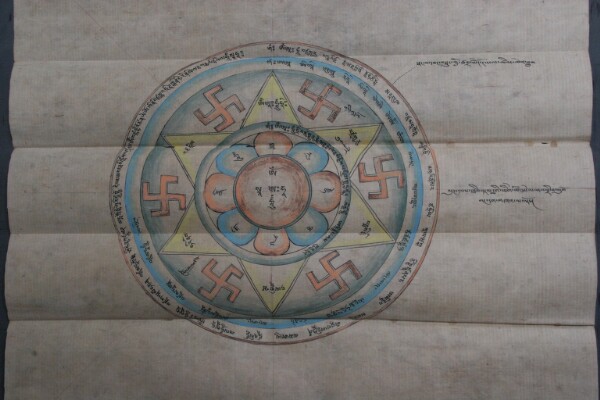
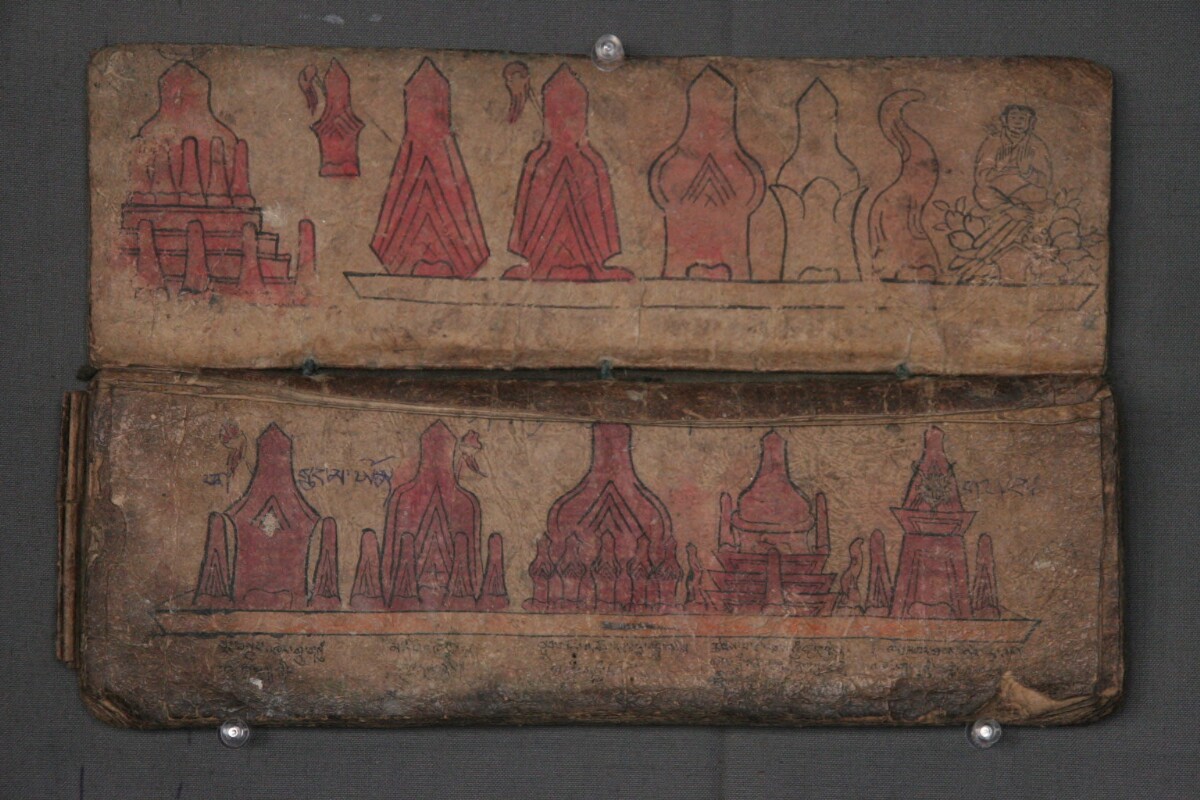
Last month we imported 1,358 Bhutanese manuscripts — 232,800 pages — from the British Library’s Endangered Archives Programme. These are handwritten pecha manuscripts spanning the 14th through 20th centuries, written in both dbu can (formal headed script) and dbu med (cursive headless script), covering Buddhist philosophy, ritual practice, astrology, history, and more.
The images are high-resolution JPEG2000 from the British Library’s professional digitization. The question was whether current AI models could actually read them.
General-purpose OCR cannot. The GlotOCR Bench evaluation (Kargaran et al., 2026), which tested OCR across 200+ scripts, found that Tibetan falls below 10% accuracy on standard OCR models. So we ran our own experiment.
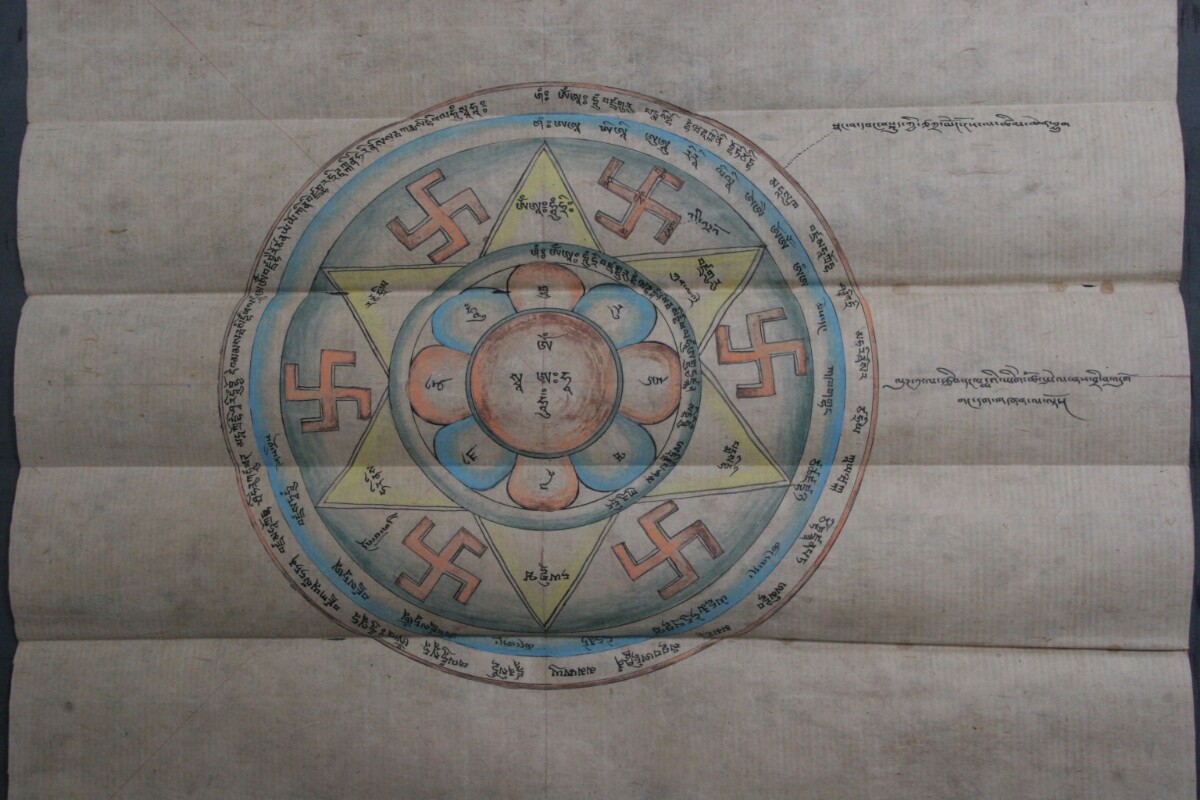
The Corpus
Our 1,358 manuscripts come from four Endangered Archives Programme projects, plus a smaller set from other digital libraries:
EAP039: Gangtey Monastery — 284 manuscripts, roughly 34,500 pages. Gangtey was founded by Tenzin Legpai Dondrup, grandson of the great treasure-revealer Pema Lingpa. The collection includes revealed texts (terma), liturgical manuals, and astrological treatises.
EAP105: Drametse and Ogyen Choling — Over 720 manuscripts, roughly 62,500 pages. Drametse Monastery was founded in 1511 and is the origin of the Drametse Nga Cham (drum dance), a UNESCO Intangible Cultural Heritage.
EAP310: Thadrak, Neyphug, Phurdrup, and Tshamdrak Temples — 316 manuscripts, roughly 119,000 pages. These temple collections represent some of the largest single deposits in our corpus.
Additional sources — 53 texts from the Internet Archive, the Buddhist Digital Resource Center, and Gallica, including European accounts of Bhutan and Drukpa Kagyu lineage texts.
The Experiment
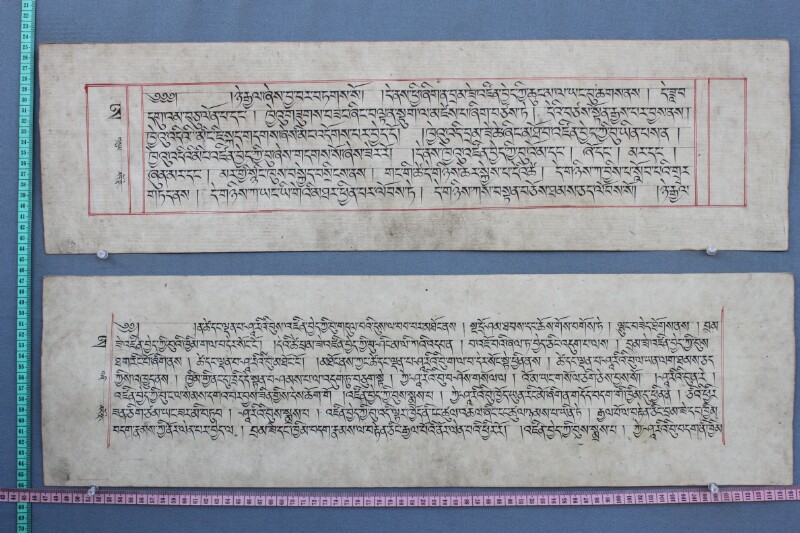
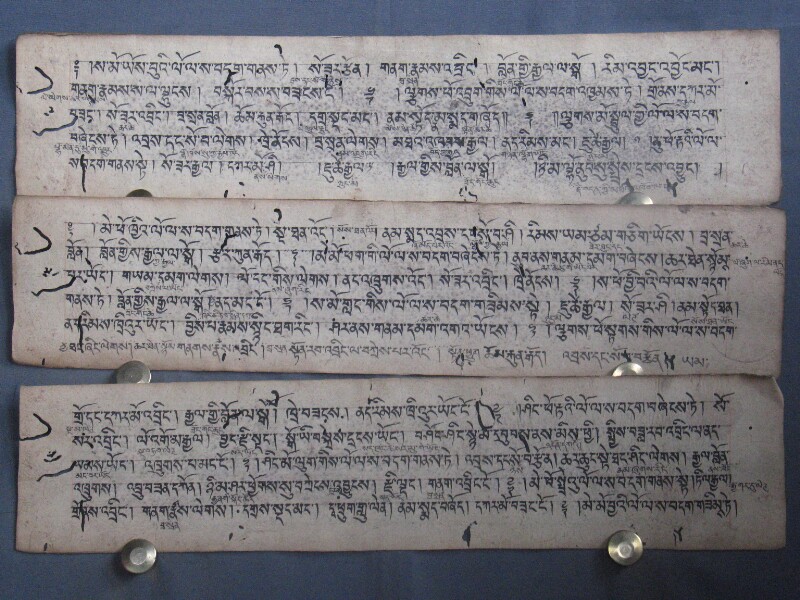
We tested OCR consistency on the same Gangtey dbu med manuscript page — an astrological text from the 60-year element-animal cycle — across three models. Rather than measuring against ground truth (which would require Tibetan paleographers), we measured something more immediately useful for pipeline work: how consistent is each model with itself, and how much do models agree with each other?
| Model | Runs | MCR | Notes |
|---|---|---|---|
| Claude Opus 4.6 | 3 | 100% | 3/3 identical. Correct script, genre, and content ID. |
| Gemini 3 Flash | 5 | 80% | 4/5 identical. 1 mode switch (24.4% char similarity to dominant). |
| Gemini 3.1 Flash Lite | 3 | N/A | Misidentified genre entirely. Hallucinated “ritual manual for weather control.” |
| Cross-model | — | 89.4% | Character similarity, Opus vs Flash dominant mode. |
The mode-switching behavior in Gemini Flash is notable: at temperature=0, you would expect deterministic output, but VLMs can exhibit what amounts to bifurcated interpretation of ambiguous visual input. Within the dominant mode, consistency was perfect.
Given that the GlotOCR benchmark found sub-10% accuracy for Tibetan on general OCR models, 89% cross-model agreement on handwritten cursive manuscripts is striking. The likely explanation is that vision-language models have absorbed enough Tibetan text during pretraining to perform well on OCR even where traditional pipeline-based approaches fail.
The Tibetan OCR Landscape
Our experiment sits within a rapidly developing ecosystem of Tibetan-language AI tools. We want to describe that landscape honestly, because the work being done by dedicated Tibetan digital humanities projects is more important than anything we are doing.
The Buddhist Digital Resource Center has been the backbone of Tibetan digital preservation for decades. In March 2025, BDRC released the first open-source desktop Tibetan OCR application, built on Easter2 architecture trained on approximately 43,000 line samples. In February 2026, BDRC launched a major open datasets initiative with over 30 million scanned pages and 5 million etexts — an extraordinary resource for the entire field.
Monlam AI, based in Dharamshala, claims state-of-the-art Tibetan comprehension with their Melong model, trained on approximately 24 billion Tibetan tokens. The exile Tibetan community building AI tools for their own language — on their own terms, for their own purposes — is one of the most inspiring developments in the space.
OpenPecha maintains open Tibetan etexts and collaborative annotations. The project represents the kind of community-driven infrastructure that makes everything else possible.
Consistency, Hallucination, and Trust
The deeper question is not “how accurate is the OCR” but “how do we know when to trust it?”
Wang and Wang (2025) showed that simple aggregation across 3-5 LLM runs dramatically improves consistency. This echoes a foundational result from Lopresti and Zhou (1996): scanning a page three times and running consensus voting eliminates 20-50% of single-engine OCR errors. That insight is 30 years old, and it applies directly to VLM-based OCR.
“Seeing is Believing?” demonstrated that VLMs over-rely on linguistic priors when visual conditions degrade. We observed this directly: Gemini 3.1 Flash Lite “read” an astrological text as a ritual manual for weather control. The output was coherent Tibetan Buddhist terminology — it just had nothing to do with what was on the page. The model was writing, not reading.
Conformal Risk Control for OCR introduces accept/abstain decisions with statistical guarantees: VLMs are overconfident on hallucinated outputs, so internal confidence scores are unreliable. Cross-view consistency — what we measured as cross-run and cross-model agreement — serves as better evidence for trustworthiness.
Modal Consistency Rate
For pipeline OCR at scale, we propose Modal Consistency Rate (MCR) as the primary quality signal. Run each page N times (we use N=3). The MCR is the fraction of runs producing the majority output.
- MCR = 100% — High confidence. The model has a single, stable interpretation.
- MCR = 67% — Some ambiguity, but a consensus exists. Use the majority reading.
- MCR = 33% — Low confidence. The page is genuinely ambiguous. Flag for review.
Combined with cross-model agreement, you get a two-dimensional quality signal:
| High Cross-Model | Low Cross-Model | |
|---|---|---|
| High MCR | Trustworthy | Consistent but model-dependent |
| Low MCR | Unlikely in practice | Ambiguous page, needs review |
Can You Trust Any Translation?
Consistency tells us whether the model agrees with itself. But does it agree with human translators? We tested using our block-print of the Zhi khro dgongs pa rang grol (the Bardo Thodol cycle), comparing against scholarly translations from Lotsawa House (Adam Pearcey, 2016).
Our OCR captured the opening:
༄༅། །ཟབ་ཆོས་ཞི་ཁྲོ་དགོངས་པ་རང་གྲོལ། སྔོན་འགྲོ་རང་རྒྱུད་སྦྱོང་བའི་ཞལ་ཤེས་ནི།
Our AI translation:
“Profound Dharma of the Peaceful and Wrathful Ones, Self-Liberated Wisdom. The oral instructions for purifying one’s own continuum through the preliminary practices.”
The standard scholarly translation:
“Profound Teaching of the Peaceful and Wrathful Ones, Self-Liberation Through Intention. Oral instructions for training one’s own mind-stream through the preliminaries.”
The differences are instructive. dgongs pa can mean “wisdom,” “intention,” or “realization” depending on context. rgyud sbyong means something between “purifying the continuum” and “training the mind-stream.” These are the kinds of disagreements you see between any two independent translators of Classical Tibetan. The AI gets the meaning right. It makes different terminological choices, but choices that a Tibetologist would recognize as defensible rather than wrong.
What Comes Next
Routing all 232K pages through Gemini 3 Flash. Not Flash Lite. Flash Lite hallucinates on cursive Tibetan, and these manuscripts are predominantly cursive.
Benchmarking against BDRC’s Tibetan OCR app. Their Easter2-based system is trained specifically on Tibetan manuscripts. We want to know how it compares to VLMs on our corpus, particularly on dbu med cursive.
Exploring VLM fine-tuning. Chung and Choi fine-tuned LLaMA-3.2-11B on 60,000 synthetic Manchu word images and achieved 93.1% accuracy on real handwritten documents. A similar approach for Tibetan dbu med could address our hardest cases.
Reaching out to BDRC and OpenPecha. Our 232,000 pages of monastery manuscripts, with multi-model OCR consistency data, could serve as a shared benchmark. The Tibetan digital humanities community has been building infrastructure for this work far longer than we have.
The Bigger Picture
These manuscripts were digitized by the British Library’s Endangered Archives Programme because they were at risk of physical loss. The monasteries and temples that hold them — Gangtey, Drametse, Ogyen Choling, Thadrak, Neyphug, Phurdrup, Tshamdrak — preserve centuries of Bhutanese Buddhist scholarship, ritual practice, astrology, and history.
The digitization saved the images. But images alone are opaque. A researcher cannot search a photograph. The manuscripts remain locked behind script, language, and the sheer volume of 232,000 pages.
OCR and translation — even imperfect OCR and translation — begin to unlock that. When a model reads a page with 89% cross-model agreement, that is not a scholarly transcription. But it is a bridge. It makes a manuscript findable.
The manuscripts have survived centuries. The OCR just needs to be good enough to help people find them.