Silent Encounters: The Esoteric in the Ancient Hermetica
The Hermetica abound in elements of esoteric discourse: rhetorics of initiation and initiated silence, secret teachings, hidden texts, and ineffable encounters with the highest principles of reality through special faculties of consciousness.
Primary Sources

The Hermetic Corpus
Ott.lat.2074 is a breathtaking intellectual odyssey that bridges the gap between ancient Hermetic mystery and the rigorous structuralism of the Middle Ages. The text presents a world where the 'First Cause' is pursued through every available lens: the precision of Aristotelian categories, the negati

The Pimander of Hermes Trismegistus
Marsilio Ficino’s translation of the Pimander introduces the concept of Prisca Theologia, the original theology that predates the classical world. The work argues that human beings possess a dual nature: we are physically mortal but spiritually divine. Through dialogues between Hermes and the divine

The Divine Pymander
The Divine Pymander is a foundational pillar of Hermeticism, offering a visionary exploration of how humanity can transcend the shackles of Fate through Gnosis. Translated by the legendary Marsilio Ficino for the Medici court, this text presents the 'Prisca Theologia'—a primordial wisdom that prefig

Complete Hermetica (1505 Paris Edition)
The Complete Hermetica (1505 Paris Edition) is a profound synthesis of Western esotericism, offering a transformative vision of humanity’s place in the cosmos. Through the legendary dialogues of Hermes Trismegistus, the text argues that ignorance is the ultimate plague of the soul, while true knowle

Corpus Hermeticum with Pneumatica and Ocellus Lucanus
This text offers a rare synthesis of ancient mechanical ingenuity and the esoteric search for the divine. From Heron’s groundbreaking theories on the vacuum—which prefigure modern atomic theory—to Hermes Trismegistus’s meditations on the soul's ascent, the volume challenges the modern divide between

The Divine Pymander, Asclepius, and On the Mysteries
This monumental synthesis of Hermetic and Neoplatonic thought offers a radical roadmap for the soul’s ascent from the sensory 'multitude' to the intellectual 'One.' By weaving together the revelations of Hermes Trismegistus with the rigorous defenses of Iamblichus and the metaphysical depth of Procl

Pymander. Asclepius. On the Mysteries of the Egyptians. On Plato's Alcibiades, on the Soul and the Daemon. On Sacrifice.
This seminal volume brings together the core texts of the Hermetic and Neoplatonic traditions, asserting a unified lineage of 'ancient theology' (Prisca Theologia) that flows from Hermes Trismegistus to Plato. Readers will encounter bold claims about the human condition: that we are 'twofold' beings

On the Mysteries of the Egyptians - Pimander - Asclepius
This volume serves as a primary manual for understanding the mechanics of theurgy and the nature of the soul. It moves beyond simple philosophy to outline how ritual acts as a bridge between the mortal realm and the intelligible world. The authors argue that the soul is not a prisoner of the body bu

Complete Extant Works
This collection serves as a direct challenge to the foundations of ancient religious life. Clement strips away the veneer of pagan mythology, exposing its deities as merely mortal men and its temples as burial grounds. He argues that Greek philosophy, while incomplete, provides the essential logical

Poimandres
This collection functions as a foundational guide for those seeking to understand the nature of God, the soul, and the cosmos. Hermes Trismegistus argues that the physical world is a veil, and that ignorance of one's own divinity is the ultimate human disaster. The text demands that you reject world

Poimandres
Poimandres is a foundational pillar of Western esotericism that posits humanity as a 'divine animal' caught between the material and the eternal. Purported to be the work of the legendary Hermes Trismegistus—a syncretic fusion of the Greek Hermes and Egyptian Thoth—this tractate offers a radical cos

Extant Works
Clement does not view the world of Greek philosophy as an enemy to his faith. Instead, he treats it as a classroom where humanity learns to recognize the truth found in Christ. He argues that Greek thinkers were essentially students of Hebrew prophecy who failed to grasp the full picture. This colle

Biblical Palimpsest with Inquisition Abjuration Documents
The Hermetic Corpus stands as one of the most provocative syncretic works in history, blending the legendary insights of Hermes Trismegistus with the foundational theology of early Christianity. It makes the bold claim that spiritual liberation is a process of 'gnosis'—a transformation of the mind t

Works in Greek and Latin
Clement treats the entirety of human existence as a classroom for the soul. He claims that Greek philosophy contains fragments of divine truth, though it ultimately fails to reach the goal of salvation. Instead, he proposes the Word of God as the true Instructor who heals the passions and guides hum

Divine Pymander. Asclepius
The 'Divine Pymander' and 'Asclepius' represent a breathtaking synthesis of Greek philosophy and Egyptian mysticism, offering a roadmap for spiritual regeneration. Attributed to the thrice-greatest messenger of knowledge, Hermes Trismegistus, the text presents a bold vision of a universe ordered by

On the Mysteries (Thomas Taylor trans.)
In this foundational work of Neoplatonic thought, Iamblichus (writing as the Egyptian priest Abammon) offers a powerful rebuttal to the idea that religion is merely a human invention or a series of emotional delusions. By framing divine knowledge as an innate, eternal part of the soul's essence that

Sancti Irenaei Adversus Haereses
This edition by W. Wigan Harvey reconstructs the intellectual battlefield of the early centuries, where orthodox tradition clashed with complex Gnostic speculation. It argues that Gnosticism was not a primitive Christian development but a syncretic invention built upon distorted Greek and Egyptian p

Greek Patrology, Vol. 8: Clement of Alexandria I

Works, Vol. I (Dindorf, Oxford)
Clement of Alexandria presents a bold vision where Greek philosophy serves as a mere prelude to the ultimate truth of the Logos. He argues that while poets like Orpheus and Sophocles caught sparks of divinity, only the Christian Way offers a complete transformation of human nature. This text is not

Clement of Alexandria I: Protrepticus and Paedagogus
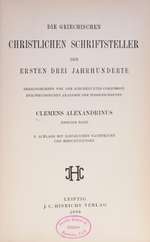
Clement of Alexandria II: Stromata I-VI
Clement argues that all wisdom originates from a singular divine source. He asserts that Greek philosophy serves as a vital tool for the believer, provided it is treated as a preparation rather than the final destination. The text demands intellectual rigor and warns against the vanity of mere debat

Clement of Alexandria III: Stromata VII-VIII, Excerpts, and Who is the Rich Man that Shall be Saved?
This volume functions as the ultimate key to the library of a brilliant mind. Clement of Alexandria does not merely cite pagan authors; he reframes their concepts of virtue, cosmology, and ethics to construct a Christian framework. He demands that his readers move beyond simple faith toward a rigoro

The Hermetic Writings, Volume I: Texts and Translation
This volume is a monumental reconstruction of the Hermetic tradition, presenting a world where philosophy is not merely an academic exercise but a literal means of deification. Scott challenges the notion that these texts are mere 'occult rubbish,' instead revealing them as the profound response of