Matthew Neujahr on the Sibylline Oracles
The Sibylline Oracles are a very influential, but largely-forgotten, oracular compendium probably redacted in more or less the form we know it in the sixth or seventh century in late antiquity, but containing material going back no-one-knows-how-far.
Primary Sources

The Works of Virgil
The Works of Virgil stands as a monumental pillar of Western literature, weaving together didactic agricultural wisdom and high-stakes heroic myth. Virgil masterfully transitions from the 'humble' subjects of bee-keeping and animal husbandry to the harrowing survival of the Trojan people, positing t

Aristophanes . Aristophanes
These plays are not dusty relics. They are blunt instruments of social critique that target the hypocrisy of politicians, the moral rot of new educational fads, and the desperate greed of the common citizen. Aristophanes uses humor to puncture the self-importance of the ruling class and the intellec

The Divine Institutes (Divinarum Institutionum)
In this seminal work, Lactantius—the advisor to Constantine I—presents a radical argument: the supernatural endurance of martyrs is the ultimate proof of the Christian God, far outstripping the legendary bravery of Roman heroes like Mucius and Regulus. By contrasting the empty rhetoric of secular ph

Works: The Divine Institutes; On the Wrath of God; On the Workmanship of God; The Phoenix
Lactantius wrote this work to dismantle the pagan world and replace it with a rational, Christian order. He argues that human philosophy is a broken vessel, useless without the revelation of the one true God. His prose turns the sharp tools of classical rhetoric against the very gods those same rhet

Sibylline Oracles
Sebastian Castellio and his contemporaries treat the Sibylline Oracles as a bridge between classical antiquity and Christian revelation. They argue that the sheer complexity and historical corruption of these manuscripts prove they are not modern forgeries, but genuine relics of ancient divine inspi

Plato Euthyphro, Apology, Crito, Phaedo, Phaedrus
Plato documents the final days of his teacher, Socrates, as he confronts a city that wants him dead. The text moves from the courtroom to the prison cell, eventually shifting into deep metaphysical inquiry. It argues that philosophy is nothing less than the practice of dying. By rejecting passive wr

On Isis and Osiris
In this treatise, Plutarch rescues Egyptian theology from the twin errors of superstition and skepticism. He argues that myths about dismemberment and divine struggle are not accounts of ancient kings, but symbolic representations of moral and metaphysical forces. By mapping these stories onto the b
Comedies of Aristophanes
This collection presents the surviving plays of Aristophanes, the undisputed master of Old Comedy. He uses raucous humor to dismantle the arrogance of powerful politicians and the hypocrisy of intellectual elites. His work transforms the failures of the Athenian state into a spectacle of logic and s

Sibylline Oracles (Greek)
Charles Alexandre presents a study of the Sibylline Oracles that strips away centuries of confusion to reveal the political and religious motives behind these prophetic verses. He argues that these texts are not mere pagan leftovers but sophisticated tools of Jewish and Christian polemic. The collec

Comedies
Aristophanis Comoediae is a foundational exploration of Old Comedy, asserting that the stage is a vital site for political truth and public education. Through masterpieces like 'The Acharnians' and 'The Knights,' Aristophanes delivers a searing critique of the Peloponnesian War’s origins and the ris

The Satyricon
Petronius delivers a savage critique of a society obsessed with wealth, performative virtue, and the decline of genuine intellect. Through the eyes of his desperate protagonists, he exposes the grotesque reality behind the dinner parties and legal systems of the Roman elite. This edition provides th

Plutarch's Morals, Vol. 4 (includes Isis and Osiris)
In this compelling volume of 'Morals,' Plutarch investigates the enigmatic mechanics of the 'spirit of divination,' arguing that prophecy is as much a physical phenomenon as it is a divine one. By examining the transformative power of natural vapors and the 'dry' temperament of the soul, he suggests

Plutarch's Morals, Vol. 5
This volume provides a fascinating window into Plutarch’s dual mastery of political ethics and natural philosophy. Plutarch moves beyond mere biography to offer bold claims about the physical world—arguing that cold is an active force rather than a mere absence of heat, and critiquing the Stoic visi
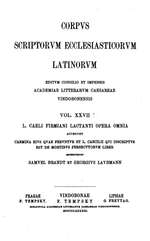
Complete Works (Opera Omnia)
Samuel Brandt and Georg Laubmann perform a rigorous autopsy on the editorial history of Lactantius. They move beyond mere translation to examine the mechanics of textual corruption, genealogy, and the flawed legacy of early printed editions. The editors argue that the quality of a text depends on th

Euthyphro, Apology, Crito, Phaedo, and Phaedrus
This collection captures the final days of history's most famous provocateur. Socrates turns his own trial into a masterclass on how to live and die with integrity. He dismantles the hollow arguments of his accusers and shows that true wisdom starts with the admission of ignorance. The text forces y

Aristophanes II: Peace, Birds, Frogs (Loeb)
This volume collects three of the most influential comedies from ancient Athens. Aristophanes combines sharp political satire with mythological parody to critique the corrupt leaders and litigious culture of his time. He argues for the restoration of rural prosperity and the civic importance of high