We are the One: Plotinus' Participatory Metaphysics
Plotinus' universe is uniquely full of the human self, which extends all the way from the sucking mud of matter's non-existence to the ultimate profundity of the One's non-existence, and all the existent bits in-between. We discuss some of the ways in which this human metaphysical terrain is explore
Primary Sources

Proclus in Politiam Platonis . Proklos eis Politeian tou Platonos
In this commentary, the last great Neoplatonist philosopher reconciles the poetic genius of Homer with the rigorous logic of Plato. Proclus argues that myths are not fabrications but deliberate veils for ineffable truths. He maintains that true music and rhythm serve as the structural foundation for

The Enneads

The Enneads
The Enneads is a towering achievement of late antiquity that reshaped the trajectory of Western and Near-Eastern thought, influencing everything from Christian theology to Islamic mysticism. Plotinus presents a bold metaphysical hierarchy—the One, the Intellect, and the Soul—arguing that true happin

Plotinus . Plotinos . Scilicet Plotini Enneades VI et Maximi Tyrii Dissertationes XI
Plotinus strips away the distractions of the physical world to reveal the singular, transcendent source of all being. The text documents the final philosophical ascent of a man who viewed his own body as a temporary, secondary image. You will encounter arguments that collapse the boundaries between

Commentary on Plato's Timaeus

Commentary on Plato's Timaeus

Proclus: Platonic Theology and Elements of Theology
This work defines the hierarchy of the universe through the eyes of one of antiquity's final great thinkers. Proclus argues that reality is not a random collection of objects but a systematic emanation from the One. He explains how human intellect can bridge the gap between mortal limitations and et

The Enneads
The Enneads is a monumental achievement in Western philosophy, serving as the bridge between classical Hellenic thought and the burgeoning spiritual traditions of Late Antiquity. Plotinus offers a unique perspective on reality, viewing the physical world as a mere 'image of an image' while positing

The Enneads of Plotinus
The 'Plotini Enneades' is the foundational pillar of Neoplatonism, presented here in a historic 1460 copy transcribed by the renowned scribe John Skutariotes. Plotinus offers a transformative perspective on reality, arguing that the material world is but a shadow of the 'Intelligible Realm' and that

Plotinus, Enneads I-VI; Porphyry, Vita Plotini
This collection, organized by Porphyry, serves as a direct guide for anyone seeking to understand the soul's origin and ultimate return to the One. Plotinus treats philosophy not as an academic exercise, but as a practical path toward enlightenment. He argues that the physical world is merely a shad

Proclus' Commentary on Plato's Republic (Cambridge, St John's College, MS F.15)
This commentary is not merely an analysis of political theory. It is a guide to the Neoplatonic universe where justice serves as a structural harmony for both the city and the individual soul. Proclus argues that myths are not just stories, but symbolic veils designed to hide profound divine truths

Corpus Hermeticum and Plotinus' Enneads (Cambridge, Trinity College, MS B.9.9)
This rare collection documents the struggle of the human soul to recognize its divine origin while trapped in the sensible world. It presents the Hermetic tradition as an intuitive, performative realization of truth, contrasted against the systematic, dialectical path of Plotinus. The text argues th

Enneads (1580 Greek-Latin, Ficino trans.)

The Enneads
The Enneads represents the pinnacle of Neoplatonic thought, a monumental synthesis where logic meets mysticism. Through the lens of Marsilio Ficino’s Renaissance commentary, Plotinus’s work is presented as a 'philosophical bait' designed to lead the intellectual mind toward religious faith through p

The Enneads

Proclus (Cambridge, Trinity College, MS O.5.11)
This manuscript preserves the rigorous dialectic of one of antiquity’s final great minds. Proclus examines the One not as a physical object, but as the absolute origin and end of every existing thing. He challenges the reader to consider how a source can be responsible for all diversity without beco

Fragments of Empedocles and Parmenides from the Commentaries of Simplicius
In this groundbreaking 19th-century study, Amedeo Peyron performs a high-stakes rescue mission of ancient Greek thought. By comparing a newly discovered Turin manuscript against the standard Venice edition, Peyron exposes the latter as a fraudulent 'back-translation' from medieval Latin, effectively
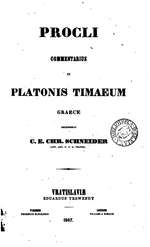
Commentary on Plato's Timaeus
This commentary serves as the definitive architecture of Neoplatonic thought, mapping the procession of all things from the One down to the physical realm. Proclus argues that the universe is not a product of blind chance but a living, ordered image sustained by divine providence. He treats the Tima

Commentary on the Timaeus
Proclus offers a breathtakingly dense metaphysical defense of Plato’s cosmology, positioning the soul as the critical 'middle nature' bridging the eternal and the material. By weaving together Pythagorean mathematics, Orphic theology, and rigorous dialectic, he argues that the cosmos is not a random

Plotini Opera Omnia cum Ficini commentariis
Plotini Opera Omnia represents the pinnacle of Neoplatonic thought, blending the original 3rd-century mystical insights of Plotinus with the intellectual fire of the Renaissance philosopher Marsilio Ficino. This text serves as a rigorous bridge between the classical logic of Plato and the burgeoning

Proclus: Commentary on Plato's Timaeus

Commentary on Plato's Timaeus, Vol. I
Proclus’s commentary on the Timaeus represents the pinnacle of Neoplatonic cosmology, offering a rigorous metaphysical map of the sensible world. He argues that the universe is not a chaotic assembly of matter, but a unified organism positioned between the eternal and the temporal through the 'middl

Commentary on Plato's Timaeus, Volume II
Ernst Diehl’s landmark edition of Proclus’ commentary is more than a philological triumph; it is a gateway to the ancient world’s most sophisticated interpretation of cosmic origins. By tracing the 'genealogy' of the text through the libraries of Renaissance cardinals and Byzantine scribes, Diehl re

The Enneads of Plotinus Vol. I
The Enneads of Plotinus, translated with poetic intensity by Stephen McKenna, stands as the foundation of Neoplatonism and a bridge between classical Greek logic and Western mysticism. Plotinus offers a bold metaphysical hierarchy—The One, the Intellectual-Principle, and the Soul—arguing that our tr