'Poet, Philosopher, Hierophant': Introducing Porphyry of Tyre
We introduce Porphyry of Tyre, a most prolific Platonist writer and thinker. Come for the Platonist metaphysics, stay for the esoteric reading-strategies, exorcisms, divine possessions, and lost work on the River Styx.
Primary Sources

Proclus in Politiam Platonis . Proklos eis Politeian tou Platonos
In this commentary, the last great Neoplatonist philosopher reconciles the poetic genius of Homer with the rigorous logic of Plato. Proclus argues that myths are not fabrications but deliberate veils for ineffable truths. He maintains that true music and rhythm serve as the structural foundation for

Plotinus . Plotinos . Scilicet Plotini Enneades VI et Maximi Tyrii Dissertationes XI
Plotinus strips away the distractions of the physical world to reveal the singular, transcendent source of all being. The text documents the final philosophical ascent of a man who viewed his own body as a temporary, secondary image. You will encounter arguments that collapse the boundaries between

Philosophical and Literary Miscellany
Vat.gr.2181 is a multi-layered interrogation of the Greek soul, weaving together the technical precision of poetic metrics with the subversive chaos of Old Comedy. Through the works of Aristophanes and the reflections of Porphyry, the manuscript explores the corrupting influence of money on the poli

Commentary on Plato's Timaeus

Commentary on Plato's Timaeus

Commentary on Euclid's Elements

Proclus: Platonic Theology and Elements of Theology
This work defines the hierarchy of the universe through the eyes of one of antiquity's final great thinkers. Proclus argues that reality is not a random collection of objects but a systematic emanation from the One. He explains how human intellect can bridge the gap between mortal limitations and et

Hieroclis Expositio versuum Pythagorae qui aurei dicuntur . Hermes Trismegistus . Adde etiam Hermes Trismegistus, Apuleio interprete
Hierocles provides a rigorous manual for navigating the soul's ascent from material distraction to intellectual clarity. He argues that human suffering is not a divine punishment but a result of our own misalignment with natural law. By practicing nightly self-examination, we can transform the body

Commentaries on Plato's Alcibiades I and Homer's Iliad
This text serves as a manual for the soul to recover its own essence. Proclus rejects the idea that truth is a collection of facts gathered from the outside world. Instead, he insists that philosophy begins when a person realizes their own ignorance and turns away from the shifting opinions of the m

Commentary on Plato's Alcibiades
This commentary provides a rigorous map of the soul's ascent from material obsession to intellectual unity. Proclus challenges the reader to move beyond common opinion by demonstrating that true wisdom requires internal, not external, investigation. He argues that our failures result from a lack of

The Enneads of Plotinus
The 'Plotini Enneades' is the foundational pillar of Neoplatonism, presented here in a historic 1460 copy transcribed by the renowned scribe John Skutariotes. Plotinus offers a transformative perspective on reality, arguing that the material world is but a shadow of the 'Intelligible Realm' and that

On the Mysteries of the Egyptians
This work defends traditional religious practice against the skepticism of philosophers like Porphyry. Iamblichus asserts that the gods are not swayed by human emotions, but rather that rituals align the human soul with a pre-existing divine order. He defines the universe as a singular, living organ

Proclus' Commentary on Plato's Republic (Cambridge, St John's College, MS F.15)
This commentary is not merely an analysis of political theory. It is a guide to the Neoplatonic universe where justice serves as a structural harmony for both the city and the individual soul. Proclus argues that myths are not just stories, but symbolic veils designed to hide profound divine truths

On the Mysteries of the Egyptians, Chaldeans, and Assyrians
Edited and translated by the Renaissance visionary Marsilio Ficino, 'Mysteries of Egypt' brings together the most influential voices of late antiquity—Iamblichus, Porphyry, and Proclus—alongside the mystical revelations of Hermes Trismegistus. The text argues that divine knowledge is not a product o

Platonic Theology, Theological Treatises, and Homilies
This work brings together the cold, clear heights of Proclus’s Neoplatonic hierarchy and the warm, corrective moral vision of John Chrysostom. It refuses to separate the act of knowing God from the act of living for Him. The text argues that the soul is not a passive bystander in existence but a cha

Corpus Hermeticum and Plotinus' Enneads (Cambridge, Trinity College, MS B.9.9)
This rare collection documents the struggle of the human soul to recognize its divine origin while trapped in the sensible world. It presents the Hermetic tradition as an intuitive, performative realization of truth, contrasted against the systematic, dialectical path of Plotinus. The text argues th

Commentary on the First Book of Euclid's Elements
This commentary moves beyond standard textbook explanations to position Euclid as a guide for metaphysical development. Proclus argues that mathematical forms are innate to the soul, acting as a mirror for higher intellectual archetypes. He challenges the reader to look past the visible drawing of a

Enneads (1580 Greek-Latin, Ficino trans.)

The Enneads
The Enneads represents the pinnacle of Neoplatonic thought, a monumental synthesis where logic meets mysticism. Through the lens of Marsilio Ficino’s Renaissance commentary, Plotinus’s work is presented as a 'philosophical bait' designed to lead the intellectual mind toward religious faith through p

The Enneads

Elements of Theology and Physics
Proclus’s 'Elements of Theology and Physics' is a monumental achievement in late classical philosophy, offering a systematic 'More Geometrico' (mathematical style) approach to the nature of existence. By transforming metaphysical inquiry into a series of logical propositions and proofs, Proclus maps

Life of Pythagoras and Sentences on the Intelligibles
Porphyry’s 'Life of Pythagoras and Sentences on the Intelligibles' offers a rare window into the ancient quest for spiritual deification through intellect and discipline. By blending a hagiography of Pythagoras—complete with his rejection of the 'impure' Cylon and his cryptic dietary bans—with a rig

Proclus (Cambridge, Trinity College, MS O.5.11)
This manuscript preserves the rigorous dialectic of one of antiquity’s final great minds. Proclus examines the One not as a physical object, but as the absolute origin and end of every existing thing. He challenges the reader to consider how a source can be responsible for all diversity without beco

On Isis and Osiris
In this treatise, Plutarch rescues Egyptian theology from the twin errors of superstition and skepticism. He argues that myths about dismemberment and divine struggle are not accounts of ancient kings, but symbolic representations of moral and metaphysical forces. By mapping these stories onto the b

The Life of Proclus
This biography documents the transition of Proclus from a brilliant young student to the final great successor of the Athenian Academy. Marinus provides a map of the soul, scaling from basic civic virtues to the heights of theurgic practice and divine communication. He strips away the historical rum

Platonic Theology (Thomas Taylor trans.)
This work functions as a complete, scientific manual for navigating the hierarchy of the universe. Proclus rejects the idea that the divine is beyond our reach; instead, he provides a rigorous path for the human soul to return to its source. Readers will encounter a vision where stars are living bei
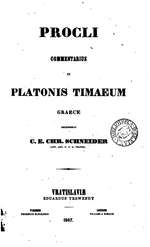
Commentary on Plato's Timaeus
This commentary serves as the definitive architecture of Neoplatonic thought, mapping the procession of all things from the One down to the physical realm. Proclus argues that the universe is not a product of blind chance but a living, ordered image sustained by divine providence. He treats the Tima

Commentary on the Timaeus
Proclus offers a breathtakingly dense metaphysical defense of Plato’s cosmology, positioning the soul as the critical 'middle nature' bridging the eternal and the material. By weaving together Pythagorean mathematics, Orphic theology, and rigorous dialectic, he argues that the cosmos is not a random

The Elements of Theology
The Elements of Theology functions as a rigorous, axiomatic guide to the structure of reality. Proclus assumes that if a first cause exists, all subsequent levels of being must unfold with mathematical necessity. He maps the path from the singular source of all things down to individual souls and ma

Select Works of Porphyry
Select Works of Porphyry offers a rigorous and poetic manual for spiritual transcendence that remains strikingly relevant today. Porphyry presents a radical defense of 'ethical vegetarianism,' arguing that the slaughter of animals is historically and spiritually linked to human warfare and moral dec

Plotini Opera Omnia cum Ficini commentariis
Plotini Opera Omnia represents the pinnacle of Neoplatonic thought, blending the original 3rd-century mystical insights of Plotinus with the intellectual fire of the Renaissance philosopher Marsilio Ficino. This text serves as a rigorous bridge between the classical logic of Plato and the burgeoning

Proclus: Commentary on Plato's Timaeus

Lives of the Sophists and Fragments of the Histories
Eunapius of Sardis provides a defiant look at the fourth century through the lives of men he considers divine. He presents philosophers not as mere academics but as wonder-workers and living libraries who bridged the gap between humanity and the gods. The text combines intimate biographical details

Plutarch's Morals, Vol. 4 (includes Isis and Osiris)
In this compelling volume of 'Morals,' Plutarch investigates the enigmatic mechanics of the 'spirit of divination,' arguing that prophecy is as much a physical phenomenon as it is a divine one. By examining the transformative power of natural vapors and the 'dry' temperament of the soul, he suggests

Three Short Works (including Life of Pythagoras)
This volume, meticulously edited by the legendary August Nauck, preserves the surviving fragments of Porphyry’s most personal and provocative works. At its core, the text challenges the foundations of ancient Greek religion, replacing blood-soaked sacrifices with a philosophy of internal purity and

Commentary on Plato's Timaeus, Vol. I
Proclus’s commentary on the Timaeus represents the pinnacle of Neoplatonic cosmology, offering a rigorous metaphysical map of the sensible world. He argues that the universe is not a chaotic assembly of matter, but a unified organism positioned between the eternal and the temporal through the 'middl

Commentary on Plato's Timaeus, Volume II
Ernst Diehl’s landmark edition of Proclus’ commentary is more than a philological triumph; it is a gateway to the ancient world’s most sophisticated interpretation of cosmic origins. By tracing the 'genealogy' of the text through the libraries of Renaissance cardinals and Byzantine scribes, Diehl re

The Enneads of Plotinus Vol. I
The Enneads of Plotinus, translated with poetic intensity by Stephen McKenna, stands as the foundation of Neoplatonism and a bridge between classical Greek logic and Western mysticism. Plotinus offers a bold metaphysical hierarchy—The One, the Intellectual-Principle, and the Soul—arguing that our tr