Porphyry and the Barbarians: Ethnicity, Religious Practice, and Esoteric Interpretation
Before we get to some observations of Porphyry’s complex and fascinating reception of various ‘nations’ (ethnē) and texts as sources of esoteric wisdom, we take this opportunity to go back to basics a bit, discussing the cultural realities of two important conceptual dichotomies in late antiquity...
Primary Sources

Contra Celsum (1481 editio princeps)
This editio princeps reveals more than a theological argument. It captures the tension between Humanist scholarship and the existential dread caused by the Ottoman advance into Italy. Origen argues that Christianity survives not through the ornate rhetoric of philosophers, but through the lived powe

De Abstinentia ab Esu Animalium Libri Quatuor
This work documents a philosophical stand against the consumption of living creatures. Porphyry argues that meat eating is a departure from natural law and a source of moral corruption. He treats the soul as a prisoner of bodily indulgence, suggesting that a simple diet is the only key to true freed

The Iliad and the Odyssey
This document offers a startlingly original perspective on Homer’s foundational works by weaving technical bibliographical analysis into the social fabric of 1990 Zurich. While the text provides meticulous collation notes that deconstruct the physical signatures of the Greek-Latin edition, it simult

Ecclesiastical History

On Abstinence from Animal Food
In this seminal Neoplatonist treatise, Porphyry argues that the consumption of meat is a spiritual anchor that binds the human soul to material distraction. By refuting the anthropocentric claims of the Stoics and Epicureans, he posits that animals possess reason, sensation, and a share in the 'comm

Enneads (1580 Greek-Latin, Ficino trans.)

The Enneads

Origen Philocalia (Greek)
In this definitive collection edited by William Spencer, readers encounter the first great synthesis of Greek philosophy and Christian theology. Origen does not merely rebut charges of magic and sedition; he builds a comprehensive metaphysical framework that justifies 'simple faith' as a moral medic

Orphica
Gottfried Hermann does not offer a polished myth but a raw, confrontational look at how we inherit the ancient past. He forces the reader to confront the reality that many famous works were misattributed, patched together, or distorted by centuries of scribal error. The text exposes the vanity of th

The Chronicle of Eusebius, Vol. 1
This volume presents the first complete recovery of the Eusebian Chronicle from a preserved Armenian manuscript. It corrects the errors of Western scholars like Scaliger, who relied on guesswork and fabricated fragments. The text bridges the gap between pagan mythology and biblical genealogy by plac

Select Works of Porphyry
Select Works of Porphyry offers a rigorous and poetic manual for spiritual transcendence that remains strikingly relevant today. Porphyry presents a radical defense of 'ethical vegetarianism,' arguing that the slaughter of animals is historically and spiritually linked to human warfare and moral dec

Plotini Opera Omnia cum Ficini commentariis
Plotini Opera Omnia represents the pinnacle of Neoplatonic thought, blending the original 3rd-century mystical insights of Plotinus with the intellectual fire of the Renaissance philosopher Marsilio Ficino. This text serves as a rigorous bridge between the classical logic of Plato and the burgeoning

On the Chaldean Oracles
In 'De oraculis Chaldaicis', Wilhelm Kroll performs a masterclass in philological detective work, reconstructing the lost fragments of a text that Neoplatonists like Proclus considered more authoritative than Plato himself. This work navigates the high-stakes tension between rigorous historical crit

Church History (Historia Ecclesiastica)
Eusebius of Caesarea’s 'Church History' is far more than a simple chronicle; it is a monumental work of historiography that provides the primary scaffolding for our understanding of early Christianity. In this definitive GCS edition, readers encounter a sophisticated blend of textual criticism, regn

The Chaldaean Oracles
G.R.S. Mead brings to life one of the most mysterious and influential texts of late antiquity, bridging the gap between Hellenic philosophy and Eastern mysticism. Through his unique Gnostic-leaning perspective, Mead decodes the cryptic Oracles to describe a universe governed by 'Iynges' (divine whir

Theurgia, or The Egyptian Mysteries (includes Letter to Anebo)
Theurgia presents a heated debate between the philosopher Porphyry and the Egyptian priest Abammon. Porphyry challenges the logic of rituals and the nature of gods who seem subject to human commands. Abammon retorts that divine knowledge is innate and that theurgy is not about changing the gods, but

The Enneads of Plotinus Vol. I
The Enneads of Plotinus, translated with poetic intensity by Stephen McKenna, stands as the foundation of Neoplatonism and a bridge between classical Greek logic and Western mysticism. Plotinus offers a bold metaphysical hierarchy—The One, the Intellectual-Principle, and the Soul—arguing that our tr
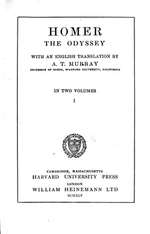
The Odyssey, Books 1-12
This epic poem serves as the bedrock of Western storytelling by defining the hero as a man of many wiles. It confronts the brutal realities of war, the fragility of the household, and the desperate human need for home. The text challenges the reader to distinguish between divine fate and mortal foll

Orphic Fragments
Otto Kern reconstructs the fragmented legacy of Orpheus to reveal the evolution of Greek religious thought. The text examines the historical validity of Orpheus while documenting his influence on figures like Pythagoras and Plato. It presents a radical theology where the creator Phanes is swallowed