From Mystery to 'Mysticism'
Primary Sources

Physics, Metaphysics, and Ethics
This text serves as the foundation for Western natural philosophy by demanding that we identify the 'why' behind every phenomenon. Aristotle rejects the idea that the universe results from random chance. He argues that nature operates with clear purpose and that every change requires a specific caus

Proclus in Politiam Platonis . Proklos eis Politeian tou Platonos
In this commentary, the last great Neoplatonist philosopher reconciles the poetic genius of Homer with the rigorous logic of Plato. Proclus argues that myths are not fabrications but deliberate veils for ineffable truths. He maintains that true music and rhythm serve as the structural foundation for

Aristotle (Cambridge, University Library, MS Add. 1732)
Aristotle argues here that the universe is finite, ordered, and governed by natural laws that leave no room for the random or the infinite. He rejects the idea of a chaotic cosmos, insisting that everything from the path of a comet to the development of an embryo follows a predictable, purposeful de

Commentary on Plato's Timaeus

Commentary on Plato's Timaeus

Commentary on Euclid's Elements

Proclus: Platonic Theology and Elements of Theology
This work defines the hierarchy of the universe through the eyes of one of antiquity's final great thinkers. Proclus argues that reality is not a random collection of objects but a systematic emanation from the One. He explains how human intellect can bridge the gap between mortal limitations and et

Commentary on Plato's Alcibiades
This commentary provides a rigorous map of the soul's ascent from material obsession to intellectual unity. Proclus challenges the reader to move beyond common opinion by demonstrating that true wisdom requires internal, not external, investigation. He argues that our failures result from a lack of

Proclus' Commentary on Plato's Republic (Cambridge, St John's College, MS F.15)
This commentary is not merely an analysis of political theory. It is a guide to the Neoplatonic universe where justice serves as a structural harmony for both the city and the individual soul. Proclus argues that myths are not just stories, but symbolic veils designed to hide profound divine truths

On the Mysteries of the Egyptians, Chaldeans, and Assyrians
Edited and translated by the Renaissance visionary Marsilio Ficino, 'Mysteries of Egypt' brings together the most influential voices of late antiquity—Iamblichus, Porphyry, and Proclus—alongside the mystical revelations of Hermes Trismegistus. The text argues that divine knowledge is not a product o

Proclus, Theologia Platonica; Michael Psellos
This essential exploration of Neoplatonic thought bridges the gap between Platonic philosophy and the mystical traditions of Orpheus and the Chaldeans. Proclus and Psellos argue that the universe is not a random collection of matter, but a sophisticated hierarchy governed by the interplay of 'Limit'
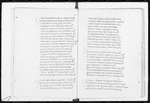
Orphic and Homeric Hymns
This remarkable collection offers an intimate look at the intersection of ancient Greek theology, ritual practice, and poetic tradition. By weaving together the Orphic perspective on cosmogony with the Homeric celebration of divine exploits, the text presents a world where every natural force—from t

Elements of Theology and Physics
Proclus’s 'Elements of Theology and Physics' is a monumental achievement in late classical philosophy, offering a systematic 'More Geometrico' (mathematical style) approach to the nature of existence. By transforming metaphysical inquiry into a series of logical propositions and proofs, Proclus maps

The Mystical Initiations; or, Hymns of Orpheus
This volume is an act of defiance against the modern reduction of religion to mere history or folklore. Taylor argues that the Greek theological tradition is a coherent, scientific approach to reality that utilizes polytheism to express the hierarchy of a single, unified source. By translating these

Sallust on the Gods and the World; Proclus Hymns
Sallustius and Proclus present a rigorous framework for Neoplatonic theology. They argue that the world is an eternal expression of divine goodness, where evil acts only as a shadow caused by a lack of light. By practicing virtue and engaging with symbolic myths, the individual can escape the cycle

Orphica
Gottfried Hermann does not offer a polished myth but a raw, confrontational look at how we inherit the ancient past. He forces the reader to confront the reality that many famous works were misattributed, patched together, or distorted by centuries of scribal error. The text exposes the vanity of th

Platonic Theology (Thomas Taylor trans.)
This work functions as a complete, scientific manual for navigating the hierarchy of the universe. Proclus rejects the idea that the divine is beyond our reach; instead, he provides a rigorous path for the human soul to return to its source. Readers will encounter a vision where stars are living bei

The Elements of Theology
The Elements of Theology functions as a rigorous, axiomatic guide to the structure of reality. Proclus assumes that if a first cause exists, all subsequent levels of being must unfold with mathematical necessity. He maps the path from the singular source of all things down to individual souls and ma

Complete Works of Aristotle

Complete Works of Aristotle (Aristotelis Opera Omnia)
Aristotle’s 'Rhetoric' is far more than a manual for oratory; it is a profound exploration of human psychology and the ethical foundations of social life. By defining rhetoric as the counterpart to dialectic, Aristotle elevates persuasion from mere emotional manipulation to a structured art based on

Proclus: Commentary on Plato's Timaeus

Orphica (Abel Edition, with Proclus Hymns & Hymn to Isis)
Eugen Abel reconstructs the Orphic tradition by stripping away centuries of editorial clutter. He aligns fragmented myths and hymns into a logical sequence, transforming obscure lore into a cohesive theological system. The text argues that music, ritual, and language possess the power to move mounta
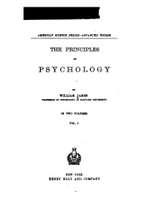
The Principles of Psychology (Vol. I)
This text treats the mind as a subject of observable, biological reality rather than metaphysical speculation. James rejects the idea of a ghost in the machine and instead explores how brain physiology dictates our behavior, memory, and sense of self. He argues that our consciousness is not a static
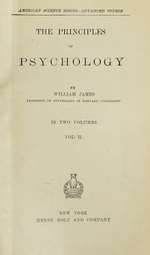
The Principles of Psychology (Vol. II)

Works of Aristotle (Vol. 2)
This text provides a direct look at Aristotle's natural philosophy as he connects the material world to human behavior. He argues that plants, animals, and humans follow consistent physical laws governed by heat, moisture, and motion. By examining everything from the optics of shadows to the mechani

William James Varieties of Religious Experience (1902)
In this seminal work, William James discards abstract formulas in favor of the 'living facts' of human experience, arguing that the true heart of religion lies not in institutions, but in the individual's inner life. Originally delivered as the prestigious Gifford Lectures, James’s study revolutioni

The Varieties of Religious Experience
The Varieties of Religious Experience remains a landmark work because it treats the 'inner life' of faith with the rigor of a scientist and the empathy of a philosopher. William James challenges the 'medical materialists' of his day by arguing that the value of a spiritual experience should be judge

Orphic Fragments
Otto Kern reconstructs the fragmented legacy of Orpheus to reveal the evolution of Greek religious thought. The text examines the historical validity of Orpheus while documenting his influence on figures like Pythagoras and Plato. It presents a radical theology where the creator Phanes is swallowed