Soul-Flight, Noetic Bodies, and Pneumatic Vehicles: Toward a History of the Platonist Subtle Body
Turning from the general, theoretical concerns of the previous episode, we dive into the evidence for subtle-body theories in antiquity.
Primary Sources

The Complete Works of Plato Translated by Marsilio Ficino
This collection serves as a portal to the mind of Plato as seen through the eyes of one of the 15th century's most influential thinkers. Ficino treats philosophy not as a sterile academic exercise but as a medicine for the soul. He constructs an argument for the harmony between pagan wisdom and Chri

On Kingship; On Dreams
This collection captures the volatile intersection of Neoplatonic thought and late Roman political catastrophe. Synesius refuses to separate his intellectual life from the grim realities of governing a crumbling province. He employs everything from sharp political satire to intricate theological myt

The Complete Works of Plato
This monumental edition of Plato’s *Opera Omnia* is more than a translation; it is a sacred bridge between Greek antiquity and Renaissance humanism, curated by Marsilio Ficino to harmonize philosophy with divine religion. Within these pages, readers will find the 'divine' Plato—a thinker who argues

De operatione daemonum
De operatione daemonum offers a rare glimpse into the medieval Byzantine mind, where philosophy and the supernatural were inextricably linked. While the 11th-century monk Michael Psellus provides the eerie subject matter, this edition’s editor, Jean-François Boissonade, presents a bold defense of "b

Enneads (1580 Greek-Latin, Ficino trans.)

The Complete Works of the Divine Plato
This 1590 edition of Plato’s 'Complete Works' serves as a spiritual and intellectual map of the human condition, viewed through the transformative Neoplatonic lens of Marsilio Ficino. Synthesizing classical dialectic with religious piety, the text argues that the ultimate end of man is to achieve a

Complete Works Vol. I (Opera Omnia)
This volume serves as a radical manifesto for empirical medicine. Galen argues that health is a fragile balance maintained against a volatile environment, where celestial shifts and weather patterns directly dictate the onset of pestilence. He dismantles the errors of his contemporaries, insisting t

Plato Euthyphro, Apology, Crito, Phaedo, Phaedrus
Plato documents the final days of his teacher, Socrates, as he confronts a city that wants him dead. The text moves from the courtroom to the prison cell, eventually shifting into deep metaphysical inquiry. It argues that philosophy is nothing less than the practice of dying. By rejecting passive wr

Iamblichus' Life of Pythagoras
This biography moves beyond the historical man to capture the legend of a teacher who viewed philosophy as a total way of life. Iamblichus details the rigorous discipline required to align the human soul with the structure of the cosmos. Readers encounter a curriculum that treats music, diet, and si
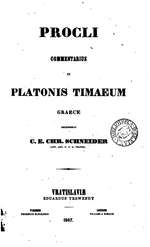
Commentary on Plato's Timaeus
This commentary serves as the definitive architecture of Neoplatonic thought, mapping the procession of all things from the One down to the physical realm. Proclus argues that the universe is not a product of blind chance but a living, ordered image sustained by divine providence. He treats the Tima

On the Mysteries (Thomas Taylor trans.)
In this foundational work of Neoplatonic thought, Iamblichus (writing as the Egyptian priest Abammon) offers a powerful rebuttal to the idea that religion is merely a human invention or a series of emotional delusions. By framing divine knowledge as an innate, eternal part of the soul's essence that

Complete Works of Aristotle

Plotini Opera Omnia cum Ficini commentariis
Plotini Opera Omnia represents the pinnacle of Neoplatonic thought, blending the original 3rd-century mystical insights of Plotinus with the intellectual fire of the Renaissance philosopher Marsilio Ficino. This text serves as a rigorous bridge between the classical logic of Plato and the burgeoning

Complete Works of Aristotle (Aristotelis Opera Omnia)
Aristotle’s 'Rhetoric' is far more than a manual for oratory; it is a profound exploration of human psychology and the ethical foundations of social life. By defining rhetoric as the counterpart to dialectic, Aristotle elevates persuasion from mere emotional manipulation to a structured art based on
On Music
'De Musica' serves as a vital bridge to the forgotten sonic landscapes of antiquity, offering a rare glimpse into the 'nomic' laws that once dictated the structure of every Greek melody. This edition, curated by Richard Volkmann, presents the bold claim that ancient music was a sophisticated tool fo

In Aristotelis Physicorum Libros Commentaria
This work is a massive intellectual rescue mission. Simplicius gathers the fragments of pre-Socratic thought, the critiques of the Academy, and the logical rigor of the Lyceum to build a unified system of natural philosophy. He tackles why we can know the physical world and how motion, time, and the

Timaeus (Greek text with commentary)
R.D. Archer-Hind’s edition of the Timaeus offers a radical reinterpretation of Plato’s later philosophy, arguing that this dialogue represents the culmination of Platonic metaphysics where the dualism of mind and matter is finally resolved. By identifying Being with a Universal Mind, the text presen

Phaedo
The Phaedo captures the final conversation of a man facing his own execution with absolute calm. Socrates argues that the philosopher spends their entire life preparing for death because the body acts as a prison for the truth. He maintains that true knowledge belongs only to the soul, which must ev

Natural and Moral Questions, On Fate, On the Soul
In these pages, Alexander moves beyond mere commentary to defend the reality of human choice against the crushing weight of determinism. He argues that if every event is necessitated by a prior cause, the very idea of possibility loses its meaning. Readers will find a rigorous, logical defense of th

On the Chaldean Oracles
In 'De oraculis Chaldaicis', Wilhelm Kroll performs a masterclass in philological detective work, reconstructing the lost fragments of a text that Neoplatonists like Proclus considered more authoritative than Plato himself. This work navigates the high-stakes tension between rigorous historical crit

The Republic
Most people act justly only because they fear the consequences of getting caught. Plato guts this assumption by creating a theoretical city where justice is defined not by laws, but by the internal harmony of the individual soul. He argues that political stability requires rulers who hate power and

Works of Plato (Republic, Timaeus, Critias)
Plato, the architect of Western philosophy, invites readers into a series of intellectual battles that remain startlingly modern. In these pages, he dismantles the cynical view that 'might makes right' and proposes a revolutionary vision of an ideal state where gender is no barrier to leadership and

Commentary on Plato's Timaeus, Vol. I
Proclus’s commentary on the Timaeus represents the pinnacle of Neoplatonic cosmology, offering a rigorous metaphysical map of the sensible world. He argues that the universe is not a chaotic assembly of matter, but a unified organism positioned between the eternal and the temporal through the 'middl

Works (Laws, Definitions)

The Rhetoric, Poetic, and Nicomachean Ethics of Aristotle
In this essential pillar of Western philosophy, Aristotle argues that happiness (Eudaimonia) is not a passive feeling but an active 'energy of the soul' guided by virtue. He makes the bold claim that we are not born virtuous; rather, we become what we repeatedly do, carving our character through the

The Chaldaean Oracles
G.R.S. Mead brings to life one of the most mysterious and influential texts of late antiquity, bridging the gap between Hellenic philosophy and Eastern mysticism. Through his unique Gnostic-leaning perspective, Mead decodes the cryptic Oracles to describe a universe governed by 'Iynges' (divine whir
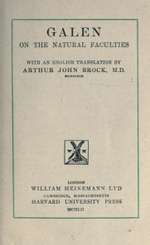
On the Natural Faculties
In this seminal work, Galen of Pergamon bridges the gap between medicine and philosophy to define the very essence of biological life. He rejects the 'dead' physics of the atomists—who viewed the body as a machine of unchanging particles—in favor of a 'Nature' that acts as an internal artisan. Throu

Chronographia (Michael Psellus)
The Chronographia is a rare historical record where the author is both a high-ranking official and a trained philosopher. Psellus strips away the formal mask of the Byzantine court to reveal the raw human impulses driving the state. He documents the shift from the rigid, ascetic militarism of Basil

Generation of Animals
This work moves beyond mere observation to define the mechanics of life through the lens of causality. Aristotle argues that nature acts with intent, directing matter toward a fully formed individual. He proposes that the male contributes the formative movement while the female provides the material