Esoteric Hermeneutics, Divine Hierarchy, and the Ineffable: The Philosophy of Iamblichus, Part I
In this episode, part one of two, we begin to explore the philosophy of Iamblichus. We begin with an account of his influential formation of an Aristotelean/Platonic curriculum and his theory of a ‘target’ (skopos) of each Platonic dialogue.
Primary Sources

Commentary on Plato's Timaeus

Commentary on Plato's Timaeus
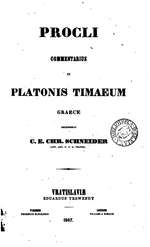
Commentary on Plato's Timaeus
This commentary serves as the definitive architecture of Neoplatonic thought, mapping the procession of all things from the One down to the physical realm. Proclus argues that the universe is not a product of blind chance but a living, ordered image sustained by divine providence. He treats the Tima

Commentary on the Timaeus
Proclus offers a breathtakingly dense metaphysical defense of Plato’s cosmology, positioning the soul as the critical 'middle nature' bridging the eternal and the material. By weaving together Pythagorean mathematics, Orphic theology, and rigorous dialectic, he argues that the cosmos is not a random

Problems Concerning First Principles
This text documents the final stand of the Platonic school against the encroaching silence of history. Damascius argues that any attempt to label or define the First Principle inevitably degrades it into a mere thing among many. He posits that the absolute must exist beyond Being and Unity to remain

Problems and Solutions Concerning First Principles, Volume 1
This text provides a front-row seat to the intellectual collapse of a dying tradition and the rigorous brilliance that accompanied it. Damascius argues that human reason is inherently inadequate when it tries to define the first principle, yet he maps the process of causality with unmatched precisio

Problems and Solutions Concerning First Principles, Volume 3
As the final leader of the Athenian Neoplatonic school, Damascius faces the impossible task of defining the source of all things. He argues that any description of the first principle inevitably limits it, as language requires duality and separation. The text rejects the simple labels used by his pr

Commentary on Plato's Timaeus, Vol. I
Proclus’s commentary on the Timaeus represents the pinnacle of Neoplatonic cosmology, offering a rigorous metaphysical map of the sensible world. He argues that the universe is not a chaotic assembly of matter, but a unified organism positioned between the eternal and the temporal through the 'middl

Commentary on Plato's Timaeus, Volume II
Ernst Diehl’s landmark edition of Proclus’ commentary is more than a philological triumph; it is a gateway to the ancient world’s most sophisticated interpretation of cosmic origins. By tracing the 'genealogy' of the text through the libraries of Renaissance cardinals and Byzantine scribes, Diehl re