The 'Greater Kinds', Souls, and Kosmos: Iamblichus' Philosophy, Part II
Primary Sources

Commentary on Plato's Timaeus

Commentary on Plato's Timaeus

On the Mysteries
In this masterwork of Neoplatonic synthesis, Marsilio Ficino navigates the treacherous waters between Epicurean indulgence and Stoic austerity. He argues that the human soul is not merely a passenger in the body, but an indivisible spark capable of transforming physical sensation into intellectual '

On the Mysteries of the Egyptians
This work defends traditional religious practice against the skepticism of philosophers like Porphyry. Iamblichus asserts that the gods are not swayed by human emotions, but rather that rituals align the human soul with a pre-existing divine order. He defines the universe as a singular, living organ

On the Mysteries of the Egyptians, Chaldeans, and Assyrians
Edited and translated by the Renaissance visionary Marsilio Ficino, 'Mysteries of Egypt' brings together the most influential voices of late antiquity—Iamblichus, Porphyry, and Proclus—alongside the mystical revelations of Hermes Trismegistus. The text argues that divine knowledge is not a product o

The Divine Pymander, Asclepius, and On the Mysteries
This monumental synthesis of Hermetic and Neoplatonic thought offers a radical roadmap for the soul’s ascent from the sensory 'multitude' to the intellectual 'One.' By weaving together the revelations of Hermes Trismegistus with the rigorous defenses of Iamblichus and the metaphysical depth of Procl

Pymander. Asclepius. On the Mysteries of the Egyptians. On Plato's Alcibiades, on the Soul and the Daemon. On Sacrifice.
This seminal volume brings together the core texts of the Hermetic and Neoplatonic traditions, asserting a unified lineage of 'ancient theology' (Prisca Theologia) that flows from Hermes Trismegistus to Plato. Readers will encounter bold claims about the human condition: that we are 'twofold' beings

On the Mysteries of the Egyptians - Pimander - Asclepius
This volume serves as a primary manual for understanding the mechanics of theurgy and the nature of the soul. It moves beyond simple philosophy to outline how ritual acts as a bridge between the mortal realm and the intelligible world. The authors argue that the soul is not a prisoner of the body bu

On the Mysteries (De Mysteriis)
This volume presents the definitive Neoplatonic defense of ritual as a tool for spiritual transformation. It shifts the focus from mere intellectual debate to the practical application of sacred symbols. Iamblichus posits that man exists as a unique bridge between the material and the eternal. The t
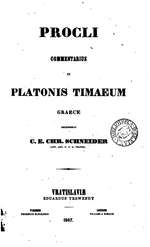
Commentary on Plato's Timaeus
This commentary serves as the definitive architecture of Neoplatonic thought, mapping the procession of all things from the One down to the physical realm. Proclus argues that the universe is not a product of blind chance but a living, ordered image sustained by divine providence. He treats the Tima

Commentary on the Timaeus
Proclus offers a breathtakingly dense metaphysical defense of Plato’s cosmology, positioning the soul as the critical 'middle nature' bridging the eternal and the material. By weaving together Pythagorean mathematics, Orphic theology, and rigorous dialectic, he argues that the cosmos is not a random

On the Mysteries (Thomas Taylor trans.)
In this foundational work of Neoplatonic thought, Iamblichus (writing as the Egyptian priest Abammon) offers a powerful rebuttal to the idea that religion is merely a human invention or a series of emotional delusions. By framing divine knowledge as an innate, eternal part of the soul's essence that

On the Months
This text operates as a bridge to a vanished intellectual era. Lydus compiles fragments from sources now lost to time, organizing them into a map of the Roman year. He treats time as a physical and spiritual architecture, connecting the simple act of marking days to Pythagorean number theory and the

Commentary on Plato's Timaeus, Vol. I
Proclus’s commentary on the Timaeus represents the pinnacle of Neoplatonic cosmology, offering a rigorous metaphysical map of the sensible world. He argues that the universe is not a chaotic assembly of matter, but a unified organism positioned between the eternal and the temporal through the 'middl

Commentary on Plato's Timaeus, Volume II
Ernst Diehl’s landmark edition of Proclus’ commentary is more than a philological triumph; it is a gateway to the ancient world’s most sophisticated interpretation of cosmic origins. By tracing the 'genealogy' of the text through the libraries of Renaissance cardinals and Byzantine scribes, Diehl re

The Eighth Book of Moses
The Eighth Book of Moses is a masterpiece of Greco-Egyptian syncretism, blending Hebrew tradition with Hermetic ritual to present a unique vision of divine creation and human empowerment. At its heart lies a startling cosmogony: a deity whose laughter creates light, water, and the soul itself. The t