Politics and Religion in Late Antiquity, Part II: The Rise of Christianity and the Invention and Eclipse of 'Paganism'
We dive into the history of late-antique Rome from the perspective of Jews, Christians, ‘pagans’, ‘heretics’, and others vis à vis the Roman state, and give some partial explanations for how the ‘impossible’ happened, and the Empire became the Christian Empire.
Primary Sources

The Four Gospels
The text transforms the Gospel accounts into a structured path for spiritual development. It presents the Incarnation not just as history, but as a living reality that demands total commitment from the believer. The anonymous author insists that true knowledge requires a reciprocal relationship wher

Gregory of Nazianzus, Basil of Caesarea and John Chrysostom (Cambridge, University Library, MS Nn.1.23)
Readers encounter the sharp, combative, and deeply spiritual arguments of Gregory of Nazianzus, Basil of Caesarea, and John Chrysostom. These thinkers reject the cold precision of heretical philosophy in favor of a faith that embraces what the human mind cannot map. They argue that the union of divi

Origen, Homiliae in Psalmos (29 homilies, discovered 2012)
These homilies represent a rare direct encounter with Origen's preaching voice. He treats the Psalms not as ancient poetry, but as a map for internal warfare and divine union. The text challenges the reader to categorize their own thoughts and desires as either fleeting shadows or eternal seeds. Ori

Contra Celsum (1481 editio princeps)
This editio princeps reveals more than a theological argument. It captures the tension between Humanist scholarship and the existential dread caused by the Ottoman advance into Italy. Origen argues that Christianity survives not through the ornate rhetoric of philosophers, but through the lived powe

The Nevv Testament of Iesus Christ (Douay-Rheims, 1582)

Origen Philocalia (Greek)
In this definitive collection edited by William Spencer, readers encounter the first great synthesis of Greek philosophy and Christian theology. Origen does not merely rebut charges of magic and sedition; he builds a comprehensive metaphysical framework that justifies 'simple faith' as a moral medic

Erasmus: New Testament with Greek Text and Annotations
A text by Desiderius Erasmus. About the author (Desiderius Erasmus): Desiderius Erasmus Roterodamus, commonly known in English as Erasmus of Rotterdam or simply Erasmus, was a Dutch humanist, Christian theologian, and pioneering p...

On the Magistrates of the Roman Republic
John Lydus offers an unparalleled insider’s view of the Roman Praetorian Prefecture, bridging the gap between the mythic origins of Romulus and the bureaucratic decay of the Justinianic era. Through a blend of etymology, history, and personal memoir, Lydus traces the evolution of magistracies from t

On the Months
This text operates as a bridge to a vanished intellectual era. Lydus compiles fragments from sources now lost to time, organizing them into a map of the Roman year. He treats time as a physical and spiritual architecture, connecting the simple act of marking days to Pythagorean number theory and the

Complete Works XVIII: Against Celsus I-IV (Lommatzsch)
In 'Contra Celsum I-IV,' Origen provides a groundbreaking response to the first major intellectual assault on Christianity. Rather than relying solely on tradition, Origen deconstructs Greek mythology as morally bankrupt while elevating the historical and ethical superiority of the Mosaic law and th

Lives of the Sophists and Fragments of the Histories
Eunapius of Sardis provides a defiant look at the fourth century through the lives of men he considers divine. He presents philosophers not as mere academics but as wonder-workers and living libraries who bridged the gap between humanity and the gods. The text combines intimate biographical details

Codex Vaticanus: Novum Testamentum Graece
The Codex Vaticanus serves as the bedrock of modern textual criticism. By providing the Greek text alongside a record of the fierce academic struggle to translate and verify it, this book exposes the high stakes of biblical scholarship in the 19th century. Mai’s work confronts the reader with the ra
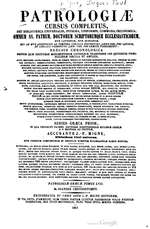
Patrologia Graeca vol. 57: John Chrysostom on Matthew I
This volume moves past academic debate to show how early Christians applied the life of Christ to their own messy reality. Chrysostom argues that the Gospel provides a universal path to holiness that is accessible to everyone, not just monks or philosophers. He dissects the genealogy of Jesus and th

Greek New Testament (Novum Testamentum Graece)
This edition represents the culmination of Tischendorf's life work in biblical textual criticism. He argues that the standard biblical texts of his time were based on relatively recent and flawed manuscripts. By prioritizing the oldest uncial codices, including his own discovery of Codex Sinaiticus,

New Testament in Syriac (Peshitta)
The New Testament in Syriac (Peshitta) is more than a translation; it is a scholarly monument and a spiritual treasure of the Early Church. Published by the British and Foreign Bible Society, this text presents the revised scholarship of G.H. Gwilliam alongside unique Syriac 'Discourses' and 'Tablet

Codex Sinaiticus: New Testament (Facsimile)
This monumental work offers more than a simple reproduction; it is a meticulous investigation into the physical and historical DNA of the Christian scriptures. Kirsopp and Helen Lake navigate the high-stakes world of 19th-century archaeology and palaeography to settle the long-standing debate over w
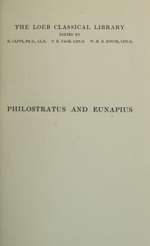
Lives of the Sophists (Philostratus and Eunapius)
Philostratus and Eunapius present a world where language was the ultimate currency. These biographies reveal how public speaking morphed from a civic duty into a high-stakes performance art that granted men wealth, immunity from taxes, and direct access to emperors. The narrative captures the volati

Philostratus and Eunapius: Lives of the Sophists
Philostratus and Eunapius present a world where the ability to improvise a speech was the ultimate currency. These biographies document the transition from classical philosophy to the performative, often arrogant world of the Second Sophistic. Readers encounter figures who balanced immense wealth, c