Thinking through Monotheism, Henotheism, Polytheism, and Dualism in Late Antiquity
In the last of our somewhat-abstract, concept-riddled wide-angle approaches to late antiquity at the end of the third century CE, we discuss some of the more important -theisms of the era: mono-, heno-, and poly-, with a special bonus section looking at dualism in religion in theory and practice.
Primary Sources

The Hermetic Corpus
Ott.lat.2074 is a breathtaking intellectual odyssey that bridges the gap between ancient Hermetic mystery and the rigorous structuralism of the Middle Ages. The text presents a world where the 'First Cause' is pursued through every available lens: the precision of Aristotelian categories, the negati

De Civitate Dei

The Pimander of Hermes Trismegistus
Marsilio Ficino’s translation of the Pimander introduces the concept of Prisca Theologia, the original theology that predates the classical world. The work argues that human beings possess a dual nature: we are physically mortal but spiritually divine. Through dialogues between Hermes and the divine

Contra Celsum (1481 editio princeps)
This editio princeps reveals more than a theological argument. It captures the tension between Humanist scholarship and the existential dread caused by the Ottoman advance into Italy. Origen argues that Christianity survives not through the ornate rhetoric of philosophers, but through the lived powe

The Divine Pymander
The Divine Pymander is a foundational pillar of Hermeticism, offering a visionary exploration of how humanity can transcend the shackles of Fate through Gnosis. Translated by the legendary Marsilio Ficino for the Medici court, this text presents the 'Prisca Theologia'—a primordial wisdom that prefig

Complete Hermetica (1505 Paris Edition)
The Complete Hermetica (1505 Paris Edition) is a profound synthesis of Western esotericism, offering a transformative vision of humanity’s place in the cosmos. Through the legendary dialogues of Hermes Trismegistus, the text argues that ignorance is the ultimate plague of the soul, while true knowle

On Nature and Grace and On the Spirit and the Letter
In this definitive defense of Divine Grace, Augustine of Hippo confronts the bold Pelagian claim that human nature is inherently capable of sinlessness. He argues that while humanity was created good, original sin has left the race as a 'mass of perdition,' unable to achieve righteousness without th
De spiritu et litera liber unus

On Faith and Works
In 'De fide et operibus' (On Faith and Works), Aurelius Augustine confronts a controversy that remains strikingly modern: the tension between the grace of baptism and the necessity of moral transformation. He vigorously refutes the notion that the sacrament serves as a 'get out of hell free' card fo

Corpus Hermeticum with Pneumatica and Ocellus Lucanus
This text offers a rare synthesis of ancient mechanical ingenuity and the esoteric search for the divine. From Heron’s groundbreaking theories on the vacuum—which prefigure modern atomic theory—to Hermes Trismegistus’s meditations on the soul's ascent, the volume challenges the modern divide between

The Divine Pymander, Asclepius, and On the Mysteries
This monumental synthesis of Hermetic and Neoplatonic thought offers a radical roadmap for the soul’s ascent from the sensory 'multitude' to the intellectual 'One.' By weaving together the revelations of Hermes Trismegistus with the rigorous defenses of Iamblichus and the metaphysical depth of Procl

Pymander. Asclepius. On the Mysteries of the Egyptians. On Plato's Alcibiades, on the Soul and the Daemon. On Sacrifice.
This seminal volume brings together the core texts of the Hermetic and Neoplatonic traditions, asserting a unified lineage of 'ancient theology' (Prisca Theologia) that flows from Hermes Trismegistus to Plato. Readers will encounter bold claims about the human condition: that we are 'twofold' beings

The Art and Science of the True Proportion of Attic Letters
In 'The Art and Science of the True Proportion of Attic Letters,' Geoffroy Tory reimagines the Roman alphabet as a 'microcosm' of human anatomy and celestial harmony. Rejecting the 'barbaric' scripts of the past, Tory utilizes a rigorous mathematical grid to construct letters that are as morally upr

Corpus Hermeticum and Plotinus' Enneads (Cambridge, Trinity College, MS B.9.9)
This rare collection documents the struggle of the human soul to recognize its divine origin while trapped in the sensible world. It presents the Hermetic tradition as an intuitive, performative realization of truth, contrasted against the systematic, dialectical path of Plotinus. The text argues th

Poimandres
This collection functions as a foundational guide for those seeking to understand the nature of God, the soul, and the cosmos. Hermes Trismegistus argues that the physical world is a veil, and that ignorance of one's own divinity is the ultimate human disaster. The text demands that you reject world

Poimandres
Poimandres is a foundational pillar of Western esotericism that posits humanity as a 'divine animal' caught between the material and the eternal. Purported to be the work of the legendary Hermes Trismegistus—a syncretic fusion of the Greek Hermes and Egyptian Thoth—this tractate offers a radical cos

The Shepherd of Men
Readers will find an argument that the world is a sentient, organized entity governed by divine justice. The author, Hannibal Rosseli, attempts to reconcile classical philosophy with the teachings of the Church. He posits that justice is the defining trait of humanity and that the soul's return to G

Biblical Palimpsest with Inquisition Abjuration Documents
The Hermetic Corpus stands as one of the most provocative syncretic works in history, blending the legendary insights of Hermes Trismegistus with the foundational theology of early Christianity. It makes the bold claim that spiritual liberation is a process of 'gnosis'—a transformation of the mind t

Against Celsus
This 1658 edition presents the definitive intellectual struggle between early Christian thought and pagan philosophy. Origen systematically dismantles the arguments of Celsus by shifting the debate from mere rhetoric to the moral transformation of the human soul. He argues that the life and death of

Complete Works XVIII: Against Celsus I-IV (Lommatzsch)
In 'Contra Celsum I-IV,' Origen provides a groundbreaking response to the first major intellectual assault on Christianity. Rather than relying solely on tradition, Origen deconstructs Greek mythology as morally bankrupt while elevating the historical and ethical superiority of the Mosaic law and th

Complete Works XIX: Against Celsus V-VIII (Lommatzsch)
This work captures a master of Greek logic turning his focus toward his fiercest opponent. Origen refuses to retreat into silence; he dissects every charge Celsus brings against the Christian faith. He tackles the paradox of the incarnation, the validity of biblical allegory, and the nature of human
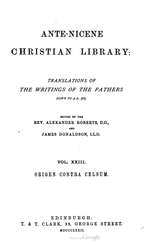
Ante-Nicene Christian Library, Vol. 23: Origen Contra Celsum
This volume captures one of the most significant debates in Western history. Origen faces Celsus, a brilliant pagan critic who attacks the Christian faith as a dangerous, superstitious sect. Origen does not retreat. Instead, he systematically deconstructs the claims of Greek philosophy to show that

Nicene and Post-Nicene Fathers, Series 1, Vol. 1 (Augustine: Confessions, Letters)
Philip Schaff compiles an essential record of the early Church through the eyes of Eusebius, the man who first mapped out Christian history. The text tackles the messy reality of the Arian controversy and the precarious rise of Constantine. It forces you to confront the divide between a faith under

Nicene and Post-Nicene Fathers, Series 1, Vol. 2 (Augustine: City of God, Christian Doctrine)
This volume presents the definitive ecclesiastical histories of Socrates Scholasticus and Sozomen, documenting how Christianity transformed from a persecuted sect into an imperial power. Readers follow the turbulent Arian controversy, where theological debates over the divinity of the Son served as

Origenes: Contra Celsum (Greek Critical Edition)

The Hermetic Writings, Volume I: Texts and Translation
This volume is a monumental reconstruction of the Hermetic tradition, presenting a world where philosophy is not merely an academic exercise but a literal means of deification. Scott challenges the notion that these texts are mere 'occult rubbish,' instead revealing them as the profound response of