Theology, Politics, and Radiant Darkness: Michael Motia on Gregory of Nyssa
We are honoured to have Michæl Motia, scholar of religion, on the podcast to discuss Gregory of Nyssa, one of the most important Christian theologians and the fountainhead of ideas of divine infinity and of divine presence-as-absence-as-presence at the heart of Christian mysticism.
Primary Sources

Greek Old Testament
About the author (Anonymous): Anonymous may refer to:Anonymity, the state of an individual's identity, or personally identifiable information, being publicly unknown Anonymous work, a work of art or literature that has an unnamed or unknown creator or author Anonymity, a property of a voting rule, s

Hebrew Bible
The Hebrew Bible presents a brutal and honest account of humanity attempting to live under the shadow of a demanding deity. It moves from the origins of the cosmos to the intricate rules of social and ritual life. Readers encounter heroes who are deeply flawed and a God whose actions are often as te

Pal.lat.1328
Pal.lat.1328 is a monumental synthesis of Hermetic philosophy and medieval Arabic science, offering a rare glimpse into the systematic pursuit of the Philosopher’s Stone. The text makes the bold claim that alchemy is 'lower astronomy'—a sacred art where metals act as terrestrial stars and volatile s

The Hermetic Corpus
Ott.lat.2074 is a breathtaking intellectual odyssey that bridges the gap between ancient Hermetic mystery and the rigorous structuralism of the Middle Ages. The text presents a world where the 'First Cause' is pursued through every available lens: the precision of Aristotelian categories, the negati

Reg.lat.1352
This manuscript is a monumental synthesis of classical literature and Hermetic philosophy, featuring the voices of Virgil, Servius, Apuleius, and the legendary Hermes Trismegistus. It boldly navigates the transition from the physical world of agriculture and apiculture to the metaphysical realms of

Biblia Sacra (Gutenberg Bible)
This text preserves the Vulgate translation, serving as a monument to the collision between human fallibility and divine authority. Jerome asserts that understanding scripture requires disciplined study rather than casual opinion. You will encounter the foundational narratives of the world, from the

Biblia: Luther Bible (1535)
This 1535 edition of the Biblia represents a seminal moment in Christian history, capturing the work of Martin Luther at the height of his theological influence. As the primary figure of the Protestant Reformation, Luther’s unique perspective as a scholar and former friar transformed the Bible from

The Chaldean Oracles
This text offers a rare, syncretic exploration of Zoroastrian oracles interpreted through the lens of Neoplatonic and Christian thought. It presents a universe structured in three distinct parts—the eternal, the immortal but generated, and the decaying—and positions the human soul as a mediator 'glu

Corpus Hermeticum and Plotinus' Enneads (Cambridge, Trinity College, MS B.9.9)
This rare collection documents the struggle of the human soul to recognize its divine origin while trapped in the sensible world. It presents the Hermetic tradition as an intuitive, performative realization of truth, contrasted against the systematic, dialectical path of Plotinus. The text argues th

Poimandres
This collection functions as a foundational guide for those seeking to understand the nature of God, the soul, and the cosmos. Hermes Trismegistus argues that the physical world is a veil, and that ignorance of one's own divinity is the ultimate human disaster. The text demands that you reject world
Orphic and Homeric Hymns
This remarkable collection offers an intimate look at the intersection of ancient Greek theology, ritual practice, and poetic tradition. By weaving together the Orphic perspective on cosmogony with the Homeric celebration of divine exploits, the text presents a world where every natural force—from t

The Bible

Poimandres
Poimandres is a foundational pillar of Western esotericism that posits humanity as a 'divine animal' caught between the material and the eternal. Purported to be the work of the legendary Hermes Trismegistus—a syncretic fusion of the Greek Hermes and Egyptian Thoth—this tractate offers a radical cos

The Shepherd of Men
Readers will find an argument that the world is a sentient, organized entity governed by divine justice. The author, Hannibal Rosseli, attempts to reconcile classical philosophy with the teachings of the Church. He posits that justice is the defining trait of humanity and that the soul's return to G
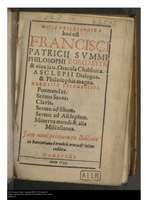
Philosophical Magic: Zoroaster and his 320 Chaldean Oracles
This work reclaims the identity of Zoroaster as a primordial philosopher rather than a mythical figure. Patrizi argues that the cosmos is a divine construction, pulsating with the activity of the Paternal Mind and maintained by the soul. Readers will find a rigorous defense of theurgy as a legitimat

Philosophical Magic: The Chaldean Oracles
This text provides a bridge between ancient pagan theology and the Christian era by asserting that the oldest sages were actually practitioners of a high, holy religion. Patrizi challenges the Aristotelian status quo of his time by arguing that philosophy is inherently tied to theurgy and the animat

Biblical Palimpsest with Inquisition Abjuration Documents
The Hermetic Corpus stands as one of the most provocative syncretic works in history, blending the legendary insights of Hermes Trismegistus with the foundational theology of early Christianity. It makes the bold claim that spiritual liberation is a process of 'gnosis'—a transformation of the mind t

The Five Books of Moses
This monumental work presents the 'Five Books of Moses' as a labor of both divine revelation and scholarly perfection. Correcting over three hundred errors from previous printings, Menasseh ben Israel offers a text designed to 'show the peoples and the princes its beauty.' It traces the cosmic origi

The Holy Bible

On Isis and Osiris
In this treatise, Plutarch rescues Egyptian theology from the twin errors of superstition and skepticism. He argues that myths about dismemberment and divine struggle are not accounts of ancient kings, but symbolic representations of moral and metaphysical forces. By mapping these stories onto the b

The Mystical Initiations; or, Hymns of Orpheus
This volume is an act of defiance against the modern reduction of religion to mere history or folklore. Taylor argues that the Greek theological tradition is a coherent, scientific approach to reality that utilizes polytheism to express the hierarchy of a single, unified source. By translating these

Biblia Sacra Vulgatae: Clementine Vulgate Latin Bible
This 1804 Venice edition of the Biblia Sacra Vulgatae stands as a monument to ecclesiastical history and structural precision. Authorized by the successive mandates of Popes Sixtus V and Clement VIII, this version represents the definitive Sixtine-Clementine standard that shaped Catholic liturgy for

Orphica (Argonautica, Hymni, Lithica)
This volume is not just a poem; it is an argument about how we reconstruct the past. Hermann and Gesner treat the Argonautica and the Lithica as damaged artifacts, using rigorous philology to peel away the layers of corruption added by centuries of scribes. They engage with the Orphic texts to uncov

Astuatsashunch: Armenian Bible, Old Testament (Zohrab)
This edition serves as a corrective to the flawed printing history that plagued the Armenian Bible for generations. Zohrab rejects foreign influences and editorial laziness, opting instead for a systematic collation of ancient manuscripts. He defends the integrity of the Septuagint-based Armenian tr

Armenian Bible, New Testament (Zohrab)
This volume stands as a monument to the Armenian translation tradition, blending ancient linguistic heritage with the editorial care of Hovhannes Zohrab. Zohrab does not merely present a text; he investigates the differences between manuscripts to provide an accurate, corrected reading. He argues th

Orphica
Gottfried Hermann does not offer a polished myth but a raw, confrontational look at how we inherit the ancient past. He forces the reader to confront the reality that many famous works were misattributed, patched together, or distorted by centuries of scribal error. The text exposes the vanity of th

The Holy Bible (Wycliffe), Vol. 1
This edition documents the volatile birth of English biblical translation and the bold reformers behind it. It challenges the historical narrative of the Wycliffite movement by clearly distinguishing between the early and later versions of the text. By analyzing manuscript history and editorial meth

The Holy Bible (Wycliffe), Vol. 2
Wycliffe's translation offers a raw and direct look at the power dynamics between heaven and earth. It does not soften the brutal realities of ancient rule or the intense weight of divine judgment. The text presents history as a series of moral choices where obedience to the unseen God outweighs pol

The Holy Bible (Wycliffe), Vol. 3
John Wycliffe and his followers created this translation to put the uncompromising clarity of scripture directly into the hands of the people. The text strips away human pride to focus on the cold reality of divine judgment and the necessity of personal discipline. It argues that physical beauty and

The Holy Bible (Wycliffe), Vol. 4
John Wycliffe's translation challenges readers to look past religious tradition to find the core authority of Jesus Christ. The text forces a choice between worldly status and the kingdom of heaven, emphasizing faith over legalism. It presents a world where the heart's true state matters more than o

Al-Kitab al-Muqaddas: Arabic Bible
The authors present the Bible in a clear, accessible Arabic that maintains the weight of its original theological claims. By pairing the books of the Bible with a structured index of Quranic Surahs, the work highlights the points of contact between these two great traditions. Readers will encounter

Plutarch's Morals, Vol. 4 (includes Isis and Osiris)
In this compelling volume of 'Morals,' Plutarch investigates the enigmatic mechanics of the 'spirit of divination,' arguing that prophecy is as much a physical phenomenon as it is a divine one. By examining the transformative power of natural vapors and the 'dry' temperament of the soul, he suggests

Orphica (Abel Edition, with Proclus Hymns & Hymn to Isis)
Eugen Abel reconstructs the Orphic tradition by stripping away centuries of editorial clutter. He aligns fragmented myths and hymns into a logical sequence, transforming obscure lore into a cohesive theological system. The text argues that music, ritual, and language possess the power to move mounta

On the Chaldean Oracles
In 'De oraculis Chaldaicis', Wilhelm Kroll performs a masterclass in philological detective work, reconstructing the lost fragments of a text that Neoplatonists like Proclus considered more authoritative than Plato himself. This work navigates the high-stakes tension between rigorous historical crit

Hexaglot Bible: Hebrew, Septuagint, Vulgate, Syriac, English, German, French
Experience the Bible like never before through a monumental six-language parallel edition that bridges ancient manuscripts and modern translations. Discover the intricate genealogy of Jesus Christ by comparing the Hebrew, Septuagint, Vulgate, and Syriac texts side-by-side with modern European master
Clement of Alexandria II: Stromata I-VI
Clement argues that all wisdom originates from a singular divine source. He asserts that Greek philosophy serves as a vital tool for the believer, provided it is treated as a preparation rather than the final destination. The text demands intellectual rigor and warns against the vanity of mere debat

Old Testament in Syriac (Peshitta)
The Peshitta serves as a vital anchor for understanding how early Aramaic-speaking communities received and interpreted the sacred text. Beyond the foundational narratives of Genesis and the Exodus, it integrates mystical and liturgical commentaries that link the physical body to spiritual salvation

Philostratus and Eunapius: The Lives of the Sophists (Loeb)
The Sophists were more than teachers; they were the celebrities of the Roman Empire, capable of swaying crowds and emperors alike with nothing but their voice. Philostratus and Eunapius capture their arrogance, their brilliance, and the intense rivalries that fueled their rise. This text reveals a w

Orphic Fragments
Otto Kern reconstructs the fragmented legacy of Orpheus to reveal the evolution of Greek religious thought. The text examines the historical validity of Orpheus while documenting his influence on figures like Pythagoras and Plato. It presents a radical theology where the creator Phanes is swallowed

The Hermetic Writings, Volume I: Texts and Translation
This volume is a monumental reconstruction of the Hermetic tradition, presenting a world where philosophy is not merely an academic exercise but a literal means of deification. Scott challenges the notion that these texts are mere 'occult rubbish,' instead revealing them as the profound response of