Riddle Me This: Heraclitus of Ephesus
Heraclitus of Ephesus made one well-known contribution to the history of western thought: his dictum that ‘nature loves to hide’ has been cited down the ages by philosophers, alchemists, mystics, and scientists, as the locus classicus of the inherent trickiness of nature, her ability to present o...
Primary Sources

The Chaldean Oracles
This text offers a rare, syncretic exploration of Zoroastrian oracles interpreted through the lens of Neoplatonic and Christian thought. It presents a universe structured in three distinct parts—the eternal, the immortal but generated, and the decaying—and positions the human soul as a mediator 'glu
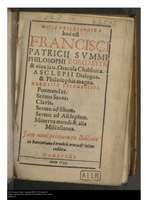
Philosophical Magic: Zoroaster and his 320 Chaldean Oracles
This work reclaims the identity of Zoroaster as a primordial philosopher rather than a mythical figure. Patrizi argues that the cosmos is a divine construction, pulsating with the activity of the Paternal Mind and maintained by the soul. Readers will find a rigorous defense of theurgy as a legitimat

Philosophical Magic: The Chaldean Oracles
This text provides a bridge between ancient pagan theology and the Christian era by asserting that the oldest sages were actually practitioners of a high, holy religion. Patrizi challenges the Aristotelian status quo of his time by arguing that philosophy is inherently tied to theurgy and the animat

On Heraclitus of Ephesus
This work restores the physical reality of Heraclitean philosophy. Dauriac rejects Hegelian attempts to turn the Ephesian into an early dialectician of empty concepts. Instead, he positions Heraclitus as a physicist of the first order who identified fire as the eternal, mobile substance governing al

The Chaldaean Oracles
G.R.S. Mead brings to life one of the most mysterious and influential texts of late antiquity, bridging the gap between Hellenic philosophy and Eastern mysticism. Through his unique Gnostic-leaning perspective, Mead decodes the cryptic Oracles to describe a universe governed by 'Iynges' (divine whir