One Empire, Many Names: Reading 'Byzantium' with Anthony Kaldellis
We are delighted to speak with Anthony Kaldellis about ‘Byzantium’, fabled empire full of Greek-speaking Romans which never fell until the fifteenth century, and which plays an outsize role in the history of western esotericism. Come for the historiographical debates about the term ‘Byzantine’, stay
Primary Sources

Pal.gr.64
In Pal.gr.64, Michael Psellos offers a masterful synthesis of Homeric epic and Byzantine intellectualism. Far more than a mere commentary, this work explores the heavy burden of divine sovereignty and the intricate psychological tensions that drive both gods and men. From the heights of Olympus to t

On Plato and the Chaldaean Oracles
In this profound exploration of Neoplatonic thought, Michael Psellos offers a masterful synthesis of Pythagorean mathematics, music theory, and metaphysical cosmology. By dissecting the 'soul-generation' described in Plato’s Timaeus, Psellos argues that the soul is not a random occurrence but a meti

Proclus, Theologia Platonica; Michael Psellos
This essential exploration of Neoplatonic thought bridges the gap between Platonic philosophy and the mystical traditions of Orpheus and the Chaldeans. Proclus and Psellos argue that the universe is not a random collection of matter, but a sophisticated hierarchy governed by the interplay of 'Limit'

Michael Psellos on Plato's Psychogony and John Kamateros on Astronomy
This manuscript represents a pinnacle of 11th-century Byzantine scholarship, merging the abstract metaphysics of Plato with the concrete precision of ancient astrology. Michael Psellos provides a daring commentary on the soul's composition, arguing that its essence is defined by harmonic ratios that

De operatione daemonum
De operatione daemonum offers a rare glimpse into the medieval Byzantine mind, where philosophy and the supernatural were inextricably linked. While the 11th-century monk Michael Psellus provides the eerie subject matter, this edition’s editor, Jean-François Boissonade, presents a bold defense of "b

On the Virtues of Stones
De Lapidum Virtutibus is a captivating intersection of Byzantine natural philosophy, classical philology, and sympathetic magic. Michael Psellos sidesteps the abstract theorizing of the 'Dogmatists' to offer an empirical catalog of gemstones used to treat ailments ranging from epilepsy to melancholy

Dialogue on the Operation of Daemons
This dialogue moves beyond theological speculation to present demonology as a form of natural science. Psellos claims that demons possess airy, material bodies subject to the same physical laws as animals and humans. He documents how these creatures sustain themselves, why they fear iron, and how th

Michael Psellus on the Operation of Daemons
This text bridges the gap between pagan philosophy and Christian dogma, asserting that demonic presence is an objective reality rather than mere metaphor. Psellus argues that rejecting the existence of demons invalidates the historical accounts of the Gospels. He categorizes these entities by their
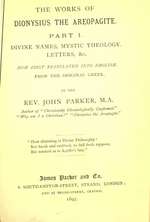
The Works of Dionysius the Areopagite
This corpus challenges the limits of human reason in theology. The author presents a rigorous system where knowledge is not gathered by intellect, but by an ecstatic process of unknowing. He reconciles Greek philosophy with Christian faith by defining reality as a hierarchical flow from a superessen

Chronographia (Michael Psellus)
The Chronographia is a rare historical record where the author is both a high-ranking official and a trained philosopher. Psellus strips away the formal mask of the Byzantine court to reveal the raw human impulses driving the state. He documents the shift from the rigid, ascetic militarism of Basil