The Pseudo-Dionysios, the Esoteric, and (Christian) Mysticism
With a wise silence do we honour the inexpressible.
Primary Sources

The Works of Dionysius the Areopagite
The Works of Dionysius the Areopagite serves as the architectural blueprint for the Christian mystical tradition, blending Neoplatonic philosophy with deep Syriac spirituality. Pseudo-Dionysius boldly identifies God through the primary names of 'Goodness' and 'Love,' presenting a Divinity that is bo

Vat.gr.370
This text provides a framework for understanding the universe as a hierarchical chain of participation in the divine. It argues that God is beyond all essence and reason, yet reveals Himself through symbols that accommodate human limitations. Readers will encounter a rigorous defense of the soul's a

Byzantine Theological Miscellany
The works of Pseudo-Dionysius the Areopagite represent one of the most daring syntheses in history, fusing Neoplatonic philosophy with Christian revelation to define the 'progenitor of apophatic theology.' This collection navigates the profound distinction between God’s unknowable essence and His pa

Pseudo-Dionysius: De Coelesti Hierarchia (c.1300 MS)
Beinecke MS 526 is more than a theological text; it is a physical intersection of medieval philosophy, astronomy, and pan-European craftsmanship. This fragment captures the 'progenitor of apophatic theology,' Pseudo-Dionysius, as he defines the hierarchies of the heavens, a concept that fundamentall

Celestial Hierarchy / Divine Names (Ficino)
This text represents a landmark synthesis of Neoplatonic thought and Christian theology, arguing that God is not a 'being' to be understood, but a 'Good' to be experienced through the Way of Negation. Marsilio Ficino resurrects the cryptic oracles of Pseudo-Dionysius to champion a 'learned ignorance

The Collected Works of Pseudo-Dionysius
This corpus challenges the reader to abandon standard definitions of God in favor of a profound, mystical unknowing. It argues that all visible existence is a symbolic reflection of a transcendent, singular source. The author insists that true spiritual authority is rooted in self-mastery and mercy

The Complete Works of Saint Dionysius the Areopagite
This corpus challenges the limits of human cognition by proposing that we reach God not through logic, but through the deliberate stripping away of all concepts. The author constructs a vision of the universe as a series of sacred ranks, where every creature exists to receive and pass on divine illu

On the Magistrates of the Roman Republic
John Lydus offers an unparalleled insider’s view of the Roman Praetorian Prefecture, bridging the gap between the mythic origins of Romulus and the bureaucratic decay of the Justinianic era. Through a blend of etymology, history, and personal memoir, Lydus traces the evolution of magistracies from t

Pseudo-Dionysius Areopagita Schriften (German 1823)
This volume is a profound gateway into the heart of speculative mysticism, blending the rigors of Neoplatonic philosophy with the fervor of early Christian theology. Readers will encounter a bold re-envisioning of the cosmos where evil is dismissed as a mere 'sham substance' and God is approached no

On the Months
This text operates as a bridge to a vanished intellectual era. Lydus compiles fragments from sources now lost to time, organizing them into a map of the Roman year. He treats time as a physical and spiritual architecture, connecting the simple act of marking days to Pythagorean number theory and the

Lives of the Sophists and Fragments of the Histories
Eunapius of Sardis provides a defiant look at the fourth century through the lives of men he considers divine. He presents philosophers not as mere academics but as wonder-workers and living libraries who bridged the gap between humanity and the gods. The text combines intimate biographical details

The Lexicon of Suidas
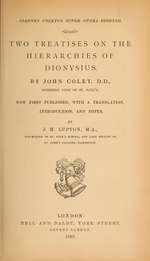
John Colet Two Treatises on the Hierarchies of Dionysius
This text revives the work of an often-overlooked Renaissance humanist who bridged ancient Greek philosophy and Christian theology. Colet contends that human spiritual development follows a path from purgation to illumination and finally to perfection. He claims that current church practices have dr

Pseudo-Dionysius Celestial and Ecclesiastical Hierarchy
In this profound synthesis of Greek philosophy and Christian mysticism, Pseudo-Dionysius—vigorously defended by translator John Parker as the genuine first-century convert of St. Paul—presents a revolutionary vision of the divine order. By exploring the nine choirs of angels and the sacred rituals o
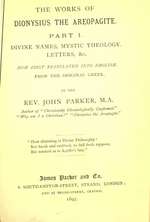
The Works of Dionysius the Areopagite
This corpus challenges the limits of human reason in theology. The author presents a rigorous system where knowledge is not gathered by intellect, but by an ecstatic process of unknowing. He reconciles Greek philosophy with Christian faith by defining reality as a hierarchical flow from a superessen
Nicene and Post-Nicene Fathers, Series 2, Vol. 14 (Seven Ecumenical Councils)
Schaff and Wace gather the authentic acts and canons of the seven ecumenical councils into a single, accessible record. These pages strip away later legends to reveal how early bishops actually handled heresy, clerical conduct, and jurisdictional disputes. The editors maintain a firm focus on histor