Paul Pasquesi on the Book of the Holy Hierotheos
We are delighted to welcome Paul Pasquesi back to the podcast to talk about the Book of the Holy Hierotheos, a little-known and under-studied classic of late-antique Syriac ‘mysticism’.
Primary Sources

The Works of Dionysius the Areopagite
The Works of Dionysius the Areopagite serves as the architectural blueprint for the Christian mystical tradition, blending Neoplatonic philosophy with deep Syriac spirituality. Pseudo-Dionysius boldly identifies God through the primary names of 'Goodness' and 'Love,' presenting a Divinity that is bo

Vat.gr.370
This text provides a framework for understanding the universe as a hierarchical chain of participation in the divine. It argues that God is beyond all essence and reason, yet reveals Himself through symbols that accommodate human limitations. Readers will encounter a rigorous defense of the soul's a

Byzantine Theological Miscellany
The works of Pseudo-Dionysius the Areopagite represent one of the most daring syntheses in history, fusing Neoplatonic philosophy with Christian revelation to define the 'progenitor of apophatic theology.' This collection navigates the profound distinction between God’s unknowable essence and His pa

The Hermetic Corpus
Ott.lat.2074 is a breathtaking intellectual odyssey that bridges the gap between ancient Hermetic mystery and the rigorous structuralism of the Middle Ages. The text presents a world where the 'First Cause' is pursued through every available lens: the precision of Aristotelian categories, the negati

Reg.lat.1352
This manuscript is a monumental synthesis of classical literature and Hermetic philosophy, featuring the voices of Virgil, Servius, Apuleius, and the legendary Hermes Trismegistus. It boldly navigates the transition from the physical world of agriculture and apiculture to the metaphysical realms of

Hieroclis Expositio versuum Pythagorae qui aurei dicuntur . Hermes Trismegistus . Adde etiam Hermes Trismegistus, Apuleio interprete
Hierocles provides a rigorous manual for navigating the soul's ascent from material distraction to intellectual clarity. He argues that human suffering is not a divine punishment but a result of our own misalignment with natural law. By practicing nightly self-examination, we can transform the body

The Pimander of Hermes Trismegistus
Marsilio Ficino’s translation of the Pimander introduces the concept of Prisca Theologia, the original theology that predates the classical world. The work argues that human beings possess a dual nature: we are physically mortal but spiritually divine. Through dialogues between Hermes and the divine

The Divine Pymander
The Divine Pymander is a foundational pillar of Hermeticism, offering a visionary exploration of how humanity can transcend the shackles of Fate through Gnosis. Translated by the legendary Marsilio Ficino for the Medici court, this text presents the 'Prisca Theologia'—a primordial wisdom that prefig

On the Mysteries of the Egyptians
This work defends traditional religious practice against the skepticism of philosophers like Porphyry. Iamblichus asserts that the gods are not swayed by human emotions, but rather that rituals align the human soul with a pre-existing divine order. He defines the universe as a singular, living organ

Pseudo-Dionysius: De Coelesti Hierarchia (c.1300 MS)
Beinecke MS 526 is more than a theological text; it is a physical intersection of medieval philosophy, astronomy, and pan-European craftsmanship. This fragment captures the 'progenitor of apophatic theology,' Pseudo-Dionysius, as he defines the hierarchies of the heavens, a concept that fundamentall

Celestial Hierarchy / Divine Names (Ficino)
This text represents a landmark synthesis of Neoplatonic thought and Christian theology, arguing that God is not a 'being' to be understood, but a 'Good' to be experienced through the Way of Negation. Marsilio Ficino resurrects the cryptic oracles of Pseudo-Dionysius to champion a 'learned ignorance

Complete Hermetica (1505 Paris Edition)
The Complete Hermetica (1505 Paris Edition) is a profound synthesis of Western esotericism, offering a transformative vision of humanity’s place in the cosmos. Through the legendary dialogues of Hermes Trismegistus, the text argues that ignorance is the ultimate plague of the soul, while true knowle

The Collected Works of Pseudo-Dionysius
This corpus challenges the reader to abandon standard definitions of God in favor of a profound, mystical unknowing. It argues that all visible existence is a symbolic reflection of a transcendent, singular source. The author insists that true spiritual authority is rooted in self-mastery and mercy

On the Mysteries of the Egyptians, Chaldeans, and Assyrians
Edited and translated by the Renaissance visionary Marsilio Ficino, 'Mysteries of Egypt' brings together the most influential voices of late antiquity—Iamblichus, Porphyry, and Proclus—alongside the mystical revelations of Hermes Trismegistus. The text argues that divine knowledge is not a product o

The Interpretation of Dreams (Oneirocritica)
The Oneirocritica is not a book of mystic vapor or vague encouragement. It is a technical guidebook designed for the professional diviner to extract concrete predictions from dreams. Artemidorus insists that a dream only has meaning when measured against the dreamer's specific life, class, and local

The Interpretation of Dreams (Oneirocritica) by Artemidorus Daldianus and Achmet
Artemidorus rejects the unverified theories of his predecessors. He relies on his own extensive travels and personal observations to build a rigorous framework for divination. The text argues that a dream's meaning is never universal: it depends entirely on the dreamer's profession, social status, a

Corpus Hermeticum with Pneumatica and Ocellus Lucanus
This text offers a rare synthesis of ancient mechanical ingenuity and the esoteric search for the divine. From Heron’s groundbreaking theories on the vacuum—which prefigure modern atomic theory—to Hermes Trismegistus’s meditations on the soul's ascent, the volume challenges the modern divide between

The Divine Pymander, Asclepius, and On the Mysteries
This monumental synthesis of Hermetic and Neoplatonic thought offers a radical roadmap for the soul’s ascent from the sensory 'multitude' to the intellectual 'One.' By weaving together the revelations of Hermes Trismegistus with the rigorous defenses of Iamblichus and the metaphysical depth of Procl

Pymander. Asclepius. On the Mysteries of the Egyptians. On Plato's Alcibiades, on the Soul and the Daemon. On Sacrifice.
This seminal volume brings together the core texts of the Hermetic and Neoplatonic traditions, asserting a unified lineage of 'ancient theology' (Prisca Theologia) that flows from Hermes Trismegistus to Plato. Readers will encounter bold claims about the human condition: that we are 'twofold' beings

On the Mysteries of the Egyptians - Pimander - Asclepius
This volume serves as a primary manual for understanding the mechanics of theurgy and the nature of the soul. It moves beyond simple philosophy to outline how ritual acts as a bridge between the mortal realm and the intelligible world. The authors argue that the soul is not a prisoner of the body bu

The Interpretation of Dreams (De Somniorum Interpretatione)
This text provides a practical manual for the art of oneiromancy. Artemidorus insists that a dream is not a random flicker of the soul but a specific indicator of future goods or evils. He demands that the reader categorize dreams based on personal identity and physical context. If you want to under

Corpus Hermeticum and Plotinus' Enneads (Cambridge, Trinity College, MS B.9.9)
This rare collection documents the struggle of the human soul to recognize its divine origin while trapped in the sensible world. It presents the Hermetic tradition as an intuitive, performative realization of truth, contrasted against the systematic, dialectical path of Plotinus. The text argues th

Poimandres
This collection functions as a foundational guide for those seeking to understand the nature of God, the soul, and the cosmos. Hermes Trismegistus argues that the physical world is a veil, and that ignorance of one's own divinity is the ultimate human disaster. The text demands that you reject world

Poimandres
Poimandres is a foundational pillar of Western esotericism that posits humanity as a 'divine animal' caught between the material and the eternal. Purported to be the work of the legendary Hermes Trismegistus—a syncretic fusion of the Greek Hermes and Egyptian Thoth—this tractate offers a radical cos

On the Mysteries of the Egyptians
‘On the Mysteries’ stands as a monumental defense of sacred action over mere intellectual speculation, primarily centered on Iamblichus’s high-stakes rebuttal to Porphyry’s skepticism. The text presents a staggering ontological map of the universe, populating the cosmos with an intricate hierarchy o

The Shepherd of Men
Readers will find an argument that the world is a sentient, organized entity governed by divine justice. The author, Hannibal Rosseli, attempts to reconcile classical philosophy with the teachings of the Church. He posits that justice is the defining trait of humanity and that the soul's return to G

Biblical Palimpsest with Inquisition Abjuration Documents
The Hermetic Corpus stands as one of the most provocative syncretic works in history, blending the legendary insights of Hermes Trismegistus with the foundational theology of early Christianity. It makes the bold claim that spiritual liberation is a process of 'gnosis'—a transformation of the mind t

The Complete Works of Saint Dionysius the Areopagite
This corpus challenges the limits of human cognition by proposing that we reach God not through logic, but through the deliberate stripping away of all concepts. The author constructs a vision of the universe as a series of sacred ranks, where every creature exists to receive and pass on divine illu

On the Mysteries (De Mysteriis)
This text documents the intense clash between two giants of late antique thought: Porphyry the skeptic and Iamblichus the mystic. Iamblichus argues that the human soul possesses innate knowledge of the divine that transcends intellectual reasoning. He posits that religious rituals, or theurgy, serve

On Isis and Osiris
In this treatise, Plutarch rescues Egyptian theology from the twin errors of superstition and skepticism. He argues that myths about dismemberment and divine struggle are not accounts of ancient kings, but symbolic representations of moral and metaphysical forces. By mapping these stories onto the b

On the Mysteries (Thomas Taylor trans.)
In this foundational work of Neoplatonic thought, Iamblichus (writing as the Egyptian priest Abammon) offers a powerful rebuttal to the idea that religion is merely a human invention or a series of emotional delusions. By framing divine knowledge as an innate, eternal part of the soul's essence that

Iamblichus On the Mysteries
Iamblichus 'On the Mysteries' is a monumental work of Neoplatonic philosophy that shifts the spiritual search from mere intellectual speculation to the experiential power of theurgy. Writing as the Egyptian priest Abammon, Iamblichus responds to the skepticism of Porphyry, arguing that the divine ca

Pseudo-Dionysius Areopagita Schriften (German 1823)
This volume is a profound gateway into the heart of speculative mysticism, blending the rigors of Neoplatonic philosophy with the fervor of early Christian theology. Readers will encounter a bold re-envisioning of the cosmos where evil is dismissed as a mere 'sham substance' and God is approached no
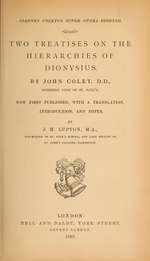
John Colet Two Treatises on the Hierarchies of Dionysius
This text revives the work of an often-overlooked Renaissance humanist who bridged ancient Greek philosophy and Christian theology. Colet contends that human spiritual development follows a path from purgation to illumination and finally to perfection. He claims that current church practices have dr

Plutarch's Morals, Vol. 4 (includes Isis and Osiris)
In this compelling volume of 'Morals,' Plutarch investigates the enigmatic mechanics of the 'spirit of divination,' arguing that prophecy is as much a physical phenomenon as it is a divine one. By examining the transformative power of natural vapors and the 'dry' temperament of the soul, he suggests

Pseudo-Dionysius Celestial and Ecclesiastical Hierarchy
In this profound synthesis of Greek philosophy and Christian mysticism, Pseudo-Dionysius—vigorously defended by translator John Parker as the genuine first-century convert of St. Paul—presents a revolutionary vision of the divine order. By exploring the nine choirs of angels and the sacred rituals o

The Works of Dionysius the Areopagite (Divine Names, Celestial Hierarchy, Mystical Theology)
This work defines the mystical path known as apophatic theology. It claims that God is not a thing to be known, but an experience beyond all essence and knowledge. You will learn how the mind must become silent to approach the Divine. The text provides a rigorous framework for why our standard langu

The Hermetic Writings, Volume I: Texts and Translation
This volume is a monumental reconstruction of the Hermetic tradition, presenting a world where philosophy is not merely an academic exercise but a literal means of deification. Scott challenges the notion that these texts are mere 'occult rubbish,' instead revealing them as the profound response of