Introducing Islam
Episode 200 of the SHWEP introduces Islām onto the stage of our narrative. We hardly discuss Islām the religion, but note instead some of the important characteristics of Islām as a social and political force in the seventh century and beyond which ensured that it would become the home of western...
Primary Sources

On the Mysteries of the Egyptians
This work defends traditional religious practice against the skepticism of philosophers like Porphyry. Iamblichus asserts that the gods are not swayed by human emotions, but rather that rituals align the human soul with a pre-existing divine order. He defines the universe as a singular, living organ

On the Mysteries of the Egyptians, Chaldeans, and Assyrians
Edited and translated by the Renaissance visionary Marsilio Ficino, 'Mysteries of Egypt' brings together the most influential voices of late antiquity—Iamblichus, Porphyry, and Proclus—alongside the mystical revelations of Hermes Trismegistus. The text argues that divine knowledge is not a product o

The Divine Pymander, Asclepius, and On the Mysteries
This monumental synthesis of Hermetic and Neoplatonic thought offers a radical roadmap for the soul’s ascent from the sensory 'multitude' to the intellectual 'One.' By weaving together the revelations of Hermes Trismegistus with the rigorous defenses of Iamblichus and the metaphysical depth of Procl

Pymander. Asclepius. On the Mysteries of the Egyptians. On Plato's Alcibiades, on the Soul and the Daemon. On Sacrifice.
This seminal volume brings together the core texts of the Hermetic and Neoplatonic traditions, asserting a unified lineage of 'ancient theology' (Prisca Theologia) that flows from Hermes Trismegistus to Plato. Readers will encounter bold claims about the human condition: that we are 'twofold' beings

The Chaldean Oracles
This text offers a rare, syncretic exploration of Zoroastrian oracles interpreted through the lens of Neoplatonic and Christian thought. It presents a universe structured in three distinct parts—the eternal, the immortal but generated, and the decaying—and positions the human soul as a mediator 'glu
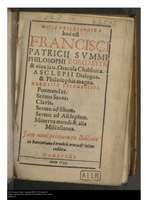
Philosophical Magic: Zoroaster and his 320 Chaldean Oracles
This work reclaims the identity of Zoroaster as a primordial philosopher rather than a mythical figure. Patrizi argues that the cosmos is a divine construction, pulsating with the activity of the Paternal Mind and maintained by the soul. Readers will find a rigorous defense of theurgy as a legitimat

Philosophical Magic: The Chaldean Oracles
This text provides a bridge between ancient pagan theology and the Christian era by asserting that the oldest sages were actually practitioners of a high, holy religion. Patrizi challenges the Aristotelian status quo of his time by arguing that philosophy is inherently tied to theurgy and the animat

On the Mysteries (De Mysteriis)
This text documents the intense clash between two giants of late antique thought: Porphyry the skeptic and Iamblichus the mystic. Iamblichus argues that the human soul possesses innate knowledge of the divine that transcends intellectual reasoning. He posits that religious rituals, or theurgy, serve

The Quran
Abraham Hinckelmann’s 1694 Hamburg edition of 'Al-Coranus' is a remarkable relic of theological warfare and linguistic obsession. Framing the Islamic scripture as a 'monster' to be defeated, Hinckelmann argues that only by mastering the original Arabic can the West hope to 'conquer' the religion. Ye

The Quran (Al-Coranus)
Abraham Hinckelmann presents a text that refuses to compromise on its core message: that humanity is governed by a singular, divine truth. Readers encounter a rigorous system of ethics that treats the saving of one life as the saving of all mankind. The work positions itself as the final link in a c

Complete Text of the Quran (Alcorani Textus Universus)
Ludovico Marracci’s Alcorani Textus Universus is a towering achievement of Oriental scholarship, offering a rare window into how the West first rigorously engaged with the Quran. Beyond a mere translation, Marracci provides a meticulous Latin-Arabic synthesis complete with 'Refutations' that challen

The Quran (Alkoran)
This 1707 edition is more than a religious text; it is a profound historical document capturing the complex encounter between East and West. While the Dutch translators frame the work within a polemical 'Voor-reeden' (Preface) that reflects the anxieties of the era, the text itself unfolds a vast ta

The Quran, Part 1
This volume moves beyond simple religious devotion to examine the Quran as a historical and cultural document. Palmer strips away theological bias to analyze how Muhammad navigated the tribal politics of 7th-century Arabia. He treats the Quran not as a static manual but as a collection of shifting m

The Chaldaean Oracles
G.R.S. Mead brings to life one of the most mysterious and influential texts of late antiquity, bridging the gap between Hellenic philosophy and Eastern mysticism. Through his unique Gnostic-leaning perspective, Mead decodes the cryptic Oracles to describe a universe governed by 'Iynges' (divine whir