The Birth of the Symbol: Peter Struck on Ancient Greek Esoteric Hermeneutics
This episode exceeds the half-hour or so slot we generally aim for by a wide margin, but the material covered is absolutely priceless. Its relevance extends well beyond the Platonist tradition and is applicable to esoteric currents of thought more generally – definitely not one to miss!
Primary Sources

Republic, Laws, and Timaeus
In this profound synthesis of 'Republic,' 'Laws,' and 'Timaeus,' Plato bridges the gap between the earthly and the divine. He argues that virtue is not merely a behavior, but a liberation of the soul achieved through alignment with the celestial sphere and the internalizing of 'common conceptions.'

Twenty-four Dialogues of Plato

Vat.gr.1
In this provocative text, Plato subverts the traditional Western emphasis on human agency by defining man as a 'divine plaything,' suggesting that our greatest dignity lies in our role as puppets of the gods. Rather than finding meaning in the grim struggle of war or history, the author argues for a

On Paradoxical Machines
In 'On Paradoxical Machines,' Anthemius of Tralles offers a rare synthesis of high Euclidean theory and the practical grit of Byzantine engineering. As one of the master architects of Constantinople, Anthemius argues that the most profound challenges of the physical world—from the construction of bu

Proclus in Politiam Platonis . Proklos eis Politeian tou Platonos
In this commentary, the last great Neoplatonist philosopher reconciles the poetic genius of Homer with the rigorous logic of Plato. Proclus argues that myths are not fabrications but deliberate veils for ineffable truths. He maintains that true music and rhythm serve as the structural foundation for

Plato . Platon . Platonis Dialogi
This collection captures the urgent, living spirit of Socratic inquiry at its most potent. Plato argues that we must abandon the distractions of the physical realm to grasp eternal truths. He warns that writing creates a dangerous illusion of wisdom by substituting memorized facts for internal under

Diversorum scriptorum Opera varia . Diaphoron syngrapheon Erga diaphora . Titulum corrige Platonis Opera omnia cum prolegomenis
Plato’s work functions as a complete framework for human conduct and cosmic understanding. He moves beyond simple dialogue to categorize the structure of reality, linking music, numbers, and political virtue to the divine. Each page challenges the reader to distinguish between fleeting sensory opini

Commentary on Plato's Timaeus

Cologny, Fondation Martin Bodmer, Cod. Bodmer 136
In this legendary account of Socrates’ final day, Plato (narrated through Phaedo) investigates the profound relationship between the soul, the divine, and the morality of existence. The text presents a startlingly calm Socrates who argues that humans are the 'possessions of the gods,' framing life a

Commentary on Plato's Timaeus

Proclus: Platonic Theology and Elements of Theology
This work defines the hierarchy of the universe through the eyes of one of antiquity's final great thinkers. Proclus argues that reality is not a random collection of objects but a systematic emanation from the One. He explains how human intellect can bridge the gap between mortal limitations and et

Plato De legibus . Platonos Nomoi . Ac praeterea alii eiusdem [Platonis] Dialogi tum gnesioi, tum nothoi, Definitiones, et epistolae
This work represents the peak of Plato's political thought, moving beyond abstract theories of justice to the mechanics of statecraft. He argues that laws are empty without the internal habits of virtue that only education can provide. Plato forces the reader to confront the reality that excess and

Plato, Cratylus and Secular Florilegium
This work presents an unflinching look at the architecture of a well-lived life. It asserts that true virtue is not an action but a deliberate choice to align the soul with divine reason. By dismantling the common obsession with physical gratification, the text demands that we prioritize the health

Proclus' Commentary on Plato's Republic (Cambridge, St John's College, MS F.15)
This commentary is not merely an analysis of political theory. It is a guide to the Neoplatonic universe where justice serves as a structural harmony for both the city and the individual soul. Proclus argues that myths are not just stories, but symbolic veils designed to hide profound divine truths

The Complete Works of Plato Translated by Marsilio Ficino
This collection serves as a portal to the mind of Plato as seen through the eyes of one of the 15th century's most influential thinkers. Ficino treats philosophy not as a sterile academic exercise but as a medicine for the soul. He constructs an argument for the harmony between pagan wisdom and Chri

Book of Biblical Antiquities (Pseudo-Philo)
This 1527 edition preserved by Adam Petri offers a rare perspective on the ancient world. It argues that human history is a cyclical struggle between divine order and mortal corruption. The text blends genealogical record keeping with sharp philosophical inquiry into the soul and the nature of the c

The Chaldean Oracles
This text offers a rare, syncretic exploration of Zoroastrian oracles interpreted through the lens of Neoplatonic and Christian thought. It presents a universe structured in three distinct parts—the eternal, the immortal but generated, and the decaying—and positions the human soul as a mediator 'glu

Proclus, Theologia Platonica; Michael Psellos
This essential exploration of Neoplatonic thought bridges the gap between Platonic philosophy and the mystical traditions of Orpheus and the Chaldeans. Proclus and Psellos argue that the universe is not a random collection of matter, but a sophisticated hierarchy governed by the interplay of 'Limit'

First Complete Latin Philo
This volume presents the definitive 1554 Basel edition of Philo’s work, translating his Greek insights into the Latin language for a new audience. Philo treats the stories of Genesis as allegorical maps for the structure of the human soul and the nature of the universe. He argues that man stands as

The Complete Works of Plato
This monumental edition of Plato’s *Opera Omnia* is more than a translation; it is a sacred bridge between Greek antiquity and Renaissance humanism, curated by Marsilio Ficino to harmonize philosophy with divine religion. Within these pages, readers will find the 'divine' Plato—a thinker who argues

Exegetical Works on the Books of Moses
This collection transforms the Books of Moses from mere historical records into a roadmap for intellectual and moral liberation. Philo argues that scriptural narratives are not just stories, but symbols for the internal war between sensory desire and divine reason. He claims that true human excellen

The Complete Works of the Divine Plato
This 1590 edition of Plato’s 'Complete Works' serves as a spiritual and intellectual map of the human condition, viewed through the transformative Neoplatonic lens of Marsilio Ficino. Synthesizing classical dialectic with religious piety, the text argues that the ultimate end of man is to achieve a
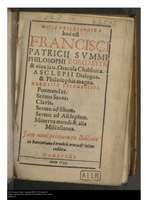
Philosophical Magic: Zoroaster and his 320 Chaldean Oracles
This work reclaims the identity of Zoroaster as a primordial philosopher rather than a mythical figure. Patrizi argues that the cosmos is a divine construction, pulsating with the activity of the Paternal Mind and maintained by the soul. Readers will find a rigorous defense of theurgy as a legitimat

Philosophical Magic: The Chaldean Oracles
This text provides a bridge between ancient pagan theology and the Christian era by asserting that the oldest sages were actually practitioners of a high, holy religion. Patrizi challenges the Aristotelian status quo of his time by arguing that philosophy is inherently tied to theurgy and the animat

Elements of Theology and Physics
Proclus’s 'Elements of Theology and Physics' is a monumental achievement in late classical philosophy, offering a systematic 'More Geometrico' (mathematical style) approach to the nature of existence. By transforming metaphysical inquiry into a series of logical propositions and proofs, Proclus maps

Proclus (Cambridge, Trinity College, MS O.5.11)
This manuscript preserves the rigorous dialectic of one of antiquity’s final great minds. Proclus examines the One not as a physical object, but as the absolute origin and end of every existing thing. He challenges the reader to consider how a source can be responsible for all diversity without beco

Philonos tou Ioudaiou ta Heuriskomena Hapanta / Philonis Judaei Opera Omnia (Vol. 1)

Philonos tou Ioudaiou ta Heuriskomena Hapanta / Philonis Judaei Opera Omnia (Vol. 2)

On Isis and Osiris
In this treatise, Plutarch rescues Egyptian theology from the twin errors of superstition and skepticism. He argues that myths about dismemberment and divine struggle are not accounts of ancient kings, but symbolic representations of moral and metaphysical forces. By mapping these stories onto the b

Complete Plato (Thomas Taylor trans.)
Thomas Taylor’s 'Complete Plato' is a monumental achievement that offers more than a mere translation; it provides the 'key' to the Platonic system through the profound insights of ancient Neoplatonic commentators. Taylor argues that philosophy is a divine discipline designed to lead the soul away f

Platonic Theology (Thomas Taylor trans.)
This work functions as a complete, scientific manual for navigating the hierarchy of the universe. Proclus rejects the idea that the divine is beyond our reach; instead, he provides a rigorous path for the human soul to return to its source. Readers will encounter a vision where stars are living bei
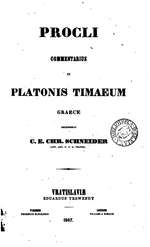
Commentary on Plato's Timaeus
This commentary serves as the definitive architecture of Neoplatonic thought, mapping the procession of all things from the One down to the physical realm. Proclus argues that the universe is not a product of blind chance but a living, ordered image sustained by divine providence. He treats the Tima

Commentary on the Timaeus
Proclus offers a breathtakingly dense metaphysical defense of Plato’s cosmology, positioning the soul as the critical 'middle nature' bridging the eternal and the material. By weaving together Pythagorean mathematics, Orphic theology, and rigorous dialectic, he argues that the cosmos is not a random

The Elements of Theology
The Elements of Theology functions as a rigorous, axiomatic guide to the structure of reality. Proclus assumes that if a first cause exists, all subsequent levels of being must unfold with mathematical necessity. He maps the path from the singular source of all things down to individual souls and ma

Complete Works of Philo Judaeus, Vol. 1
This edition brings together the foundational works of a thinker who viewed the physical world as a mere shadow of an intelligible, divine reality. Philo argues that Moses and the Greek philosophers shared a single source of truth accessible through allegory. He transforms the Genesis narrative into

Complete Works of Philo Judaeus, Vol. 2
This second volume tracks the soul's movement from the chaos of bodily passions to the stillness of divine wisdom. Philo rejects literalism, choosing instead to see biblical narratives as allegories for the human condition. He argues that true power lies not in the world but in the disciplined mind.

Complete Works of Philo Judaeus (Vol. 4)
This fourth volume provides a direct route into the mind of a thinker who viewed the lives of biblical figures as psychological maps. Philo argues that laws are not merely external commands but internal realities that align the human soul with the cosmos. He dismisses the transient noise of politics

Complete Works of Philo Judaeus (Vol. 5)
This volume presents a rigorous analysis of how divine law governs human life. Philo argues that true virtue requires mastering the passions rather than following external rituals. He treats the Decalogue as a blueprint for the soul, asserting that ethics and politics must align with the nature of G

Complete Works of Philo Judaeus (Vol. 6)
This volume presents Philo's sharp defense of an indestructible, orderly universe against the chaotic cosmologies of the Stoics and Epicureans. Beyond physics, it provides a gritty, firsthand witness to the political corruption of Alexandria under Governor Flaccus and the megalomania of Emperor Gaiu

Proclus: Commentary on Plato's Timaeus

Works of Plato
Plato’s 'The Laws' represents a monumental shift in the philosopher's journey, moving from the idealism of his youth toward a rigorous, practical exploration of legislation and social order. Translated by George Burges in 1880, this edition provides a meticulous 'literal version' that preserves the

Plutarch's Morals, Vol. 4 (includes Isis and Osiris)
In this compelling volume of 'Morals,' Plutarch investigates the enigmatic mechanics of the 'spirit of divination,' arguing that prophecy is as much a physical phenomenon as it is a divine one. By examining the transformative power of natural vapors and the 'dry' temperament of the soul, he suggests

Philo About the Contemplative Life (De Vita Contemplativa)
This edition rescues a primary document of ancient philosophy from the shadow of long-standing historical error. Conybeare challenges the claim that Philo’s description of the Therapeutae is a Christian fabrication. By meticulously comparing Greek, Armenian, and Latin manuscripts, he proves the text

Works of Plato (Republic, Timaeus, Critias)
Plato, the architect of Western philosophy, invites readers into a series of intellectual battles that remain startlingly modern. In these pages, he dismantles the cynical view that 'might makes right' and proposes a revolutionary vision of an ideal state where gender is no barrier to leadership and

Commentary on Plato's Timaeus, Vol. I
Proclus’s commentary on the Timaeus represents the pinnacle of Neoplatonic cosmology, offering a rigorous metaphysical map of the sensible world. He argues that the universe is not a chaotic assembly of matter, but a unified organism positioned between the eternal and the temporal through the 'middl

Commentary on Plato's Timaeus, Volume II
Ernst Diehl’s landmark edition of Proclus’ commentary is more than a philological triumph; it is a gateway to the ancient world’s most sophisticated interpretation of cosmic origins. By tracing the 'genealogy' of the text through the libraries of Renaissance cardinals and Byzantine scribes, Diehl re

The Chaldaean Oracles
G.R.S. Mead brings to life one of the most mysterious and influential texts of late antiquity, bridging the gap between Hellenic philosophy and Eastern mysticism. Through his unique Gnostic-leaning perspective, Mead decodes the cryptic Oracles to describe a universe governed by 'Iynges' (divine whir

Surviving Works of Philo of Alexandria (Vol. 7 - Indices)
The Indices to the Surviving Works of Philo serve as the gateway to his vast allegorical project. Hans Leisegang organizes the raw material of Philo's intellectual world, mapping the intersection of Stoic ethics, Platonic metaphysics, and biblical narrative. By cataloging the vocabulary of virtue, t