Primary Sources

Republic, Laws, and Timaeus
In this profound synthesis of 'Republic,' 'Laws,' and 'Timaeus,' Plato bridges the gap between the earthly and the divine. He argues that virtue is not merely a behavior, but a liberation of the soul achieved through alignment with the celestial sphere and the internalizing of 'common conceptions.'

Commentary on Plato's Timaeus

Commentary on Plato's Timaeus

Book of Biblical Antiquities (Pseudo-Philo)
This 1527 edition preserved by Adam Petri offers a rare perspective on the ancient world. It argues that human history is a cyclical struggle between divine order and mortal corruption. The text blends genealogical record keeping with sharp philosophical inquiry into the soul and the nature of the c

Commentary on Platos Timaeus
Chalcidius’ Commentary on Plato’s Timaeus is a landmark of intellectual history, serving as the primary bridge between ancient Greek philosophy and the Latin West. This text presents a universe built not by chance, but by a 'Demiurge' using the tools of geometry, musical harmony, and arithmetic prop

First Complete Latin Philo
This volume presents the definitive 1554 Basel edition of Philo’s work, translating his Greek insights into the Latin language for a new audience. Philo treats the stories of Genesis as allegorical maps for the structure of the human soul and the nature of the universe. He argues that man stands as

Exegetical Works on the Books of Moses
This collection transforms the Books of Moses from mere historical records into a roadmap for intellectual and moral liberation. Philo argues that scriptural narratives are not just stories, but symbols for the internal war between sensory desire and divine reason. He claims that true human excellen

Philonos tou Ioudaiou ta Heuriskomena Hapanta / Philonis Judaei Opera Omnia (Vol. 1)

Philonos tou Ioudaiou ta Heuriskomena Hapanta / Philonis Judaei Opera Omnia (Vol. 2)
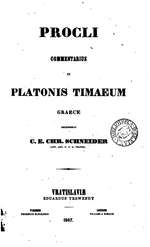
Commentary on Plato's Timaeus
This commentary serves as the definitive architecture of Neoplatonic thought, mapping the procession of all things from the One down to the physical realm. Proclus argues that the universe is not a product of blind chance but a living, ordered image sustained by divine providence. He treats the Tima

Commentary on the Timaeus
Proclus offers a breathtakingly dense metaphysical defense of Plato’s cosmology, positioning the soul as the critical 'middle nature' bridging the eternal and the material. By weaving together Pythagorean mathematics, Orphic theology, and rigorous dialectic, he argues that the cosmos is not a random

Complete Works of Philo Judaeus, Vol. 1
This edition brings together the foundational works of a thinker who viewed the physical world as a mere shadow of an intelligible, divine reality. Philo argues that Moses and the Greek philosophers shared a single source of truth accessible through allegory. He transforms the Genesis narrative into

Complete Works of Philo Judaeus, Vol. 2
This second volume tracks the soul's movement from the chaos of bodily passions to the stillness of divine wisdom. Philo rejects literalism, choosing instead to see biblical narratives as allegories for the human condition. He argues that true power lies not in the world but in the disciplined mind.

Complete Works of Philo Judaeus (Vol. 4)
This fourth volume provides a direct route into the mind of a thinker who viewed the lives of biblical figures as psychological maps. Philo argues that laws are not merely external commands but internal realities that align the human soul with the cosmos. He dismisses the transient noise of politics

Complete Works of Philo Judaeus (Vol. 5)
This volume presents a rigorous analysis of how divine law governs human life. Philo argues that true virtue requires mastering the passions rather than following external rituals. He treats the Decalogue as a blueprint for the soul, asserting that ethics and politics must align with the nature of G

Complete Works of Philo Judaeus (Vol. 6)
This volume presents Philo's sharp defense of an indestructible, orderly universe against the chaotic cosmologies of the Stoics and Epicureans. Beyond physics, it provides a gritty, firsthand witness to the political corruption of Alexandria under Governor Flaccus and the megalomania of Emperor Gaiu

Proclus: Commentary on Plato's Timaeus

Timaeus (Greek text with commentary)
R.D. Archer-Hind’s edition of the Timaeus offers a radical reinterpretation of Plato’s later philosophy, arguing that this dialogue represents the culmination of Platonic metaphysics where the dualism of mind and matter is finally resolved. By identifying Being with a Universal Mind, the text presen

Timaeus
This text argues that the physical world is not an independent reality but a symbolic refraction of a universal soul. It solves the ancient deadlock between Herakleitos, who saw only constant change, and Parmenides, who saw only immutable stillness. By reconciling these opposites through the concept

Philo About the Contemplative Life (De Vita Contemplativa)
This edition rescues a primary document of ancient philosophy from the shadow of long-standing historical error. Conybeare challenges the claim that Philo’s description of the Therapeutae is a Christian fabrication. By meticulously comparing Greek, Armenian, and Latin manuscripts, he proves the text

Works of Plato (Republic, Timaeus, Critias)
Plato, the architect of Western philosophy, invites readers into a series of intellectual battles that remain startlingly modern. In these pages, he dismantles the cynical view that 'might makes right' and proposes a revolutionary vision of an ideal state where gender is no barrier to leadership and

Commentary on Plato's Timaeus, Vol. I
Proclus’s commentary on the Timaeus represents the pinnacle of Neoplatonic cosmology, offering a rigorous metaphysical map of the sensible world. He argues that the universe is not a chaotic assembly of matter, but a unified organism positioned between the eternal and the temporal through the 'middl

Commentary on Plato's Timaeus, Volume II
Ernst Diehl’s landmark edition of Proclus’ commentary is more than a philological triumph; it is a gateway to the ancient world’s most sophisticated interpretation of cosmic origins. By tracing the 'genealogy' of the text through the libraries of Renaissance cardinals and Byzantine scribes, Diehl re

Surviving Works of Philo of Alexandria (Vol. 7 - Indices)
The Indices to the Surviving Works of Philo serve as the gateway to his vast allegorical project. Hans Leisegang organizes the raw material of Philo's intellectual world, mapping the intersection of Stoic ethics, Platonic metaphysics, and biblical narrative. By cataloging the vocabulary of virtue, t

The Greek Magical Papyri in Translation
The Greek Magical Papyri is a massive archive of raw, practical, and often transgressive documents. These texts reveal a world where the magician acted as a master of cosmic energies rather than a simple priest. You will find recipes for everything from love charms and dream oracles to the binding o