Mystery and Immortality: Plato's Phaedo
Primary Sources

Hieroclis Expositio versuum Pythagorae qui aurei dicuntur . Hermes Trismegistus . Adde etiam Hermes Trismegistus, Apuleio interprete
Hierocles provides a rigorous manual for navigating the soul's ascent from material distraction to intellectual clarity. He argues that human suffering is not a divine punishment but a result of our own misalignment with natural law. By practicing nightly self-examination, we can transform the body
Orphic and Homeric Hymns
This remarkable collection offers an intimate look at the intersection of ancient Greek theology, ritual practice, and poetic tradition. By weaving together the Orphic perspective on cosmogony with the Homeric celebration of divine exploits, the text presents a world where every natural force—from t

Life of Pythagoras and Sentences on the Intelligibles
Porphyry’s 'Life of Pythagoras and Sentences on the Intelligibles' offers a rare window into the ancient quest for spiritual deification through intellect and discipline. By blending a hagiography of Pythagoras—complete with his rejection of the 'impure' Cylon and his cryptic dietary bans—with a rig

Plato Euthyphro, Apology, Crito, Phaedo, Phaedrus
Plato documents the final days of his teacher, Socrates, as he confronts a city that wants him dead. The text moves from the courtroom to the prison cell, eventually shifting into deep metaphysical inquiry. It argues that philosophy is nothing less than the practice of dying. By rejecting passive wr

The Mystical Initiations; or, Hymns of Orpheus
This volume is an act of defiance against the modern reduction of religion to mere history or folklore. Taylor argues that the Greek theological tradition is a coherent, scientific approach to reality that utilizes polytheism to express the hierarchy of a single, unified source. By translating these

Orphica
Gottfried Hermann does not offer a polished myth but a raw, confrontational look at how we inherit the ancient past. He forces the reader to confront the reality that many famous works were misattributed, patched together, or distorted by centuries of scribal error. The text exposes the vanity of th

On the Pythagorean Life (De Vita Pythagorica)
This work presents Pythagoras not merely as a mathematician, but as a semi-divine reformer who sought to align human life with the order of the cosmos. It details a rigorous path of purification through music, diet, and strict communal ethics. Readers will encounter a tradition that treats education

On the Pythagorean Life
This expansive 1815 collection serves as the definitive gateway to the Pythagorean tradition, weaving together the biographies of Iamblichus and Porphyry with profound scholarly commentary. Readers will encounter a Pythagoras who is part scientist and part shaman—a man who disciplined his soul throu

The Theology of Arithmetic
In this profound synthesis of Pythagorean and Platonic thought, edited by Friedrich Ast, mathematics is reclaimed from the realm of 'logistics' and elevated to a sacred theology. The text argues that numbers are not mere human inventions but the eternal, immaterial blueprints—the 'pre-existent sketc
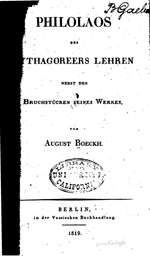
Philolaos des Pythagoreers Lehren nebst den Bruchstücken seines Werkes
This book recovers the lost fragments of Philolaus and rescues his history from a mess of contradictory legends. Boeckh challenges the old gossip that Plato simply bought stolen Pythagorean manuscripts. Instead, he demonstrates how Philolaus defined the Doric tradition of mathematics and harmony. Th

Pythagoras and Pythagorean Philosophy
Chaignet treats the history of philosophy as a rigorous forensic discipline rather than a collection of poetic myths. He argues that we cannot understand Pythagoreanism without first validating the historical fragments of figures like Philolaus and Archytas. The text moves past modern skepticism to

Orphica (Abel Edition, with Proclus Hymns & Hymn to Isis)
Eugen Abel reconstructs the Orphic tradition by stripping away centuries of editorial clutter. He aligns fragmented myths and hymns into a logical sequence, transforming obscure lore into a cohesive theological system. The text argues that music, ritual, and language possess the power to move mounta

Phaedo
The Phaedo captures the final conversation of a man facing his own execution with absolute calm. Socrates argues that the philosopher spends their entire life preparing for death because the body acts as a prison for the truth. He maintains that true knowledge belongs only to the soul, which must ev

Euthyphro, Apology, Crito, Phaedo, and Phaedrus
This collection captures the final days of history's most famous provocateur. Socrates turns his own trial into a masterclass on how to live and die with integrity. He dismantles the hollow arguments of his accusers and shows that true wisdom starts with the admission of ignorance. The text forces y

The Golden Verses of Pythagoras
This work restores the Golden Verses of Pythagoras to their status as tools for spiritual and moral development. D'Olivet challenges the modern view of art by insisting that poetry is a vehicle for divine truth rather than mere aesthetic arrangement. He maps the path of the soul from purgation to un

Orphic Fragments
Otto Kern reconstructs the fragmented legacy of Orpheus to reveal the evolution of Greek religious thought. The text examines the historical validity of Orpheus while documenting his influence on figures like Pythagoras and Plato. It presents a radical theology where the creator Phanes is swallowed