Esoteric Hermeneutics in Stoicism
The Stoics that we introduced in the previous episode had more going on esoterically than you might think.
Primary Sources

The Discourses of Epictetus
Bodleian Library MS. Auct. T. 4. 13 presents the razor-sharp insights of the former slave turned philosopher, Epictetus, as recorded by his student Arrian. This text challenges the reader to look past the 'dice' of circumstance—wealth, status, and health—and focus instead on the skill with which the

Byzantine Teaching Miscellany
The 'Byzantine Teaching Miscellany' is an extraordinary compendium that serves as both a pedagogical manual and a philosophical manifesto. It makes the bold claim that language is not merely a tool for communication but the very 'nourishment of the mind,' essential for the cultivation of a free and
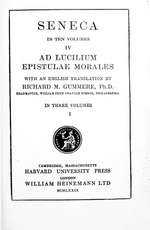
Seneca's Moral Letters, Volume 1
Seneca’s 'Epistulae Morales' is far more than a collection of ancient correspondence; it is a masterclass in Stoic resilience written by a man of staggering contradictions. While serving as a wealthy advisor to the volatile Nero, Seneca wrestled with the tension between material success and spiritua

Theophrastus, Marcus Aurelius, Epictetus, Cebes, Maximus Tyrius (Greek/Latin 1877)
This 1838 critical edition of Pausanias's 'Description of Greece' serves as a fiery manifesto for academic rigor and textual honesty. Editors Johann Heinrich Christian Schubart and Christian Walz launch a scathing critique against intellectual giants like Immanuel Bekker, accusing them of 'excessive

Seneca's Moral Epistles Vol. 2 (Letters 66-92)
In this profound volume of the Epistulae Morales, Seneca presents a radical Stoic defense of the equality of all virtues. Through the moving example of his physically frail friend Claranus, Seneca argues that the Supreme Good is an absolute force, unmarred by external deformity or hardship. He makes

Moral Essays of Seneca, Volume I
Seneca’s 'Moral Essays Vol. 1' stands as a cornerstone of Stoic philosophy, providing a radical perspective on how to live with dignity in an unpredictable world. Through the expert translation of John W. Basore, this volume explores the provocative idea that adversity is not a misfortune, but a nec

Epictetus Enchiridion and Cebes Tabula (1660)
This rare 1660 collection presents the definitive Stoic 'Handbook' alongside the vivid, allegorical 'Tablet' of Cebes, creating a comprehensive guide to the liberated mind. Epictetus, a former slave turned philosopher, argues that true freedom is found not in external power, but in the internal disc

Meditations
This book captures the private reflections of a man who held absolute power but sought only inner freedom. Aurelius treats life as a transient, often brutal, but ultimately orderly process. He argues that our suffering does not come from events but from our own judgments about those events. By align

Epictetus Works (Discourses, Enchiridion, Fragments)
Unlike the abstract metaphysical wandering of other ancient schools, the philosophy of Epictetus is a gritty, boots-on-the-ground guide to daily living. This edition, curated and translated by Thomas Wentworth Higginson, emphasizes the 'Practical Ethics' that made Stoicism the refuge of both emperor
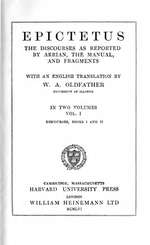
The Discourses of Epictetus, Volume I
This volume presents the foundational teachings of Epictetus, the Stoic philosopher whose wisdom was forged through a life of bondage and banishment. Unlike many abstract philosophical treatises, these 'Discourses'—captured by his devoted student Arrian—read as direct, conversational, and uncompromi

Epictetus' Discourses Vol. 2 (Books 3-4) & Encheiridion
This volume is a harsh, practical training manual for living with internal freedom. Epictetus argues that most human misery comes from chasing things we cannot control like wealth, reputation, or the opinions of others. He rejects academic vanity and demands that you align your actions with your sta

Communings with Himself
Meditations is a rare and intimate glimpse into the mind of Marcus Aurelius, the last of the 'Five Good Emperors,' who practiced Stoicism as a lived discipline rather than a dry theory. These 'communings with himself' challenge the reader to view life as a transient flux where only character and rea

Seneca's Moral Epistles Vol. 3 (Letters 93-124)
Seneca’s 'Moral Letters to Lucilius, Volume III' represents the mature zenith of Stoic philosophy, offering a roadmap for ethical living in an era of uncertainty. Through this acclaimed Loeb Classical Library edition, translated by Richard M. Gummere, readers are invited into a private correspondenc