The Esoteric Philo
In this episode we return to the thought of the great Philo of Alexandria, concentrating specifically on the contours of esotericism in his work. We look at three main topics:
Primary Sources

Book of Biblical Antiquities (Pseudo-Philo)
This 1527 edition preserved by Adam Petri offers a rare perspective on the ancient world. It argues that human history is a cyclical struggle between divine order and mortal corruption. The text blends genealogical record keeping with sharp philosophical inquiry into the soul and the nature of the c

First Complete Latin Philo
This volume presents the definitive 1554 Basel edition of Philo’s work, translating his Greek insights into the Latin language for a new audience. Philo treats the stories of Genesis as allegorical maps for the structure of the human soul and the nature of the universe. He argues that man stands as

Exegetical Works on the Books of Moses
This collection transforms the Books of Moses from mere historical records into a roadmap for intellectual and moral liberation. Philo argues that scriptural narratives are not just stories, but symbols for the internal war between sensory desire and divine reason. He claims that true human excellen

Philonos tou Ioudaiou ta Heuriskomena Hapanta / Philonis Judaei Opera Omnia (Vol. 1)

Philonos tou Ioudaiou ta Heuriskomena Hapanta / Philonis Judaei Opera Omnia (Vol. 2)

Complete Works of Philo Judaeus, Vol. 1
This edition brings together the foundational works of a thinker who viewed the physical world as a mere shadow of an intelligible, divine reality. Philo argues that Moses and the Greek philosophers shared a single source of truth accessible through allegory. He transforms the Genesis narrative into

Complete Works of Philo Judaeus, Vol. 2
This second volume tracks the soul's movement from the chaos of bodily passions to the stillness of divine wisdom. Philo rejects literalism, choosing instead to see biblical narratives as allegories for the human condition. He argues that true power lies not in the world but in the disciplined mind.

Complete Works of Philo Judaeus (Vol. 4)
This fourth volume provides a direct route into the mind of a thinker who viewed the lives of biblical figures as psychological maps. Philo argues that laws are not merely external commands but internal realities that align the human soul with the cosmos. He dismisses the transient noise of politics

Complete Works of Philo Judaeus (Vol. 5)
This volume presents a rigorous analysis of how divine law governs human life. Philo argues that true virtue requires mastering the passions rather than following external rituals. He treats the Decalogue as a blueprint for the soul, asserting that ethics and politics must align with the nature of G

Complete Works of Philo Judaeus (Vol. 6)
This volume presents Philo's sharp defense of an indestructible, orderly universe against the chaotic cosmologies of the Stoics and Epicureans. Beyond physics, it provides a gritty, firsthand witness to the political corruption of Alexandria under Governor Flaccus and the megalomania of Emperor Gaiu
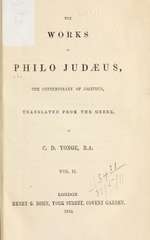
The Works of Philo Judaeus, Vol. 2
This volume treats the physical world as a temporary, often deceptive, dwelling for the intellect. Philo maintains that the mind becomes trapped by bodily passions and sensory illusions unless it pursues a rigorous path of allegorical study. He boldly claims that divine inspiration is a reachable re

On the Creation of the World (De opificio mundi)
This volume reconstructs Philo’s classic treatise on the origin of the world by tracing its survival through ancient manuscripts. Cohn systematically strips away centuries of interpolation and incompetence to recover the author’s original voice. He argues that Philo synthesized Platonic, Stoic, and

Philo About the Contemplative Life (De Vita Contemplativa)
This edition rescues a primary document of ancient philosophy from the shadow of long-standing historical error. Conybeare challenges the claim that Philo’s description of the Therapeutae is a Christian fabrication. By meticulously comparing Greek, Armenian, and Latin manuscripts, he proves the text

Surviving Works of Philo of Alexandria (Vol. 7 - Indices)
The Indices to the Surviving Works of Philo serve as the gateway to his vast allegorical project. Hans Leisegang organizes the raw material of Philo's intellectual world, mapping the intersection of Stoic ethics, Platonic metaphysics, and biblical narrative. By cataloging the vocabulary of virtue, t