Justin Rogers on Philo in Early Christianity
In an interview packed with information, Justin Rogers explains the many ways in which the work of Philo of Alexandria influenced the development of Christianity. Philo became for many early Christian intellectuals a kind of honorary doctor of the Church. We look at how this happened.
Primary Sources

Origen, Homiliae in Psalmos (29 homilies, discovered 2012)
These homilies represent a rare direct encounter with Origen's preaching voice. He treats the Psalms not as ancient poetry, but as a map for internal warfare and divine union. The text challenges the reader to categorize their own thoughts and desires as either fleeting shadows or eternal seeds. Ori

Contra Celsum (1481 editio princeps)
This editio princeps reveals more than a theological argument. It captures the tension between Humanist scholarship and the existential dread caused by the Ottoman advance into Italy. Origen argues that Christianity survives not through the ornate rhetoric of philosophers, but through the lived powe

The Complete Extant Works of Clement of Alexandria

Complete Extant Works
This collection serves as a direct challenge to the foundations of ancient religious life. Clement strips away the veneer of pagan mythology, exposing its deities as merely mortal men and its temples as burial grounds. He argues that Greek philosophy, while incomplete, provides the essential logical

Extant Works
Clement does not view the world of Greek philosophy as an enemy to his faith. Instead, he treats it as a classroom where humanity learns to recognize the truth found in Christ. He argues that Greek thinkers were essentially students of Hebrew prophecy who failed to grasp the full picture. This colle

Works in Greek and Latin
Clement treats the entirety of human existence as a classroom for the soul. He claims that Greek philosophy contains fragments of divine truth, though it ultimately fails to reach the goal of salvation. Instead, he proposes the Word of God as the true Instructor who heals the passions and guides hum

Philocalia (First Edition, Tarinus 1618)

Against Celsus
This 1658 edition presents the definitive intellectual struggle between early Christian thought and pagan philosophy. Origen systematically dismantles the arguments of Celsus by shifting the debate from mere rhetoric to the moral transformation of the human soul. He argues that the life and death of

Dialogue Against the Marcionites, Exhortation to Martyrdom (Wettstein 1674)
This 1674 edition of Origen’s work serves as a foundational pillar of early Christian apologetics, offering a masterclass in theological debate and spiritual endurance. Through a rigorous dialectic between the character Adamantius and the heretic Marcion, Origen defends the integrity of the physical

Origen Philocalia (Greek)
In this definitive collection edited by William Spencer, readers encounter the first great synthesis of Greek philosophy and Christian theology. Origen does not merely rebut charges of magic and sedition; he builds a comprehensive metaphysical framework that justifies 'simple faith' as a moral medic

Opera Omnia I (Delarue-Lommatzsch)
This volume of Origen’s 'Opera Omnia' offers a rare synthesis of rigorous textual criticism and soaring spiritual exegesis. Drawing from ancient manuscripts across the Vatican, Stockholm, and Cambridge, the text reconstructs Origen’s masterful commentary on the entry into Jerusalem. Origen argues th

Complete Works XVIII: Against Celsus I-IV (Lommatzsch)
In 'Contra Celsum I-IV,' Origen provides a groundbreaking response to the first major intellectual assault on Christianity. Rather than relying solely on tradition, Origen deconstructs Greek mythology as morally bankrupt while elevating the historical and ethical superiority of the Mosaic law and th

Complete Works XIX: Against Celsus V-VIII (Lommatzsch)
This work captures a master of Greek logic turning his focus toward his fiercest opponent. Origen refuses to retreat into silence; he dissects every charge Celsus brings against the Christian faith. He tackles the paradox of the incarnation, the validity of biblical allegory, and the nature of human
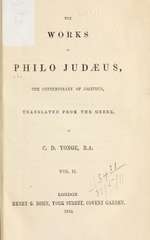
The Works of Philo Judaeus, Vol. 2
This volume treats the physical world as a temporary, often deceptive, dwelling for the intellect. Philo maintains that the mind becomes trapped by bodily passions and sensory illusions unless it pursues a rigorous path of allegorical study. He boldly claims that divine inspiration is a reachable re

Greek Patrology, Vol. 8: Clement of Alexandria I

Patrologia Graeca vol. 12: Origenes II
This text presents the early church's most intense battle over how to read the Bible. Origen argues that the literal meaning often collapses into absurdity, forcing the reader to search for a deeper, allegorical truth. He connects the soul's journey to the events of Genesis and Exodus, claiming the

Works, Vol. I (Dindorf, Oxford)
Clement of Alexandria presents a bold vision where Greek philosophy serves as a mere prelude to the ultimate truth of the Logos. He argues that while poets like Orpheus and Sophocles caught sparks of divinity, only the Christian Way offers a complete transformation of human nature. This text is not

Remains of the Hexapla, Vol. I (Field Critical Edition)
Frederick Field’s work is the definitive guide to the scattered fragments of Origen’s Hexapla. It moves beyond standard historical accounts to identify the specific translation philosophies of figures like Aquila, Symmachus, and Theodotion. The text argues that ancient translators were driven by com

Clement of Alexandria I: Protrepticus and Paedagogus
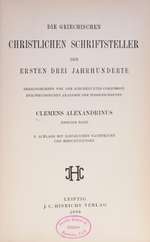
Clement of Alexandria II: Stromata I-VI
Clement argues that all wisdom originates from a singular divine source. He asserts that Greek philosophy serves as a vital tool for the believer, provided it is treated as a preparation rather than the final destination. The text demands intellectual rigor and warns against the vanity of mere debat

Clement of Alexandria III: Stromata VII-VIII, Excerpts, and Who is the Rich Man that Shall be Saved?
This volume functions as the ultimate key to the library of a brilliant mind. Clement of Alexandria does not merely cite pagan authors; he reframes their concepts of virtue, cosmology, and ethics to construct a Christian framework. He demands that his readers move beyond simple faith toward a rigoro