The Enigma of Early Christianity
In this episode we look at the evidence for the very earliest Christian movements; some scholars call it the ‘Jesus movement’, some the Early Church, some want to say it was all a case of ‘Jewish-Christianity’.
Primary Sources

The Four Gospels
The text transforms the Gospel accounts into a structured path for spiritual development. It presents the Incarnation not just as history, but as a living reality that demands total commitment from the believer. The anonymous author insists that true knowledge requires a reciprocal relationship wher

The New Testament

The Harclean Gospels

Chronicle (Chronicon)

Paintings of the Life of Jesus
These pages present a distinct provincial interpretation of the life of Jesus. The manuscript captures pivotal moments like the Transfiguration and the final judgment through a specific Byzantine lens. Readers see how the anonymous artist balanced the authority of the Law and the Prophets with the c

The Newe Testament (Tyndale, 1526)
William Tyndale’s 1526 New Testament is a landmark of both faith and linguistics, representing the first English translation from the original Greek. Bypassing the religious establishment of his day, Tyndale offers a perspective centered on personal repentance and the 'law of love' rather than rigid

Ecclesiastical History

Preparation for the Gospel

Sibylline Oracles
Sebastian Castellio and his contemporaries treat the Sibylline Oracles as a bridge between classical antiquity and Christian revelation. They argue that the sheer complexity and historical corruption of these manuscripts prove they are not modern forgeries, but genuine relics of ancient divine inspi

The Nevv Testament of Iesus Christ (Douay-Rheims, 1582)
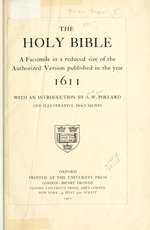
The Holy Bible: Authorized Version 1611 (Facsimile)
This volume moves past the legend to show the 1611 Bible as a product of intense human conflict and state control. It documents how translators risked their lives while competing factions struggled to dictate the precise wording of scripture to serve their own religious agendas. Readers will see tha

Ecclesiastical History
Eusebius’s 'Ecclesiastical History' stands as the foundational record of the Christian faith, bridging the gap between the Apostolic age and the year 400. This 1613 edition positions history not merely as a record of the past, but as a vital necessity for the preservation of divine truth against the

Syriac Gospel Lectionary
This text offers a radical synthesis of Syriac Christian liturgy and deep Jewish intellectual history, presenting a world where spiritual perfection requires both a rigorous ethical code and a mystical understanding of the cosmos. By interweaving Maimonidean rationalism with the visionary experience

Erasmus: New Testament with Greek Text and Annotations
A text by Desiderius Erasmus. About the author (Desiderius Erasmus): Desiderius Erasmus Roterodamus, commonly known in English as Erasmus of Rotterdam or simply Erasmus, was a Dutch humanist, Christian theologian, and pioneering p...

The Hebrew Bible
The 'Biblia Hebraica' edited by Michaelis is far more than a simple reprint of the Hebrew Bible; it is a rigorous scholarly defense of the necessity of biblical literacy in its original tongue. By integrating philological criticism with a deep spiritual parænesis, Michaelis argues that ignorance of

Ecclesiastical History
This work stands as the primary source for understanding how a persecuted sect became the state religion of Rome. It details the struggle between theological orthodoxy and imperial politics during the Arian controversy. Eusebius documents the lives of martyrs, the succession of bishops, and the tran

The Holy Bible

The Complete Works of Flavius Josephus
The Havercamp edition stands as a monument to scholarly persistence, documenting not only the history of the Jewish nation but the equally volatile history of the text itself. It forces readers to confront the reliability of ancient accounts by layering numismatic verification against traditional na

Gothic Version of the Holy Gospels from the Codex Argenteus
This book provides a window into the mind of the Goths by reconstructing their lost language. It presents the Codex Argenteus not just as an artifact, but as a living testament to a people caught between the Roman Empire and the dawn of a new faith. The authors systematically dismantle linguistic my

Letters
This text offers a raw look at the moral calculations of the Roman elite. It connects the architectural grandeur of baths and villas to the private lives of those who governed the state. Pliny forces the reader to confront the cost of success in a society ruled by capricious emperors. It is an accou

The New Testament

The Chronicle of Eusebius, Vol. 1
This volume presents the first complete recovery of the Eusebian Chronicle from a preserved Armenian manuscript. It corrects the errors of Western scholars like Scaliger, who relied on guesswork and fabricated fragments. The text bridges the gap between pagan mythology and biblical genealogy by plac

The Chronicle of Eusebius, Vol. 2
This volume serves as a radical effort to synchronize the fragmented records of antiquity. Eusebius argues that the life of Moses predates the figures of Greek mythology, effectively positioning Hebrew history as the bedrock for all secular empires. The text systematically reconciles the reigns of k

Septuagint: Greek Old Testament (Vatican Codex Edition)
The 'Septuagint: Greek Old Testament (Vatican Codex Edition)' offers a rare opportunity to engage with the biblical text as it existed in the venerable Codex Vaticanus. This specific volume, edited by the legendary Lambert Bos and Robert Holmes, represents a pinnacle of 19th-century theological scho

Evangelia Apocrypha (Apocryphal Gospels, Greek & Latin)
This edition moves beyond mere historical curiosity by applying rigorous 19th-century philology to the most famous apocryphal gospels. Tischendorf demonstrates that these documents are not just myths; they are tactical responses to the theological and social anxieties of the early Christian centurie

The Silver Codex: Fragments of the Gothic Version of the Holy Gospels
This edition serves as both a primary source for the Gothic Gospels and a record of the manuscript’s tumultuous physical history. Anders Uppström provides a rigorous diplomatic transcription, correcting previous errors and documenting his own recovery of ten lost leaves. The text exposes the tension

Vetus Testamentum Graecum: Septuagint with Latin Translation
The Septuagint stands as the primary bridge between the Hebrew scriptures and the emerging Church. This 1855 edition preserves the Vatican codex to ensure the integrity of the original text. It argues that the Greek translation is essential for understanding the New Testament and the writings of the

Sibylline Oracles (Greek)
Charles Alexandre presents a study of the Sibylline Oracles that strips away centuries of confusion to reveal the political and religious motives behind these prophetic verses. He argues that these texts are not mere pagan leftovers but sophisticated tools of Jewish and Christian polemic. The collec

Codex Vaticanus: Novum Testamentum Graece
The Codex Vaticanus serves as the bedrock of modern textual criticism. By providing the Greek text alongside a record of the fierce academic struggle to translate and verify it, this book exposes the high stakes of biblical scholarship in the 19th century. Mai’s work confronts the reader with the ra

Book of Jubilees (Ethiopic)
The Book of Jubilees offers a radical retelling of the world's history from Creation to the Exodus, structured around a precise 49-year solar calendar of 'Jubilees.' Preserved for centuries only in the Ge’ez language of Ethiopia, this text provides the missing 'backstory' to the Hebrew Bible, introd

Greek New Testament
Constantin von Tischendorf’s critical edition of the Greek New Testament is a monumental pillar of biblical scholarship, offering a text meticulously scrubbed of centuries of scribal drift. Moving beyond the traditional 'Received Text,' Tischendorf utilizes his groundbreaking discovery of Codex Sina

Greek New Testament (Novum Testamentum Graece)
This edition represents the culmination of Tischendorf's life work in biblical textual criticism. He argues that the standard biblical texts of his time were based on relatively recent and flawed manuscripts. By prioritizing the oldest uncial codices, including his own discovery of Codex Sinaiticus,

Greek Old Testament (Tischendorf)
Constantin von Tischendorf’s 'Greek Old Testament' is not merely a reprint of ancient scripture but a revolutionary act of textual restoration by one of history’s greatest biblical detectives. Tischendorf challenges the legendary origins of the Septuagint—the miraculous tale of seventy-two translato

Ecclesiastical History
This work stands as the primary record of how a small, persecuted movement transformed the Roman world. Eusebius argues that Christianity is not a recent innovation, but the fulfillment of ancient prophecy and divine purpose. He documents the struggle between apostolic tradition and rising heresies.
The Book of Tobit
In this meticulous 1878 study, Adolf Neubauer presents a compelling case for the recovery of the original 'Chaldee' (Aramaic) text of the Book of Tobit, a manuscript found hidden within the Bodleian Library. Neubauer argues that this specific text is the primary source for St. Jerome’s Latin Vulgate

Fragments from Reimarus
Reimarus offers a cold, rationalist autopsy of the New Testament. He contends that Jesus led a doomed campaign to overthrow Roman rule in Judea. When the movement failed, his disciples supposedly invented the theology of a spiritual savior to salvage their own influence. The text challenges the vali
The Life of Jesus Critically Examined
Strauss argues that the life of Jesus cannot be understood through traditional supernaturalism or the forced naturalism of earlier critics. By treating the Gospels as myths, he aims to strip away the accretions of legend to reveal the kernel of truth beneath. He claims that stories like the virgin b

The Book of the Secrets of Enoch (2 Enoch)
The Slavonic Enoch captures the worldview of a Hellenistic Jew living in Egypt at the dawn of the Common Era. It details a universe built from invisible elements and divided into distinct layers of heaven. You will encounter the fall of Satanail, the origins of the millennium, and the peculiar mecha

The Assumption of Moses
This critical edition presents the Assumption of Moses as a primary witness to the internal religious conflicts of pre-70 A.D. Judaism. Charles argues that the work serves as a manifesto for the Chasidim, prioritizing humble obedience to the law over revolutionary violence. He proves the document re

Coptic New Testament
This work is a rigorous attempt to preserve the exact syntax of the Coptic New Testament while rendering it into English. Horner rejects stylistic flow in favor of a token-based system that maps English words directly to their Coptic counterparts. The text moves beyond mere translation by documentin

The Wisdom of Ben Sira
The Wisdom of Ben Sira captures the tension between the ancient biblical world and the evolving language of the Rabbis. Through the recovery of original manuscripts from the Cairo Genizah, Schechter and Taylor show how much meaning was lost in the Greek and Syriac versions. The text challenges the r

Church History (Historia Ecclesiastica)
Eusebius of Caesarea’s 'Church History' is far more than a simple chronicle; it is a monumental work of historiography that provides the primary scaffolding for our understanding of early Christianity. In this definitive GCS edition, readers encounter a sophisticated blend of textual criticism, regn

New Testament in Syriac (Peshitta)
The New Testament in Syriac (Peshitta) is more than a translation; it is a scholarly monument and a spiritual treasure of the Early Church. Published by the British and Foreign Bible Society, this text presents the revised scholarship of G.H. Gwilliam alongside unique Syriac 'Discourses' and 'Tablet

1 Enoch (Ethiopic Text)
R.H. Charles’s monumental edition of 1 Enoch offers a rigorous philological reconstruction of one of antiquity's most influential and suppressed texts. Through an exhaustive collation of Ethiopic manuscripts and Greek fragments, Charles argues for a complex Semitic origin, revealing a worldview wher

Septuagint (LXX) Codex Vaticanus Edition
This landmark 1906 edition is far more than a simple translation; it is a monumental feat of textual criticism that restores the Greek Old Testament to its primary manuscript foundations. Readers will encounter a sophisticated critical apparatus that documents how the stories of Creation, the Flood,

Codex Zographensis: Old Church Slavonic Gospels
This volume provides a critical look at the evolution of the Slavic Bible and the linguistic shifts that defined early Eastern European literacy. Vatroslav Jagić argues that Glagolitic manuscripts like the Zographensis are more reliable than later Cyrillic texts for recovering the original 9th-centu

Coptic New Testament, Sahidic Dialect (Vol. 3)
The 'Coptic New Testament, Sahidic Dialect (Vol. 3)' is a rigorous academic achievement that provides a window into the 2nd-century Egyptian Church’s scriptural tradition. Edited by George William Horner, this volume presents the Sahidic Coptic text of the Gospel of John alongside a literal English

The Greek Versions of the Testaments of the Twelve Patriarchs
For centuries, scholars dismissed this text as a late Christian invention. R. H. Charles dismantles that error by using linguistic detectives work to recover the original Hebrew voice of the patriarchs. He demonstrates that the Greek manuscripts are merely translations of earlier, lost Hebrew docume

Codex Sinaiticus: New Testament (Facsimile)
This monumental work offers more than a simple reproduction; it is a meticulous investigation into the physical and historical DNA of the Christian scriptures. Kirsopp and Helen Lake navigate the high-stakes world of 19th-century archaeology and palaeography to settle the long-standing debate over w
The Apocalypse of Abraham
This text presents a radical vision of human history, framing it as a cosmic contest between the followers of God and the forces of Azazel. G. H. Box organizes these ancient accounts to reveal a world defined by deep dualism, where the fate of humanity depends on an coming Elect One. The narrative f
The Hebrew Book of Enoch
Hugo Odeberg shatters the assumption that Jewish mysticism was a late invention of the ninth century. By analyzing the textual history and manuscript fragments of 3 Enoch, he places these visions firmly within the era of the Talmud. He argues that the figure of Metatron acts as a crucial bridge betw