Plutarch's On Isis and Osiris
Primary Sources

Republic, Laws, and Timaeus
In this profound synthesis of 'Republic,' 'Laws,' and 'Timaeus,' Plato bridges the gap between the earthly and the divine. He argues that virtue is not merely a behavior, but a liberation of the soul achieved through alignment with the celestial sphere and the internalizing of 'common conceptions.'

On Paradoxical Machines
In 'On Paradoxical Machines,' Anthemius of Tralles offers a rare synthesis of high Euclidean theory and the practical grit of Byzantine engineering. As one of the master architects of Constantinople, Anthemius argues that the most profound challenges of the physical world—from the construction of bu

Arist. De arte poetica . Aristotelous Peri poietikes . Ac praeterea Plutarchi, Herodoti, Dionis Chrysostomi, Libanii, Menandri, ac Demetrii Phalerei quaedam
Aristotle changed how we think about storytelling, but this volume goes much further. It includes essential guidance from Plutarch and Demetrius on how to read, write, and think critically. You will discover why poetry is more philosophical than history and how to spot a writer who is trying to dece

The Histories of Herodotus and Works of Plutarch and Gemistus Plethon
The authors examine why civilizations collapse and how leaders lose their grip on reality. By juxtaposing Herodotus's accounts of imperial hubris with the metaphysical arguments of Plethon and Plutarch, the text bridges the gap between ancient storytelling and systematic philosophy. You will encount

Commentaries on Euripides, Aeschylus, and Aristophanes
Moschopoulos and Thomas Magister move beyond simple translation to reveal the rigorous construction of classical drama. They treat the stage as a machine where every word, meter, and ritual gesture performs a specific task. By linking linguistic structure to philosophical concepts like the tripartit

Quaestiones Convivales (Moralia 46 = Plan. 78) (defective at the end and with lacunae) (Cambridge, University Library, MS Nn.2.39)
This text invites you to pull up a chair at a table populated by the greatest minds of antiquity. Plutarch bridges the gap between the trivial and the cosmic, arguing that how we dine, drink, and converse reflects our deepest moral character. He treats the symposium not as a place for simple revelry

The Complete Works of Plato Translated by Marsilio Ficino
This collection serves as a portal to the mind of Plato as seen through the eyes of one of the 15th century's most influential thinkers. Ficino treats philosophy not as a sterile academic exercise but as a medicine for the soul. He constructs an argument for the harmony between pagan wisdom and Chri

The Chaldean Oracles
This text offers a rare, syncretic exploration of Zoroastrian oracles interpreted through the lens of Neoplatonic and Christian thought. It presents a universe structured in three distinct parts—the eternal, the immortal but generated, and the decaying—and positions the human soul as a mediator 'glu

The Complete Extant Works of Clement of Alexandria

Complete Extant Works
This collection serves as a direct challenge to the foundations of ancient religious life. Clement strips away the veneer of pagan mythology, exposing its deities as merely mortal men and its temples as burial grounds. He argues that Greek philosophy, while incomplete, provides the essential logical

The Complete Works of Plato
This monumental edition of Plato’s *Opera Omnia* is more than a translation; it is a sacred bridge between Greek antiquity and Renaissance humanism, curated by Marsilio Ficino to harmonize philosophy with divine religion. Within these pages, readers will find the 'divine' Plato—a thinker who argues

The Complete Works of the Divine Plato
This 1590 edition of Plato’s 'Complete Works' serves as a spiritual and intellectual map of the human condition, viewed through the transformative Neoplatonic lens of Marsilio Ficino. Synthesizing classical dialectic with religious piety, the text argues that the ultimate end of man is to achieve a

Extant Works
Clement does not view the world of Greek philosophy as an enemy to his faith. Instead, he treats it as a classroom where humanity learns to recognize the truth found in Christ. He argues that Greek thinkers were essentially students of Hebrew prophecy who failed to grasp the full picture. This colle
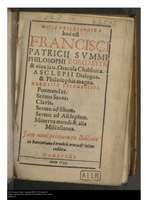
Philosophical Magic: Zoroaster and his 320 Chaldean Oracles
This work reclaims the identity of Zoroaster as a primordial philosopher rather than a mythical figure. Patrizi argues that the cosmos is a divine construction, pulsating with the activity of the Paternal Mind and maintained by the soul. Readers will find a rigorous defense of theurgy as a legitimat

Works in Greek and Latin
Clement treats the entirety of human existence as a classroom for the soul. He claims that Greek philosophy contains fragments of divine truth, though it ultimately fails to reach the goal of salvation. Instead, he proposes the Word of God as the true Instructor who heals the passions and guides hum

On Isis and Osiris
In this treatise, Plutarch rescues Egyptian theology from the twin errors of superstition and skepticism. He argues that myths about dismemberment and divine struggle are not accounts of ancient kings, but symbolic representations of moral and metaphysical forces. By mapping these stories onto the b

Greek Patrology, Vol. 8: Clement of Alexandria I

Works, Vol. I (Dindorf, Oxford)
Clement of Alexandria presents a bold vision where Greek philosophy serves as a mere prelude to the ultimate truth of the Logos. He argues that while poets like Orpheus and Sophocles caught sparks of divinity, only the Christian Way offers a complete transformation of human nature. This text is not

Plutarch's Morals, Vol. 4 (includes Isis and Osiris)
In this compelling volume of 'Morals,' Plutarch investigates the enigmatic mechanics of the 'spirit of divination,' arguing that prophecy is as much a physical phenomenon as it is a divine one. By examining the transformative power of natural vapors and the 'dry' temperament of the soul, he suggests

Plutarch's Morals, Vol. 5
This volume provides a fascinating window into Plutarch’s dual mastery of political ethics and natural philosophy. Plutarch moves beyond mere biography to offer bold claims about the physical world—arguing that cold is an active force rather than a mere absence of heat, and critiquing the Stoic visi

Timaeus (Greek text with commentary)
R.D. Archer-Hind’s edition of the Timaeus offers a radical reinterpretation of Plato’s later philosophy, arguing that this dialogue represents the culmination of Platonic metaphysics where the dualism of mind and matter is finally resolved. By identifying Being with a Universal Mind, the text presen

Timaeus
This text argues that the physical world is not an independent reality but a symbolic refraction of a universal soul. It solves the ancient deadlock between Herakleitos, who saw only constant change, and Parmenides, who saw only immutable stillness. By reconciling these opposites through the concept

On the Chaldean Oracles
In 'De oraculis Chaldaicis', Wilhelm Kroll performs a masterclass in philological detective work, reconstructing the lost fragments of a text that Neoplatonists like Proclus considered more authoritative than Plato himself. This work navigates the high-stakes tension between rigorous historical crit

The Republic
Most people act justly only because they fear the consequences of getting caught. Plato guts this assumption by creating a theoretical city where justice is defined not by laws, but by the internal harmony of the individual soul. He argues that political stability requires rulers who hate power and

Works of Plato (Republic, Timaeus, Critias)
Plato, the architect of Western philosophy, invites readers into a series of intellectual battles that remain startlingly modern. In these pages, he dismantles the cynical view that 'might makes right' and proposes a revolutionary vision of an ideal state where gender is no barrier to leadership and

Clement of Alexandria I: Protrepticus and Paedagogus
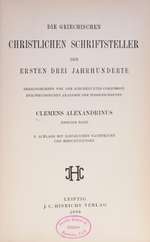
Clement of Alexandria II: Stromata I-VI
Clement argues that all wisdom originates from a singular divine source. He asserts that Greek philosophy serves as a vital tool for the believer, provided it is treated as a preparation rather than the final destination. The text demands intellectual rigor and warns against the vanity of mere debat

The Miscellanies, Books I-VI
This text operates as a masterclass in synthesis, bridging the gap between pagan philosophy and the rigorous demands of the Christian faith. Clement claims that the Greeks borrowed their greatest insights from Hebrew prophets, framing philosophy as a necessary preparation for a deeper understanding

The Chaldaean Oracles
G.R.S. Mead brings to life one of the most mysterious and influential texts of late antiquity, bridging the gap between Hellenic philosophy and Eastern mysticism. Through his unique Gnostic-leaning perspective, Mead decodes the cryptic Oracles to describe a universe governed by 'Iynges' (divine whir

Clement of Alexandria III: Stromata VII-VIII, Excerpts, and Who is the Rich Man that Shall be Saved?
This volume functions as the ultimate key to the library of a brilliant mind. Clement of Alexandria does not merely cite pagan authors; he reframes their concepts of virtue, cosmology, and ethics to construct a Christian framework. He demands that his readers move beyond simple faith toward a rigoro