The Chaldaean Oracles
The Chaldæan Oracles weren’t Chaldæan, nor were they oracles in the traditional sense – they were something else entirely.
Primary Sources

Proclus' Commentary on Plato's Republic (Cambridge, St John's College, MS F.15)
This commentary is not merely an analysis of political theory. It is a guide to the Neoplatonic universe where justice serves as a structural harmony for both the city and the individual soul. Proclus argues that myths are not just stories, but symbolic veils designed to hide profound divine truths

The Chaldean Oracles
This text offers a rare, syncretic exploration of Zoroastrian oracles interpreted through the lens of Neoplatonic and Christian thought. It presents a universe structured in three distinct parts—the eternal, the immortal but generated, and the decaying—and positions the human soul as a mediator 'glu
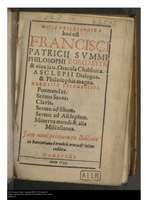
Philosophical Magic: Zoroaster and his 320 Chaldean Oracles
This work reclaims the identity of Zoroaster as a primordial philosopher rather than a mythical figure. Patrizi argues that the cosmos is a divine construction, pulsating with the activity of the Paternal Mind and maintained by the soul. Readers will find a rigorous defense of theurgy as a legitimat

Philosophical Magic: The Chaldean Oracles
This text provides a bridge between ancient pagan theology and the Christian era by asserting that the oldest sages were actually practitioners of a high, holy religion. Patrizi challenges the Aristotelian status quo of his time by arguing that philosophy is inherently tied to theurgy and the animat

Select Works of Porphyry
Select Works of Porphyry offers a rigorous and poetic manual for spiritual transcendence that remains strikingly relevant today. Porphyry presents a radical defense of 'ethical vegetarianism,' arguing that the slaughter of animals is historically and spiritually linked to human warfare and moral dec

Nicene and Post-Nicene Fathers, Series 1, Vol. 1 (Augustine: Confessions, Letters)
Philip Schaff compiles an essential record of the early Church through the eyes of Eusebius, the man who first mapped out Christian history. The text tackles the messy reality of the Arian controversy and the precarious rise of Constantine. It forces you to confront the divide between a faith under

On the Chaldean Oracles
In 'De oraculis Chaldaicis', Wilhelm Kroll performs a masterclass in philological detective work, reconstructing the lost fragments of a text that Neoplatonists like Proclus considered more authoritative than Plato himself. This work navigates the high-stakes tension between rigorous historical crit

The Chaldaean Oracles
G.R.S. Mead brings to life one of the most mysterious and influential texts of late antiquity, bridging the gap between Hellenic philosophy and Eastern mysticism. Through his unique Gnostic-leaning perspective, Mead decodes the cryptic Oracles to describe a universe governed by 'Iynges' (divine whir

Numenius of Apamea: The Father of Neo-Platonism
Readers will encounter the true origins of Neoplatonic thought through the fragmented brilliance of Numenius of Apamea. The author presents a rigorous system where the First God remains aloof while a Second God undertakes the messy business of creation. By tracing the soul's descent into material im