Inter philosophos occultorum curiosior: Numenius of Apamea
Numenius of Apamea is a tantalising figure in the history of esotericism: we have just enough of his writings – preserved in fragments by Christians and also reconstructible with great difficulty and danger from the writings of later philosophers –to give us some idea of what kind of philosopher he was.
Primary Sources

Proclus in Politiam Platonis . Proklos eis Politeian tou Platonos
In this commentary, the last great Neoplatonist philosopher reconciles the poetic genius of Homer with the rigorous logic of Plato. Proclus argues that myths are not fabrications but deliberate veils for ineffable truths. He maintains that true music and rhythm serve as the structural foundation for

Origen, Homiliae in Psalmos (29 homilies, discovered 2012)
These homilies represent a rare direct encounter with Origen's preaching voice. He treats the Psalms not as ancient poetry, but as a map for internal warfare and divine union. The text challenges the reader to categorize their own thoughts and desires as either fleeting shadows or eternal seeds. Ori

Vat.gr.243
This manuscript acts as a master class in the anatomy of language and existence. It moves from simple definitions of genus and species to the complex machinery of modal syllogisms. By analyzing how we predicate properties to subjects, the text forces the reader to confront the limits of human knowle

Philosophical and Literary Miscellany
Vat.gr.2181 is a multi-layered interrogation of the Greek soul, weaving together the technical precision of poetic metrics with the subversive chaos of Old Comedy. Through the works of Aristophanes and the reflections of Porphyry, the manuscript explores the corrupting influence of money on the poli

Proclus: Platonic Theology and Elements of Theology
This work defines the hierarchy of the universe through the eyes of one of antiquity's final great thinkers. Proclus argues that reality is not a random collection of objects but a systematic emanation from the One. He explains how human intellect can bridge the gap between mortal limitations and et

Contra Celsum (1481 editio princeps)
This editio princeps reveals more than a theological argument. It captures the tension between Humanist scholarship and the existential dread caused by the Ottoman advance into Italy. Origen argues that Christianity survives not through the ornate rhetoric of philosophers, but through the lived powe

On the Dream of Scipio; The Saturnalia
Macrobius delivers a unique time capsule from the fifth century. He frames his work as a series of lively, high-stakes banquets where Roman intellectuals dissect everything from the calendar to the mechanics of the human stomach. The book argues that all gods ultimately point to the sun and that gre

The Collected Works of Macrobius
Macrobius offers a breathtaking Neoplatonic synthesis that transforms the study of literature, science, and ethics into a spiritual pilgrimage. By providing a technical commentary on Cicero’s 'Dream of Scipio' and a sweeping encyclopedic dialogue in the 'Saturnalia,' he argues that the universe is g

Commentary on the Dream of Scipio; The Saturnalia; On the Birthday
This volume serves as a systematic record of Roman science, religion, and literature. Macrobius uses Cicero’s Dream of Scipio to explore the immortality of the soul and the mathematical ratios of the planets. He identifies the Sun as the singular power behind all major deities while providing techni

Preparation for the Gospel

On Abstinence from Animal Food
In this seminal Neoplatonist treatise, Porphyry argues that the consumption of meat is a spiritual anchor that binds the human soul to material distraction. By refuting the anthropocentric claims of the Stoics and Epicureans, he posits that animals possess reason, sensation, and a share in the 'comm

Commentary on the Dream of Scipio and the Saturnalia
Macrobius’s writings represent the ultimate synthesis of Late Antique wisdom, bridging the gap between the classical past and the medieval future. In his 'Commentary on the Dream of Scipio,' he offers a radical Neoplatonic vision of the soul's descent from the stars, arguing that our physical life i

Proclus, Theologia Platonica; Michael Psellos
This essential exploration of Neoplatonic thought bridges the gap between Platonic philosophy and the mystical traditions of Orpheus and the Chaldeans. Proclus and Psellos argue that the universe is not a random collection of matter, but a sophisticated hierarchy governed by the interplay of 'Limit'

Complete Extant Works
This collection serves as a direct challenge to the foundations of ancient religious life. Clement strips away the veneer of pagan mythology, exposing its deities as merely mortal men and its temples as burial grounds. He argues that Greek philosophy, while incomplete, provides the essential logical

Commentary on the First Book of Euclid's Elements
This commentary moves beyond standard textbook explanations to position Euclid as a guide for metaphysical development. Proclus argues that mathematical forms are innate to the soul, acting as a mirror for higher intellectual archetypes. He challenges the reader to look past the visible drawing of a

Extant Works
Clement does not view the world of Greek philosophy as an enemy to his faith. Instead, he treats it as a classroom where humanity learns to recognize the truth found in Christ. He argues that Greek thinkers were essentially students of Hebrew prophecy who failed to grasp the full picture. This colle

Works in Greek and Latin
Clement treats the entirety of human existence as a classroom for the soul. He claims that Greek philosophy contains fragments of divine truth, though it ultimately fails to reach the goal of salvation. Instead, he proposes the Word of God as the true Instructor who heals the passions and guides hum

Elements of Theology and Physics
Proclus’s 'Elements of Theology and Physics' is a monumental achievement in late classical philosophy, offering a systematic 'More Geometrico' (mathematical style) approach to the nature of existence. By transforming metaphysical inquiry into a series of logical propositions and proofs, Proclus maps

Life of Pythagoras and Sentences on the Intelligibles
Porphyry’s 'Life of Pythagoras and Sentences on the Intelligibles' offers a rare window into the ancient quest for spiritual deification through intellect and discipline. By blending a hagiography of Pythagoras—complete with his rejection of the 'impure' Cylon and his cryptic dietary bans—with a rig

Against Celsus
This 1658 edition presents the definitive intellectual struggle between early Christian thought and pagan philosophy. Origen systematically dismantles the arguments of Celsus by shifting the debate from mere rhetoric to the moral transformation of the human soul. He argues that the life and death of

Origen Philocalia (Greek)
In this definitive collection edited by William Spencer, readers encounter the first great synthesis of Greek philosophy and Christian theology. Origen does not merely rebut charges of magic and sedition; he builds a comprehensive metaphysical framework that justifies 'simple faith' as a moral medic

Proclus (Cambridge, Trinity College, MS O.5.11)
This manuscript preserves the rigorous dialectic of one of antiquity’s final great minds. Proclus examines the One not as a physical object, but as the absolute origin and end of every existing thing. He challenges the reader to consider how a source can be responsible for all diversity without beco

Platonic Theology (Thomas Taylor trans.)
This work functions as a complete, scientific manual for navigating the hierarchy of the universe. Proclus rejects the idea that the divine is beyond our reach; instead, he provides a rigorous path for the human soul to return to its source. Readers will encounter a vision where stars are living bei
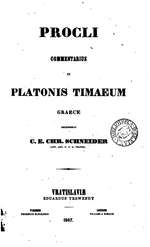
Commentary on Plato's Timaeus
This commentary serves as the definitive architecture of Neoplatonic thought, mapping the procession of all things from the One down to the physical realm. Proclus argues that the universe is not a product of blind chance but a living, ordered image sustained by divine providence. He treats the Tima

Commentary on the Timaeus
Proclus offers a breathtakingly dense metaphysical defense of Plato’s cosmology, positioning the soul as the critical 'middle nature' bridging the eternal and the material. By weaving together Pythagorean mathematics, Orphic theology, and rigorous dialectic, he argues that the cosmos is not a random

Select Works of Porphyry
Select Works of Porphyry offers a rigorous and poetic manual for spiritual transcendence that remains strikingly relevant today. Porphyry presents a radical defense of 'ethical vegetarianism,' arguing that the slaughter of animals is historically and spiritually linked to human warfare and moral dec

On the Months
This text operates as a bridge to a vanished intellectual era. Lydus compiles fragments from sources now lost to time, organizing them into a map of the Roman year. He treats time as a physical and spiritual architecture, connecting the simple act of marking days to Pythagorean number theory and the

Complete Works XVIII: Against Celsus I-IV (Lommatzsch)
In 'Contra Celsum I-IV,' Origen provides a groundbreaking response to the first major intellectual assault on Christianity. Rather than relying solely on tradition, Origen deconstructs Greek mythology as morally bankrupt while elevating the historical and ethical superiority of the Mosaic law and th

Complete Works XIX: Against Celsus V-VIII (Lommatzsch)
This work captures a master of Greek logic turning his focus toward his fiercest opponent. Origen refuses to retreat into silence; he dissects every charge Celsus brings against the Christian faith. He tackles the paradox of the incarnation, the validity of biblical allegory, and the nature of human

Proclus: Commentary on Plato's Timaeus

Greek Patrology, Vol. 8: Clement of Alexandria I

Patrologia Graeca vol. 12: Origenes II
This text presents the early church's most intense battle over how to read the Bible. Origen argues that the literal meaning often collapses into absurdity, forcing the reader to search for a deeper, allegorical truth. He connects the soul's journey to the events of Genesis and Exodus, claiming the

Works (Opera)
This text operates as an intellectual banquet where Roman scholars debate the meaning of their own traditions. Macrobius argues that all classical deities act as mere masks for the singular power of the Sun. He rejects blind superstition in favor of natural philosophy, aiming to harmonize myth with

Works, Vol. I (Dindorf, Oxford)
Clement of Alexandria presents a bold vision where Greek philosophy serves as a mere prelude to the ultimate truth of the Logos. He argues that while poets like Orpheus and Sophocles caught sparks of divinity, only the Christian Way offers a complete transformation of human nature. This text is not

On Numenius the Platonic Philosopher
Friedrich Thedinga’s dissertation reconstructs the thought of Numenius, a philosopher who dared to label Plato as Moses speaking in Attic Greek. The text critiques the historical corruption of the Platonic Academy and establishes a rigorous hierarchy of three distinct gods. Readers will encounter a

Three Short Works (including Life of Pythagoras)
This volume, meticulously edited by the legendary August Nauck, preserves the surviving fragments of Porphyry’s most personal and provocative works. At its core, the text challenges the foundations of ancient Greek religion, replacing blood-soaked sacrifices with a philosophy of internal purity and

Commentary on the Dream of Scipio
Macrobius presents a world where philosophy, medicine, and literary criticism collide at a Roman banquet. He argues that all mythology acts as a veil for physical truth, particularly the sun as the source of divine power. By analyzing Virgil alongside ancient history and mathematical ratios, he maps

Origenes: Contra Celsum (Greek Critical Edition)

Commentary on Plato's Timaeus, Vol. I
Proclus’s commentary on the Timaeus represents the pinnacle of Neoplatonic cosmology, offering a rigorous metaphysical map of the sensible world. He argues that the universe is not a chaotic assembly of matter, but a unified organism positioned between the eternal and the temporal through the 'middl

Commentary on Plato's Timaeus, Volume II
Ernst Diehl’s landmark edition of Proclus’ commentary is more than a philological triumph; it is a gateway to the ancient world’s most sophisticated interpretation of cosmic origins. By tracing the 'genealogy' of the text through the libraries of Renaissance cardinals and Byzantine scribes, Diehl re

Clement of Alexandria I: Protrepticus and Paedagogus
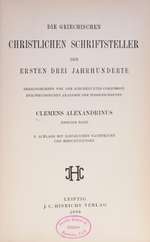
Clement of Alexandria II: Stromata I-VI
Clement argues that all wisdom originates from a singular divine source. He asserts that Greek philosophy serves as a vital tool for the believer, provided it is treated as a preparation rather than the final destination. The text demands intellectual rigor and warns against the vanity of mere debat

The Miscellanies, Books I-VI
This text operates as a masterclass in synthesis, bridging the gap between pagan philosophy and the rigorous demands of the Christian faith. Clement claims that the Greeks borrowed their greatest insights from Hebrew prophets, framing philosophy as a necessary preparation for a deeper understanding

Clement of Alexandria III: Stromata VII-VIII, Excerpts, and Who is the Rich Man that Shall be Saved?
This volume functions as the ultimate key to the library of a brilliant mind. Clement of Alexandria does not merely cite pagan authors; he reframes their concepts of virtue, cosmology, and ethics to construct a Christian framework. He demands that his readers move beyond simple faith toward a rigoro

Numenius of Apamea: The Father of Neo-Platonism
Readers will encounter the true origins of Neoplatonic thought through the fragmented brilliance of Numenius of Apamea. The author presents a rigorous system where the First God remains aloof while a Second God undertakes the messy business of creation. By tracing the soul's descent into material im