Alone with the Alone: Numenius' Metaphysics
We explore the philosophy of Numenius, in which we see the stirrings of a new type of apophatic discourse of transcendence which will come to be definitive of late antique metaphysics and theology.
Primary Sources

Republic, Laws, and Timaeus
In this profound synthesis of 'Republic,' 'Laws,' and 'Timaeus,' Plato bridges the gap between the earthly and the divine. He argues that virtue is not merely a behavior, but a liberation of the soul achieved through alignment with the celestial sphere and the internalizing of 'common conceptions.'

Twenty-four Dialogues of Plato

Vat.gr.1
In this provocative text, Plato subverts the traditional Western emphasis on human agency by defining man as a 'divine plaything,' suggesting that our greatest dignity lies in our role as puppets of the gods. Rather than finding meaning in the grim struggle of war or history, the author argues for a

Pal.gr.173
Pal.gr.173 functions as a practical manual for the soul. It moves beyond abstract theory to confront the actual stakes of living well in an unjust world. You will encounter a Socratic method that values clear thinking over popularity and moral integrity over political safety. The text forces a confr

On Paradoxical Machines
In 'On Paradoxical Machines,' Anthemius of Tralles offers a rare synthesis of high Euclidean theory and the practical grit of Byzantine engineering. As one of the master architects of Constantinople, Anthemius argues that the most profound challenges of the physical world—from the construction of bu

Urb.gr.31
Plato presents a brutal inquiry into the nature of justice and the health of the human soul. He argues that justice is not a social compromise but a requirement for inner harmony. You will discover why political leadership requires a rare, philosophical rigor that society almost always rejects. The

Plato . Platon . Platonis Dialogi
This collection captures the urgent, living spirit of Socratic inquiry at its most potent. Plato argues that we must abandon the distractions of the physical realm to grasp eternal truths. He warns that writing creates a dangerous illusion of wisdom by substituting memorized facts for internal under

The Enneads

The Enneads
The Enneads is a towering achievement of late antiquity that reshaped the trajectory of Western and Near-Eastern thought, influencing everything from Christian theology to Islamic mysticism. Plotinus presents a bold metaphysical hierarchy—the One, the Intellect, and the Soul—arguing that true happin

Diversorum scriptorum Opera varia . Diaphoron syngrapheon Erga diaphora . Titulum corrige Platonis Opera omnia cum prolegomenis
Plato’s work functions as a complete framework for human conduct and cosmic understanding. He moves beyond simple dialogue to categorize the structure of reality, linking music, numbers, and political virtue to the divine. Each page challenges the reader to distinguish between fleeting sensory opini

Plotinus . Plotinos . Scilicet Plotini Enneades VI et Maximi Tyrii Dissertationes XI
Plotinus strips away the distractions of the physical world to reveal the singular, transcendent source of all being. The text documents the final philosophical ascent of a man who viewed his own body as a temporary, secondary image. You will encounter arguments that collapse the boundaries between

Commentary on Plato's Timaeus

Cologny, Fondation Martin Bodmer, Cod. Bodmer 136
In this legendary account of Socrates’ final day, Plato (narrated through Phaedo) investigates the profound relationship between the soul, the divine, and the morality of existence. The text presents a startlingly calm Socrates who argues that humans are the 'possessions of the gods,' framing life a

Commentary on Plato's Timaeus

The Enneads
The Enneads is a monumental achievement in Western philosophy, serving as the bridge between classical Hellenic thought and the burgeoning spiritual traditions of Late Antiquity. Plotinus offers a unique perspective on reality, viewing the physical world as a mere 'image of an image' while positing

Plotinus, Enneads I-VI; Porphyry, Vita Plotini
This collection, organized by Porphyry, serves as a direct guide for anyone seeking to understand the soul's origin and ultimate return to the One. Plotinus treats philosophy not as an academic exercise, but as a practical path toward enlightenment. He argues that the physical world is merely a shad

The Complete Works of Plato Translated by Marsilio Ficino
This collection serves as a portal to the mind of Plato as seen through the eyes of one of the 15th century's most influential thinkers. Ficino treats philosophy not as a sterile academic exercise but as a medicine for the soul. He constructs an argument for the harmony between pagan wisdom and Chri

Corpus Hermeticum and Plotinus' Enneads (Cambridge, Trinity College, MS B.9.9)
This rare collection documents the struggle of the human soul to recognize its divine origin while trapped in the sensible world. It presents the Hermetic tradition as an intuitive, performative realization of truth, contrasted against the systematic, dialectical path of Plotinus. The text argues th

The Complete Works of Plato
This monumental edition of Plato’s *Opera Omnia* is more than a translation; it is a sacred bridge between Greek antiquity and Renaissance humanism, curated by Marsilio Ficino to harmonize philosophy with divine religion. Within these pages, readers will find the 'divine' Plato—a thinker who argues

Enneads (1580 Greek-Latin, Ficino trans.)

The Enneads
The Enneads represents the pinnacle of Neoplatonic thought, a monumental synthesis where logic meets mysticism. Through the lens of Marsilio Ficino’s Renaissance commentary, Plotinus’s work is presented as a 'philosophical bait' designed to lead the intellectual mind toward religious faith through p

The Enneads

The Complete Works of the Divine Plato
This 1590 edition of Plato’s 'Complete Works' serves as a spiritual and intellectual map of the human condition, viewed through the transformative Neoplatonic lens of Marsilio Ficino. Synthesizing classical dialectic with religious piety, the text argues that the ultimate end of man is to achieve a

Plato Euthyphro, Apology, Crito, Phaedo, Phaedrus
Plato documents the final days of his teacher, Socrates, as he confronts a city that wants him dead. The text moves from the courtroom to the prison cell, eventually shifting into deep metaphysical inquiry. It argues that philosophy is nothing less than the practice of dying. By rejecting passive wr

Complete Plato (Thomas Taylor trans.)
Thomas Taylor’s 'Complete Plato' is a monumental achievement that offers more than a mere translation; it provides the 'key' to the Platonic system through the profound insights of ancient Neoplatonic commentators. Taylor argues that philosophy is a divine discipline designed to lead the soul away f
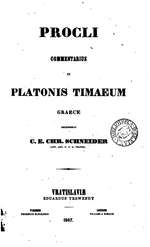
Commentary on Plato's Timaeus
This commentary serves as the definitive architecture of Neoplatonic thought, mapping the procession of all things from the One down to the physical realm. Proclus argues that the universe is not a product of blind chance but a living, ordered image sustained by divine providence. He treats the Tima

Commentary on the Timaeus
Proclus offers a breathtakingly dense metaphysical defense of Plato’s cosmology, positioning the soul as the critical 'middle nature' bridging the eternal and the material. By weaving together Pythagorean mathematics, Orphic theology, and rigorous dialectic, he argues that the cosmos is not a random

Plotini Opera Omnia cum Ficini commentariis
Plotini Opera Omnia represents the pinnacle of Neoplatonic thought, blending the original 3rd-century mystical insights of Plotinus with the intellectual fire of the Renaissance philosopher Marsilio Ficino. This text serves as a rigorous bridge between the classical logic of Plato and the burgeoning

Proclus: Commentary on Plato's Timaeus

Works of Plato
Plato’s 'The Laws' represents a monumental shift in the philosopher's journey, moving from the idealism of his youth toward a rigorous, practical exploration of legislation and social order. Translated by George Burges in 1880, this edition provides a meticulous 'literal version' that preserves the

On Numenius the Platonic Philosopher
Friedrich Thedinga’s dissertation reconstructs the thought of Numenius, a philosopher who dared to label Plato as Moses speaking in Attic Greek. The text critiques the historical corruption of the Platonic Academy and establishes a rigorous hierarchy of three distinct gods. Readers will encounter a

Dialogues of Plato, Vol. 5 (Laws, Epinomis, Letters)
This volume presents Plato’s final, most grounded political work. Unlike the Republic, these pages focus on the practical mechanisms of governance, education, and criminal justice. Plato argues that the soul must prioritize divine order over base human appetites to achieve any lasting stability. He

Timaeus (Greek text with commentary)
R.D. Archer-Hind’s edition of the Timaeus offers a radical reinterpretation of Plato’s later philosophy, arguing that this dialogue represents the culmination of Platonic metaphysics where the dualism of mind and matter is finally resolved. By identifying Being with a Universal Mind, the text presen

Timaeus
This text argues that the physical world is not an independent reality but a symbolic refraction of a universal soul. It solves the ancient deadlock between Herakleitos, who saw only constant change, and Parmenides, who saw only immutable stillness. By reconciling these opposites through the concept

Phaedo
The Phaedo captures the final conversation of a man facing his own execution with absolute calm. Socrates argues that the philosopher spends their entire life preparing for death because the body acts as a prison for the truth. He maintains that true knowledge belongs only to the soul, which must ev

The Republic
Most people act justly only because they fear the consequences of getting caught. Plato guts this assumption by creating a theoretical city where justice is defined not by laws, but by the internal harmony of the individual soul. He argues that political stability requires rulers who hate power and

Works of Plato (Republic, Timaeus, Critias)
Plato, the architect of Western philosophy, invites readers into a series of intellectual battles that remain startlingly modern. In these pages, he dismantles the cynical view that 'might makes right' and proposes a revolutionary vision of an ideal state where gender is no barrier to leadership and

Commentary on Plato's Timaeus, Vol. I
Proclus’s commentary on the Timaeus represents the pinnacle of Neoplatonic cosmology, offering a rigorous metaphysical map of the sensible world. He argues that the universe is not a chaotic assembly of matter, but a unified organism positioned between the eternal and the temporal through the 'middl

Commentary on Plato's Timaeus, Volume II
Ernst Diehl’s landmark edition of Proclus’ commentary is more than a philological triumph; it is a gateway to the ancient world’s most sophisticated interpretation of cosmic origins. By tracing the 'genealogy' of the text through the libraries of Renaissance cardinals and Byzantine scribes, Diehl re

Plato: Laches, Protagoras, Meno, Euthydemus
Plato’s dialogues remain the standard for critical thinking because they force the reader to defend their own assumptions. This collection captures Socrates at his most agile, moving from the definition of courage to the nature of knowledge itself. You will see him challenge the Sophists, whose reli

Works (Laws, Definitions)

Euthyphro, Apology, Crito, Phaedo, and Phaedrus
This collection captures the final days of history's most famous provocateur. Socrates turns his own trial into a masterclass on how to live and die with integrity. He dismantles the hollow arguments of his accusers and shows that true wisdom starts with the admission of ignorance. The text forces y

The Enneads of Plotinus Vol. I
The Enneads of Plotinus, translated with poetic intensity by Stephen McKenna, stands as the foundation of Neoplatonism and a bridge between classical Greek logic and Western mysticism. Plotinus offers a bold metaphysical hierarchy—The One, the Intellectual-Principle, and the Soul—arguing that our tr

Numenius of Apamea: The Father of Neo-Platonism
Readers will encounter the true origins of Neoplatonic thought through the fragmented brilliance of Numenius of Apamea. The author presents a rigorous system where the First God remains aloof while a Second God undertakes the messy business of creation. By tracing the soul's descent into material im

Plato: Statesman and Philebus
Plato does not merely lecture; he forces his readers to think alongside his characters. In these texts, he argues that the best kind of power is not found in static codes but in the flexible, living intelligence of the expert. He dismantles the idea that pleasure or intellect alone can anchor a huma