Geoffrey Smith on Valentinus and Valentinianism
Geoffrey Smith is a ‘Gnosticism-Sceptic’ along the lines we saw in our episode with Michael Williams, so he is not particularly interested in labelling Valentinus a Gnostic.
Primary Sources

Complete Extant Works
This collection serves as a direct challenge to the foundations of ancient religious life. Clement strips away the veneer of pagan mythology, exposing its deities as merely mortal men and its temples as burial grounds. He argues that Greek philosophy, while incomplete, provides the essential logical

Extant Works
Clement does not view the world of Greek philosophy as an enemy to his faith. Instead, he treats it as a classroom where humanity learns to recognize the truth found in Christ. He argues that Greek thinkers were essentially students of Hebrew prophecy who failed to grasp the full picture. This colle

Works in Greek and Latin
Clement treats the entirety of human existence as a classroom for the soul. He claims that Greek philosophy contains fragments of divine truth, though it ultimately fails to reach the goal of salvation. Instead, he proposes the Word of God as the true Instructor who heals the passions and guides hum

Greek Patrology, Vol. 8: Clement of Alexandria I

Works, Vol. I (Dindorf, Oxford)
Clement of Alexandria presents a bold vision where Greek philosophy serves as a mere prelude to the ultimate truth of the Logos. He argues that while poets like Orpheus and Sophocles caught sparks of divinity, only the Christian Way offers a complete transformation of human nature. This text is not

Clement of Alexandria I: Protrepticus and Paedagogus
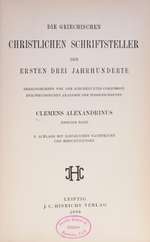
Clement of Alexandria II: Stromata I-VI
Clement argues that all wisdom originates from a singular divine source. He asserts that Greek philosophy serves as a vital tool for the believer, provided it is treated as a preparation rather than the final destination. The text demands intellectual rigor and warns against the vanity of mere debat

The Miscellanies, Books I-VI
This text operates as a masterclass in synthesis, bridging the gap between pagan philosophy and the rigorous demands of the Christian faith. Clement claims that the Greeks borrowed their greatest insights from Hebrew prophets, framing philosophy as a necessary preparation for a deeper understanding

Clement of Alexandria III: Stromata VII-VIII, Excerpts, and Who is the Rich Man that Shall be Saved?
This volume functions as the ultimate key to the library of a brilliant mind. Clement of Alexandria does not merely cite pagan authors; he reframes their concepts of virtue, cosmology, and ethics to construct a Christian framework. He demands that his readers move beyond simple faith toward a rigoro

Ante-Nicene Fathers, Vol. 5 (Hippolytus, Cyprian, Novatian)
This collection presents primary evidence for the intellectual battles of the early Church. Hippolytus argues that Gnosticism is not a new revelation but a patchwork of stolen pagan ideas and astrological tricks. Cyprian shifts the focus to the practical struggle for unity, proving that the early Ro

Refutation of All Heresies, Vol. 1
This text provides an aggressive polemic against the Gnostic sects that threatened to fracture the early Christian Church. Hippolytus dismantles their claims to divine revelation by tracing their doctrines back to the pagan classrooms of Pythagoras, Plato, and the Stoics. He asserts that these movem

Refutation of All Heresies, Vol. 2
This volume is an aggressive polemic against the Gnostic thinkers who threatened the foundations of the early Church. Hippolytus dismantles systems like those of Valentinus and Basilides by tracing their roots directly back to Pythagoras and Aristotle. He identifies these doctrines not as divine rev