Matteo Martelli on the Pseudo-Democritus
The author known as Democritus wrote four books some time in the first century CE: one book on gold, one on silver, one on gemstones, and one on dying techniques.
Primary Sources
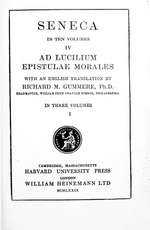
Seneca's Moral Letters, Volume 1
Seneca’s 'Epistulae Morales' is far more than a collection of ancient correspondence; it is a masterclass in Stoic resilience written by a man of staggering contradictions. While serving as a wealthy advisor to the volatile Nero, Seneca wrestled with the tension between material success and spiritua

On the Great Art
Attributed to the legendary philosopher Democritus, 'On the Great Art' is a cornerstone of Hermetic wisdom that bridges the gap between practical metallurgy and sublime mysticism. The text posits that the universe is governed by a singular natural matter, reachable only through the 'Great Purificati

Seneca's Moral Epistles Vol. 2 (Letters 66-92)
In this profound volume of the Epistulae Morales, Seneca presents a radical Stoic defense of the equality of all virtues. Through the moving example of his physically frail friend Claranus, Seneca argues that the Supreme Good is an absolute force, unmarred by external deformity or hardship. He makes

On Isis and Osiris
In this treatise, Plutarch rescues Egyptian theology from the twin errors of superstition and skepticism. He argues that myths about dismemberment and divine struggle are not accounts of ancient kings, but symbolic representations of moral and metaphysical forces. By mapping these stories onto the b

Pistis Sophia
The 'Pistis Sophia' is a profound 4th-century Gnostic gospel that challenges traditional narratives, presenting a transfigured Jesus who reveals 'higher mysteries' to disciples like Mary Magdalene and Martha. This edition, meticulously preserved by scholars like Petermann and Woide, serves as a gate

Plutarch's Morals, Vol. 4 (includes Isis and Osiris)
In this compelling volume of 'Morals,' Plutarch investigates the enigmatic mechanics of the 'spirit of divination,' arguing that prophecy is as much a physical phenomenon as it is a divine one. By examining the transformative power of natural vapors and the 'dry' temperament of the soul, he suggests

New History (Historia Nova)
The New History remains one of the most provocative accounts of late Roman decline. Zosimus breaks from other historians by blaming the empire's collapse on the rise of Christianity and the resulting loss of traditional civic rituals. His writing captures the atmosphere of a state descending into ch

Collection of Ancient Greek Alchemists, Part 1
Marcellin Berthelot and Charles-Émile Ruelle document the true origins of chemistry. They prove that ancient alchemists were originally goldsmiths who mastered the art of faking precious metals. Through the analysis of the Leiden Papyri, the authors show how these deceptive laboratory practices slow

Collection of Ancient Greek Alchemists, Part 2
This text compiles the authentic writings of Zosimus, the foundational voice of Western alchemy. It moves past simple chemistry to argue that metal transmutation is a Gnostic struggle between body and soul. Zosimus claims that if you fail to turn bodies into spirits, you will never achieve the Philo

Collection of Ancient Greek Alchemists, Part 3
Marcellin Berthelot and Charles-Émile Ruelle compile a raw, unfiltered archive of Greek alchemical thought. You will encounter ancient lab manuals that treat metallurgy as a religious duty and a scientific puzzle. These texts argue that base materials like copper hold a hidden perfection that only t

Seneca's Moral Epistles Vol. 3 (Letters 93-124)
Seneca’s 'Moral Letters to Lucilius, Volume III' represents the mature zenith of Stoic philosophy, offering a roadmap for ethical living in an era of uncertainty. Through this acclaimed Loeb Classical Library edition, translated by Richard M. Gummere, readers are invited into a private correspondenc