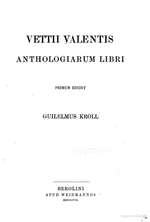
The Astrology of Vettius Valens
Vettius Valens of Antioch (120-some time after 173 CE) was a practising astrologer. His book, the Anthologies, survives in its original Greek, although it shows manifest signs of tampering up to the fifth century – this tampering, however, was by other astrologers who continued adding material to the text, keeping it up-to-date.
Primary Sources

Tetrabiblos
The Tetrabiblos is not merely a book of horoscopes; it is a monumental attempt by the father of geography and astronomy to rationalize celestial influence through the lens of Aristotelian natural philosophy. Ptolemy argues that the stars exert a physical 'temperament' upon the world, governing every

Tetrabiblos and Centiloquy
Claudius Ptolemy’s Quadripartitum, enriched by Hali’s classic commentary, stands as the most influential defense of astrology as a legitimate branch of natural philosophy. Rather than mere superstition, Ptolemy presents astrology as a rigorous study of physical influence, where the four qualities—he

Tetrabiblos (Quadripartitum)

Books of Astronomy (Firmicus, Manilius, Aratus)
Firmicus Maternus and his peers treat astrology not as superstition but as a rigorous, divine science. The text argues that the human soul remains trapped in a mortal body that responds to the precise movements of the Moon and planets. It provides specific, technical instructions for calculating lif

Fables; Poetic Astronomy; Fulgentius' Mythologies; Palaephatus; Aratus' Phenomena; Proclus On the Sphere
This volume is an essential library for anyone seeking to understand the antique view of the cosmos. It bridges the gap between literal fable and scientific observation. By gathering the works of Hyginus, Fulgentius, and Aratus, the editors demonstrate how myths once served as maps for both the heav

Astronomica
Marcus Manilius’s Astronomica, particularly in this definitive edition by Joseph Scaliger, offers a unique window into the early 1st-century AD Roman understanding of the cosmos. Far from mere superstition, the text presents a rigorous, technical system where the universe is a rational organism gove

Aphoristic Astrology of Ptolemy, Hermes, and Others
This 1641 Latin compilation serves as a monumental crossroads for Western esoteric thought, systematically organizing the aphoristic wisdom of astrology’s most legendary figures. By blending the mathematical rigor of Girolamo Cardano with the foundational philosophy of Ptolemy’s Centiloquium, the te

Tetrabiblos (The Four Books)
This text argues that celestial bodies act as a physical engine for the terrestrial world. Ptolemy maintains that the movements of the Sun and Moon regulate the seasons and the physical constitution of every living thing. By applying these observations to human birth charts, he creates a system for

Aratus with Commentaries
This text bridges the gap between cold celestial mechanics and the urgent needs of human life. Aratus argues that the heavens are not merely distant lights but a coherent system of divine signals meant to be read by the vigilant. By observing stars, animal behavior, and atmospheric shifts, a person