The Orthodox Gnostic: Introducing Clement of Alexandria
Clement is a hard man to do justice to in a single podcast episode, but we give it our best shot in this one, the first, introductory episode in a series on the early Christian father.
Primary Sources

Chronicle (Chronicon)

Ecclesiastical History

Preparation for the Gospel

Complete Extant Works
This collection serves as a direct challenge to the foundations of ancient religious life. Clement strips away the veneer of pagan mythology, exposing its deities as merely mortal men and its temples as burial grounds. He argues that Greek philosophy, while incomplete, provides the essential logical

Extant Works
Clement does not view the world of Greek philosophy as an enemy to his faith. Instead, he treats it as a classroom where humanity learns to recognize the truth found in Christ. He argues that Greek thinkers were essentially students of Hebrew prophecy who failed to grasp the full picture. This colle

Ecclesiastical History
Eusebius’s 'Ecclesiastical History' stands as the foundational record of the Christian faith, bridging the gap between the Apostolic age and the year 400. This 1613 edition positions history not merely as a record of the past, but as a vital necessity for the preservation of divine truth against the

Works in Greek and Latin
Clement treats the entirety of human existence as a classroom for the soul. He claims that Greek philosophy contains fragments of divine truth, though it ultimately fails to reach the goal of salvation. Instead, he proposes the Word of God as the true Instructor who heals the passions and guides hum

The Chronicle of Eusebius, Vol. 1
This volume presents the first complete recovery of the Eusebian Chronicle from a preserved Armenian manuscript. It corrects the errors of Western scholars like Scaliger, who relied on guesswork and fabricated fragments. The text bridges the gap between pagan mythology and biblical genealogy by plac

The Chronicle of Eusebius, Vol. 2
This volume serves as a radical effort to synchronize the fragmented records of antiquity. Eusebius argues that the life of Moses predates the figures of Greek mythology, effectively positioning Hebrew history as the bedrock for all secular empires. The text systematically reconciles the reigns of k

Greek Patrology, Vol. 8: Clement of Alexandria I

Works, Vol. I (Dindorf, Oxford)
Clement of Alexandria presents a bold vision where Greek philosophy serves as a mere prelude to the ultimate truth of the Logos. He argues that while poets like Orpheus and Sophocles caught sparks of divinity, only the Christian Way offers a complete transformation of human nature. This text is not

Ecclesiastical History
This work stands as the primary record of how a small, persecuted movement transformed the Roman world. Eusebius argues that Christianity is not a recent innovation, but the fulfillment of ancient prophecy and divine purpose. He documents the struggle between apostolic tradition and rising heresies.

Church History (Historia Ecclesiastica)
Eusebius of Caesarea’s 'Church History' is far more than a simple chronicle; it is a monumental work of historiography that provides the primary scaffolding for our understanding of early Christianity. In this definitive GCS edition, readers encounter a sophisticated blend of textual criticism, regn

Clement of Alexandria I: Protrepticus and Paedagogus
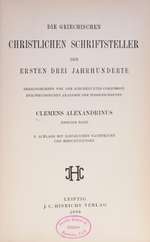
Clement of Alexandria II: Stromata I-VI
Clement argues that all wisdom originates from a singular divine source. He asserts that Greek philosophy serves as a vital tool for the believer, provided it is treated as a preparation rather than the final destination. The text demands intellectual rigor and warns against the vanity of mere debat

Clement of Alexandria III: Stromata VII-VIII, Excerpts, and Who is the Rich Man that Shall be Saved?
This volume functions as the ultimate key to the library of a brilliant mind. Clement of Alexandria does not merely cite pagan authors; he reframes their concepts of virtue, cosmology, and ethics to construct a Christian framework. He demands that his readers move beyond simple faith toward a rigoro
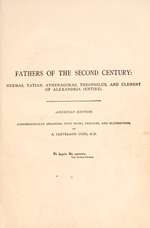
Ante-Nicene Fathers, Vol. 2 (Clement of Alexandria)
This collection captures the intellectual and moral intensity of the second century. Writers like Clement of Alexandria, Tatian, and the mysterious author of The Shepherd of Hermas dismantle pagan philosophy to clear the ground for a new, Christian worldview. They argue that true knowledge requires