Mystagogic Patchwork: Esoteric Writing in Clement's Stromateis
We explore the esoteric writing methodologies of Clement's Stromateis – the innovative ‘public secrecy’, the reasons for Clement's esotericism, and the evocation of the mysteries and of the ineffable as aspects of esoteric rhetoric.
Primary Sources

Republic, Laws, and Timaeus
In this profound synthesis of 'Republic,' 'Laws,' and 'Timaeus,' Plato bridges the gap between the earthly and the divine. He argues that virtue is not merely a behavior, but a liberation of the soul achieved through alignment with the celestial sphere and the internalizing of 'common conceptions.'

Twenty-four Dialogues of Plato

Pal.gr.173
Pal.gr.173 functions as a practical manual for the soul. It moves beyond abstract theory to confront the actual stakes of living well in an unjust world. You will encounter a Socratic method that values clear thinking over popularity and moral integrity over political safety. The text forces a confr

On Paradoxical Machines
In 'On Paradoxical Machines,' Anthemius of Tralles offers a rare synthesis of high Euclidean theory and the practical grit of Byzantine engineering. As one of the master architects of Constantinople, Anthemius argues that the most profound challenges of the physical world—from the construction of bu

Urb.gr.31
Plato presents a brutal inquiry into the nature of justice and the health of the human soul. He argues that justice is not a social compromise but a requirement for inner harmony. You will discover why political leadership requires a rare, philosophical rigor that society almost always rejects. The

Vat.gr.126
This text provides a cold, clinical autopsy of the Peloponnesian War. Thucydides rejects supernatural explanations to focus exclusively on political mechanics and military strategy. He argues that the growth of Athenian power made conflict with Sparta a mathematical certainty. By studying his accoun

Plato . Platon . Platonis Dialogi
This collection captures the urgent, living spirit of Socratic inquiry at its most potent. Plato argues that we must abandon the distractions of the physical realm to grasp eternal truths. He warns that writing creates a dangerous illusion of wisdom by substituting memorized facts for internal under

Diversorum scriptorum Opera varia . Diaphoron syngrapheon Erga diaphora . Titulum corrige Platonis Opera omnia cum prolegomenis
Plato’s work functions as a complete framework for human conduct and cosmic understanding. He moves beyond simple dialogue to categorize the structure of reality, linking music, numbers, and political virtue to the divine. Each page challenges the reader to distinguish between fleeting sensory opini

Cologny, Fondation Martin Bodmer, Cod. Bodmer 136
In this legendary account of Socrates’ final day, Plato (narrated through Phaedo) investigates the profound relationship between the soul, the divine, and the morality of existence. The text presents a startlingly calm Socrates who argues that humans are the 'possessions of the gods,' framing life a

Plato De legibus . Platonos Nomoi . Ac praeterea alii eiusdem [Platonis] Dialogi tum gnesioi, tum nothoi, Definitiones, et epistolae
This work represents the peak of Plato's political thought, moving beyond abstract theories of justice to the mechanics of statecraft. He argues that laws are empty without the internal habits of virtue that only education can provide. Plato forces the reader to confront the reality that excess and

Chronicle (Chronicon)

Plato, Cratylus and Secular Florilegium
This work presents an unflinching look at the architecture of a well-lived life. It asserts that true virtue is not an action but a deliberate choice to align the soul with divine reason. By dismantling the common obsession with physical gratification, the text demands that we prioritize the health

The Complete Works of Plato Translated by Marsilio Ficino
This collection serves as a portal to the mind of Plato as seen through the eyes of one of the 15th century's most influential thinkers. Ficino treats philosophy not as a sterile academic exercise but as a medicine for the soul. He constructs an argument for the harmony between pagan wisdom and Chri

Ecclesiastical History

Preparation for the Gospel

Complete Extant Works
This collection serves as a direct challenge to the foundations of ancient religious life. Clement strips away the veneer of pagan mythology, exposing its deities as merely mortal men and its temples as burial grounds. He argues that Greek philosophy, while incomplete, provides the essential logical

The Complete Works of Plato
This monumental edition of Plato’s *Opera Omnia* is more than a translation; it is a sacred bridge between Greek antiquity and Renaissance humanism, curated by Marsilio Ficino to harmonize philosophy with divine religion. Within these pages, readers will find the 'divine' Plato—a thinker who argues

The Complete Works of the Divine Plato
This 1590 edition of Plato’s 'Complete Works' serves as a spiritual and intellectual map of the human condition, viewed through the transformative Neoplatonic lens of Marsilio Ficino. Synthesizing classical dialectic with religious piety, the text argues that the ultimate end of man is to achieve a

Extant Works
Clement does not view the world of Greek philosophy as an enemy to his faith. Instead, he treats it as a classroom where humanity learns to recognize the truth found in Christ. He argues that Greek thinkers were essentially students of Hebrew prophecy who failed to grasp the full picture. This colle

Ecclesiastical History
Eusebius’s 'Ecclesiastical History' stands as the foundational record of the Christian faith, bridging the gap between the Apostolic age and the year 400. This 1613 edition positions history not merely as a record of the past, but as a vital necessity for the preservation of divine truth against the

Works in Greek and Latin
Clement treats the entirety of human existence as a classroom for the soul. He claims that Greek philosophy contains fragments of divine truth, though it ultimately fails to reach the goal of salvation. Instead, he proposes the Word of God as the true Instructor who heals the passions and guides hum

Plato Euthyphro, Apology, Crito, Phaedo, Phaedrus
Plato documents the final days of his teacher, Socrates, as he confronts a city that wants him dead. The text moves from the courtroom to the prison cell, eventually shifting into deep metaphysical inquiry. It argues that philosophy is nothing less than the practice of dying. By rejecting passive wr

Two Apologies and Dialogue with Trypho
This text provides a direct look at how early Christians defended their faith against charges of atheism and rebellion. Justin Martyr argues that the life of Christ is the fulfillment of ancient prophecy and the ultimate expression of the divine Word. He rejects the label of criminal, insisting that

Complete Plato (Thomas Taylor trans.)
Thomas Taylor’s 'Complete Plato' is a monumental achievement that offers more than a mere translation; it provides the 'key' to the Platonic system through the profound insights of ancient Neoplatonic commentators. Taylor argues that philosophy is a divine discipline designed to lead the soul away f

Introduction to Plato
Thomas Taylor’s 'Introduction to Plato' is a profound reclamation of ancient Neoplatonic wisdom, asserting that Plato’s work is a systematic, scientific ladder to the divine rather than mere literary dialogue. Taylor boldly positions the 'One' as a superessential principle that transcends even the C

The Chronicle of Eusebius, Vol. 1
This volume presents the first complete recovery of the Eusebian Chronicle from a preserved Armenian manuscript. It corrects the errors of Western scholars like Scaliger, who relied on guesswork and fabricated fragments. The text bridges the gap between pagan mythology and biblical genealogy by plac

The Chronicle of Eusebius, Vol. 2
This volume serves as a radical effort to synchronize the fragmented records of antiquity. Eusebius argues that the life of Moses predates the figures of Greek mythology, effectively positioning Hebrew history as the bedrock for all secular empires. The text systematically reconciles the reigns of k

The Library (Bibliotheca)
The Bibliotheca acts as a filter for the ancient world. Photius records what was worth reading and what was dangerous to believe, blending literary criticism with cold-eyed political analysis. He documents the tension between pagan wisdom and Christian dogma, tracking how ideas evolve from their ori

Greek Patrology, Vol. 8: Clement of Alexandria I

Works of Plato
Plato’s 'The Laws' represents a monumental shift in the philosopher's journey, moving from the idealism of his youth toward a rigorous, practical exploration of legislation and social order. Translated by George Burges in 1880, this edition provides a meticulous 'literal version' that preserves the

Works, Vol. I (Dindorf, Oxford)
Clement of Alexandria presents a bold vision where Greek philosophy serves as a mere prelude to the ultimate truth of the Logos. He argues that while poets like Orpheus and Sophocles caught sparks of divinity, only the Christian Way offers a complete transformation of human nature. This text is not
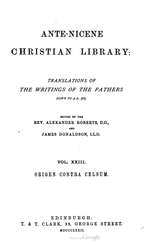
Ante-Nicene Christian Library, Vol. 23: Origen Contra Celsum
This volume captures one of the most significant debates in Western history. Origen faces Celsus, a brilliant pagan critic who attacks the Christian faith as a dangerous, superstitious sect. Origen does not retreat. Instead, he systematically deconstructs the claims of Greek philosophy to show that

Dialogues of Plato, Vol. 5 (Laws, Epinomis, Letters)
This volume presents Plato’s final, most grounded political work. Unlike the Republic, these pages focus on the practical mechanisms of governance, education, and criminal justice. Plato argues that the soul must prioritize divine order over base human appetites to achieve any lasting stability. He

Ecclesiastical History
This work stands as the primary record of how a small, persecuted movement transformed the Roman world. Eusebius argues that Christianity is not a recent innovation, but the fulfillment of ancient prophecy and divine purpose. He documents the struggle between apostolic tradition and rising heresies.

Phaedo
The Phaedo captures the final conversation of a man facing his own execution with absolute calm. Socrates argues that the philosopher spends their entire life preparing for death because the body acts as a prison for the truth. He maintains that true knowledge belongs only to the soul, which must ev

The Republic
Most people act justly only because they fear the consequences of getting caught. Plato guts this assumption by creating a theoretical city where justice is defined not by laws, but by the internal harmony of the individual soul. He argues that political stability requires rulers who hate power and

Works of Plato (Republic, Timaeus, Critias)
Plato, the architect of Western philosophy, invites readers into a series of intellectual battles that remain startlingly modern. In these pages, he dismantles the cynical view that 'might makes right' and proposes a revolutionary vision of an ideal state where gender is no barrier to leadership and

Church History (Historia Ecclesiastica)
Eusebius of Caesarea’s 'Church History' is far more than a simple chronicle; it is a monumental work of historiography that provides the primary scaffolding for our understanding of early Christianity. In this definitive GCS edition, readers encounter a sophisticated blend of textual criticism, regn

Clement of Alexandria I: Protrepticus and Paedagogus

Plato: Laches, Protagoras, Meno, Euthydemus
Plato’s dialogues remain the standard for critical thinking because they force the reader to defend their own assumptions. This collection captures Socrates at his most agile, moving from the definition of courage to the nature of knowledge itself. You will see him challenge the Sophists, whose reli
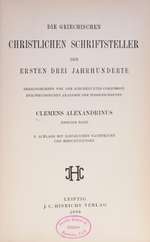
Clement of Alexandria II: Stromata I-VI
Clement argues that all wisdom originates from a singular divine source. He asserts that Greek philosophy serves as a vital tool for the believer, provided it is treated as a preparation rather than the final destination. The text demands intellectual rigor and warns against the vanity of mere debat

Works (Laws, Definitions)

Clement of Alexandria III: Stromata VII-VIII, Excerpts, and Who is the Rich Man that Shall be Saved?
This volume functions as the ultimate key to the library of a brilliant mind. Clement of Alexandria does not merely cite pagan authors; he reframes their concepts of virtue, cosmology, and ethics to construct a Christian framework. He demands that his readers move beyond simple faith toward a rigoro

Euthyphro, Apology, Crito, Phaedo, and Phaedrus
This collection captures the final days of history's most famous provocateur. Socrates turns his own trial into a masterclass on how to live and die with integrity. He dismantles the hollow arguments of his accusers and shows that true wisdom starts with the admission of ignorance. The text forces y

The Library of Photius (English)
The Library of Photius, also known as the Bibliotheca or Myriobiblon, is a cornerstone of the Byzantine Renaissance and one of the most important works of literary criticism in history. Written as a series of summaries for his brother while on a diplomatic mission, Photius reviews 279 books, spannin

Plato: Statesman and Philebus
Plato does not merely lecture; he forces his readers to think alongside his characters. In these texts, he argues that the best kind of power is not found in static codes but in the flexible, living intelligence of the expert. He dismantles the idea that pleasure or intellect alone can anchor a huma