Aron Reppmann Introduces Origen of Alexandria
Origen of Alexandria (c. 184 – c. 253 CE) is both a central figure to Christianity as a whole and to many esoteric currents within Christianity; like a hydra, the powerful ideas of the anathematised Origen pop up again and again in the history of the Churches, to some representing the truest and ...
Primary Sources

Origen, Homiliae in Psalmos (29 homilies, discovered 2012)
These homilies represent a rare direct encounter with Origen's preaching voice. He treats the Psalms not as ancient poetry, but as a map for internal warfare and divine union. The text challenges the reader to categorize their own thoughts and desires as either fleeting shadows or eternal seeds. Ori

Contra Celsum (1481 editio princeps)
This editio princeps reveals more than a theological argument. It captures the tension between Humanist scholarship and the existential dread caused by the Ottoman advance into Italy. Origen argues that Christianity survives not through the ornate rhetoric of philosophers, but through the lived powe

Against Celsus
This 1658 edition presents the definitive intellectual struggle between early Christian thought and pagan philosophy. Origen systematically dismantles the arguments of Celsus by shifting the debate from mere rhetoric to the moral transformation of the human soul. He argues that the life and death of

Origen Philocalia (Greek)
In this definitive collection edited by William Spencer, readers encounter the first great synthesis of Greek philosophy and Christian theology. Origen does not merely rebut charges of magic and sedition; he builds a comprehensive metaphysical framework that justifies 'simple faith' as a moral medic

The Kiranides (Kirani Kiranides)
The Kirani Kiranides stands as a breathtaking intersection of ancient natural philosophy and ritual magic, offering a glimpse into a time when the physical and spiritual realms were inextricably linked. This edition, enriched by the philological rigor of Rivinus and Rhyakinus, catalogs the medicinal

Opera Omnia I (Delarue-Lommatzsch)
This volume of Origen’s 'Opera Omnia' offers a rare synthesis of rigorous textual criticism and soaring spiritual exegesis. Drawing from ancient manuscripts across the Vatican, Stockholm, and Cambridge, the text reconstructs Origen’s masterful commentary on the entry into Jerusalem. Origen argues th

Complete Works XVIII: Against Celsus I-IV (Lommatzsch)
This work captures a high-stakes intellectual duel between the brilliant Christian theologian Origen and his pagan opponent Celsus. Origen rejects the idea that faith is a refuge for the ignorant, instead framing Christianity as a disciplined therapy for the soul. He argues that the life and resurre

Complete Works XIX: Against Celsus V-VIII (Lommatzsch)
This work captures a master of Greek logic turning his focus toward his fiercest opponent. Origen refuses to retreat into silence; he dissects every charge Celsus brings against the Christian faith. He tackles the paradox of the incarnation, the validity of biblical allegory, and the nature of human

Patrologia Graeca vol. 12: Origenes II
This text presents the early church's most intense battle over how to read the Bible. Origen argues that the literal meaning often collapses into absurdity, forcing the reader to search for a deeper, allegorical truth. He connects the soul's journey to the events of Genesis and Exodus, claiming the

Remains of the Hexapla, Vol. I (Field Critical Edition)
Frederick Field’s work is the definitive guide to the scattered fragments of Origen’s Hexapla. It moves beyond standard historical accounts to identify the specific translation philosophies of figures like Aquila, Symmachus, and Theodotion. The text argues that ancient translators were driven by com
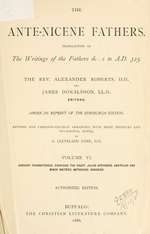
Ante-Nicene Fathers, Vol. 6 (Gregory Thaumaturgus)
This collection serves as a direct encounter with the intellectual architects of the early Church. It prioritizes the Alexandrian school as the primary engine of Christian thought while showing the constant friction between traditional Roman power and early ecclesiastical authority. The authors grap

Origenes: Contra Celsum (Greek Critical Edition)

Ante-Nicene Fathers, Vol. 4 (Origen: De Principiis, Contra Celsum)
These writings provide an unfiltered view of the moral and intellectual rigor that defined early Christian life. The authors insist that true faith demands a complete break from worldly indulgence, whether through the austere wearing of the mantle or the strict prohibition of second marriages. You w