Wikimedia Commons · Public domain · Hover to magnify, click for fullscreen
Original fileIsidis Magnae Deorum Matris Apuleiana Descriptio
Isidis - Oedipus Aegyptiacus

About This Work
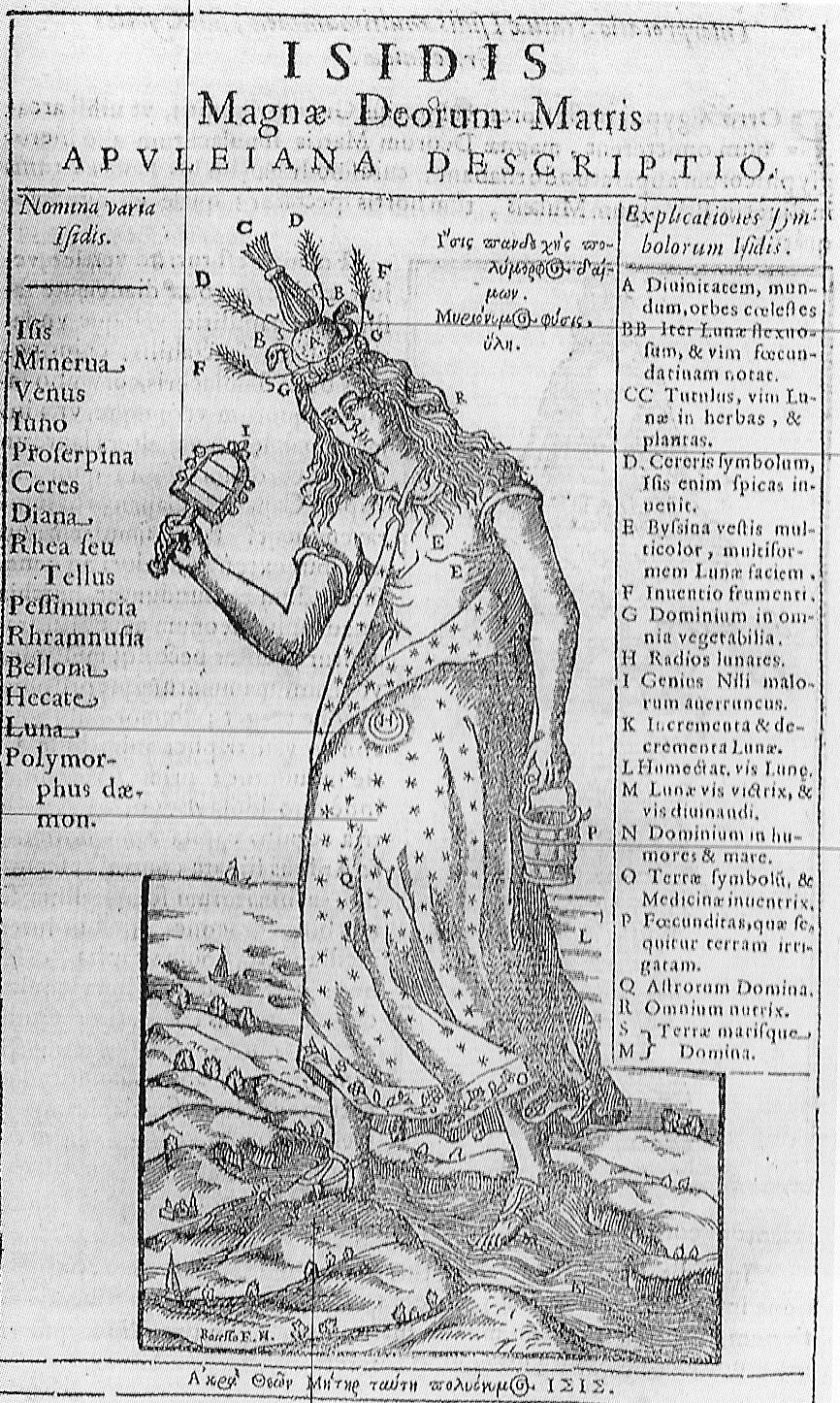
The engraving features a central, long-haired female figure representing Isis, adorned with a complex headdress of wheat stalks and a crescent moon. She wears a star-patterned robe and holds a ritual sistrum (rattle) in her raised right hand and a small bucket in her left. The figure is flanked by two columns of Latin text providing a key to the symbolic attributes labeled on her person, as well as a list of names—including Minerva, Venus, Juno, and Diana—which equate her with other classical deities. The background shows a stylized, hilly landscape with a small church and a body of water, suggesting a blend of classical iconography and 17th-century European sensibilities.
This image originates from Athanasius Kircher's 'Oedipus Aegyptiacus', a foundational work in the 17th-century European obsession with Egyptology, hermeticism, and the attempt to reconcile ancient theology with Christian knowledge. It specifically draws upon the descriptions of Isis found in Apuleius' 'The Golden Ass', framing her as a 'polymorphic' figure who embodies the totality of the natural world.
Inscriptions(Latin, Greek)
ISIDIS Magnae Deorum Matris APVLEIANA DESCRIPTIO.

Nomina varia Ifidis. [list of names: Ifis, Minerva, Venus, Iuno, Proferpina, Ceres, Diana, Rhea feu Tellus, Peffinuncia, Rhramnufia, Bellona, Hecate, Luna, Polymorphus daemon.]

Explicationes fymbolorum Ifidis. [list of keys A-S]

Baretta F. M.

Λχευ θεῶν Μήτηρ ταύτη πολυμορφοῦ Ἰσῖς.
Translation
The Apuleian Description of Isis, Great Mother of the Gods.

Various names of Isis: [Minerva, Venus, Juno, Proserpina, Ceres, Diana, Rhea or Tellus, Pessinuntia, Rhamnusia, Bellona, Hecate, Luna, Polymorphous spirit.]

Explanations of the symbols of Isis: [A-S describing cosmic/natural attributes].

Baretta fecit (made it).

Mother of the gods, this is the polymorphic Isis.
Connected Texts
Apuleius, The Golden Ass
The print is a direct visual commentary on the prayer to Isis in Book XI of Apuleius' novel.