Wikimedia Commons · Public domain · Hover to magnify, click for fullscreen
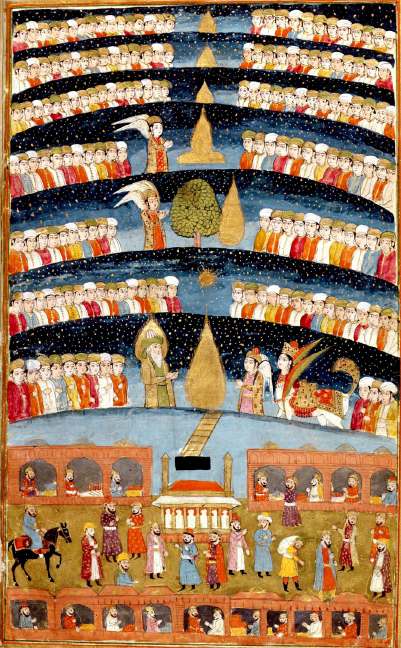
Original fileThe Ascension of the Prophet (Mi'raj)
Mohammed´s Paradise

About This Work
The painting is vertically divided into two distinct realms: a lower earthly architectural space and an upper celestial expanse. In the lower section, various figures in traditional Persian attire walk through a series of arched arcades and courtyards. Above, a ladder-like structure bridges the lower scene to the heavens, depicted as concentric, star-filled bands of dark blue. Within these heavenly tiers, rows of angels with white turbans and brightly colored robes are arranged in a seated formation; several winged angels stand near golden, flame-like shapes or stylized trees. A central golden orb emits light, signaling the divine presence, while the winged Buraq, a creature with a human-like face, stands at the threshold of the ascent.
This image depicts the Mi'raj, the nocturnal ascent of the Prophet Muhammad through the heavens, a central event in Islamic theology and mysticism. It is specifically derived from the *Ḥamlah-i Ḥaydarī*, a Persian epic poem by Muhammad Rafi' Bazil recounting the life and conquests of the Prophet and Imam Ali.
Inscriptions
A small black rectangular block appears on the bridge leading to the celestial realm, likely representing a redacted or damaged section of the original text/labeling.
Connected Texts
Ḥamlah-i Ḥaydarī
This illumination originates from a manuscript of the Ḥamlah-i Ḥaydarī, an 18th-century Persian epic narrative of Islamic history.
Provenance & Source
Object
gouache
paper
Qajar period
Persian
manuscript-illumination
Digital Source
Wikimedia Commons · Public domain
401 × 648 px
Linked Data