Wikimedia Commons · CC0 1.0 · Hover to magnify, click for fullscreen
Original fileDivina proportione

About This Work
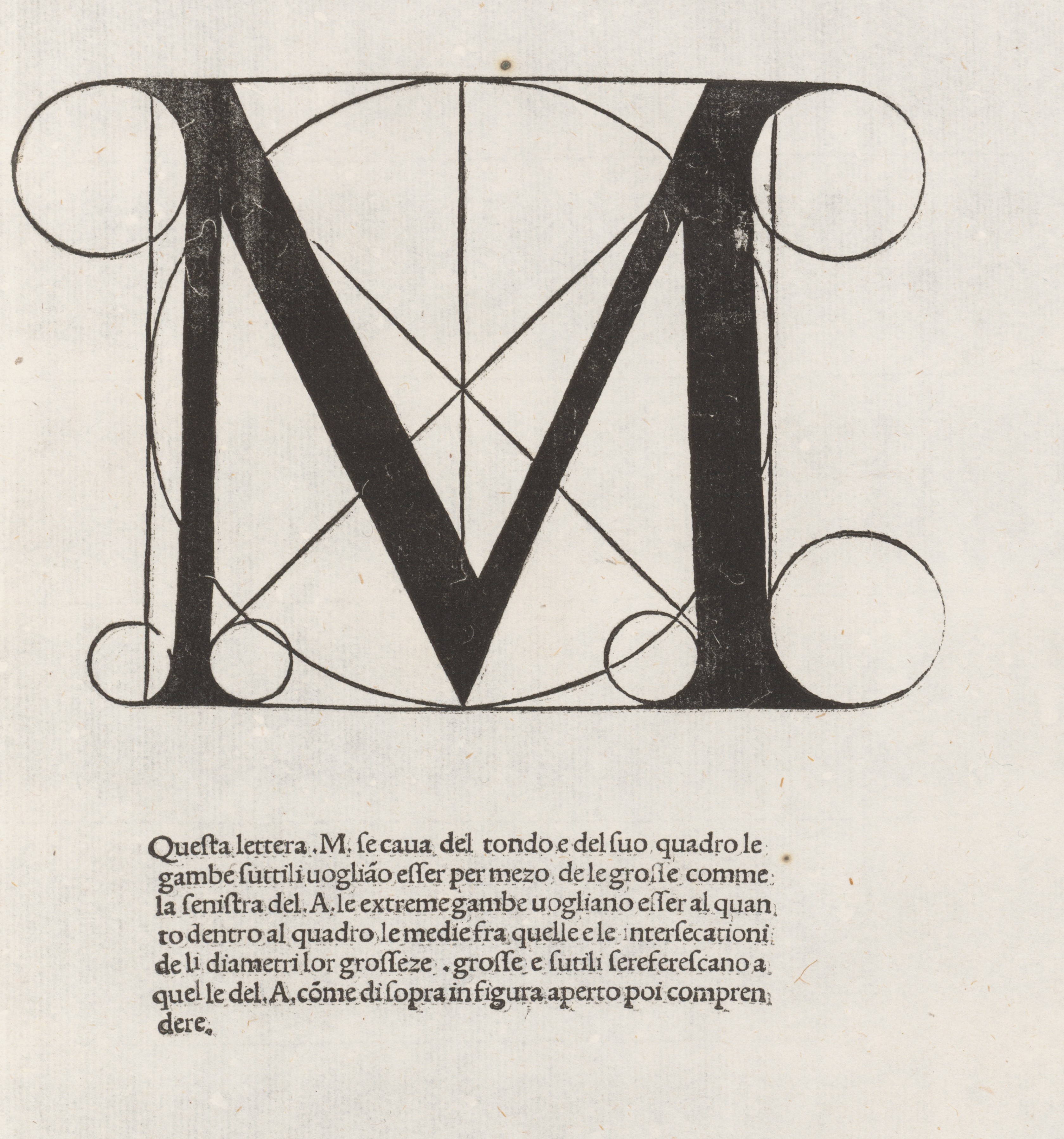
The image features a large, black capital letter 'M' superimposed on a precise grid of circles and diagonal lines within a square frame. This diagram demonstrates the Renaissance method of typography where each part of a character is defined by mathematical ratios and geometric intersections. Below the illustration, a paragraph of Italian text provides specific technical instructions on how to replicate the letter's proportions.
This work embodies the Renaissance Neoplatonic belief that mathematical harmony and the 'Divine Proportion' underlie all perfect forms, from the cosmos to human-made symbols. It represents the historic collaboration between the mathematician Luca Pacioli and Leonardo da Vinci, aiming to unify art, science, and philosophy through sacred geometry.
Inscriptions(Italian)
Questa lettera .M. se caua del tondo e del ſuo quadro le
gambe ſuttili uogliãno eſser per mezo de le groſse comme
la ſeniſtra del .A. le extreme gambe uogliãno eſser al quan
to dentro al quadro le medie fra quelle e le interſecationi
de li diametri lor groſseze . groſse e ſuttili ſerefereſcano a
quel le del .A. cõme di ſopra in figura aperto poi compren
dere.